You are viewing 1 of your 1 free articles
The Renters’ Rights Act alone isn’t going to level up the housing sector
The Renters’ Rights Act is a long-overdue step towards fairness in the rental market, but rights alone will not transform the sector, writes Dr Mahmoud Alsaeed, research associate at the Cambridge Centre for Housing & Planning Research



Dr Mahmoud Alsaeed is a research Associate at the Cambridge Centre for Housing & Planning Research, University of Cambridge
 The Renters’ Rights Act is a long-overdue step towards fairness in the rental market, but rights alone will not transform the sector, writes Dr Mahmoud Alsaeed, research associate at the Cambridge Centre for Housing & Planning Research #UKhousing
For millions of renters across England, the private rented sector (PRS) is not a temporary stopgap. It is home.
The Renters’ Rights Act marks a pivotal moment in the UK’s housing story, promising greater security, stronger rights and a clearer regulatory baseline.
Yet for these reforms to truly “level up” the sector, we must look beyond rights alone and consider three interlinked aspects: sustainability and equity, supply and regulatory capacity, and the balance between security and flexibility.
Read more

One of the least discussed, but most important, elements of the act is its link to housing quality and sustainability. The PRS has the highest levels of fuel poverty across all tenures, with 24% of private-rented households in England classed as fuel poor in 2023. More than half of private rented homes fall below EPC Band C, leaving tenants in cold properties which they cannot afford to heat.
Extending the Decent Homes Standard to the PRS is a vital step towards raising quality, as signalled in the act. It introduces a minimum expectation of safety, thermal comfort and basic conditions.
However, unless this is paired with real investment in retrofitting, decarbonisation and energy efficiency, secure tenancies may still mean living in substandard conditions.
“For tenants, the abolition of no-fault evictions is a landmark shift, providing stability and the confidence to call their rented property a home”
For the PRS and social housing sectors, this raises two related concerns: equity and transition. Social homes often benefit from clearer retrofit plans and higher standards, while many PRS homes lag behind. Unless sustainability is embedded into tenure reform, the divide between warm, efficient social housing and poorly insulated private rentals will widen.
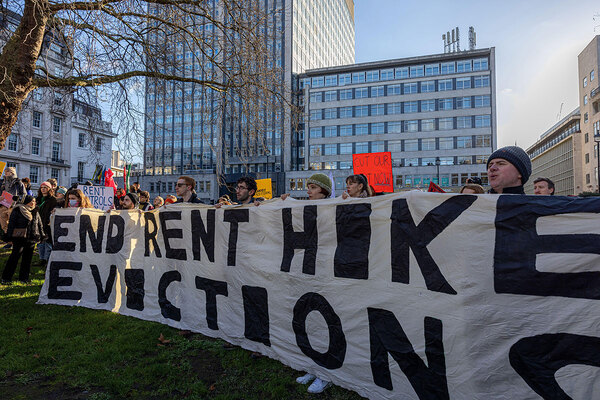
At the heart of the reform lies the abolition of ‘no-fault’ evictions under Section 21 and the move towards rolling tenancies. For tenants, this is a landmark shift, providing stability, the ability to plan ahead and the confidence to call their rented property a home.
Yet for landlords, the picture looks different. “Like any other business, it’s about managing risk,” one Sheffield property owner told me.
“More risk means higher costs, so you cover potential losses by increasing the rent.”
This perspective reflects a broader concern that less predictability could push smaller landlords out of the market or make them more selective, adding upward pressure on rents. While the act limits in-tenancy increases, it does not cap initial rents, which some landlords may raise pre-emptively to mitigate perceived risk. Unless carefully managed, this could dilute the affordability benefits the act plans to achieve.
For the act to deliver in practice, enforcement and capacity will be crucial. Local housing authorities are tasked with registering landlords, issuing penalties and ensuring property standards are upheld, but their ability to do so is under strain.
“If smaller landlords withdraw and the PRS shifts further toward institutional ownership, the result could be a two-tier rental market”
The Institute for Government’s Performance Tracker 2025 found that local government funding fell by nearly a quarter in real terms between 2010 and 2020. Councils are now stretched thin, focusing resources on essential services and struggling to meet rising demand in areas such as housing, planning and environmental health.
Provisions like the right to request a pet or the ban on ‘no benefits’ discrimination are important wins, but without staff and funding, enforcement may remain symbolic. Experience from social housing shows that policy ambition often falters at the implementation stage when regulatory capacity is weakest.
If smaller landlords withdraw and the PRS shifts further toward institutional ownership, the result could be a two-tier rental market: professionally managed but expensive homes on one side, and poorly maintained, low-cost stock on the other. With higher rents and scarce availability, we could see a significant increase in demand for social housing, and waiting lists, which already stretch to 25 years in some areas, could grow even longer.
The Renters’ Rights Act is a long-overdue step towards fairness in the rental market, but rights alone will not transform the sector. Real progress depends on investment in enforcement, sustainable housing quality and a functioning supply pipeline. Without these, the act risks stabilising some households while leaving others behind.
Levelling up housing will require more than new laws. It demands united action that turns rights into realities, so that every rented home is secure, affordable and fit for the future.
Mahmoud Alsaeed, research associate, Cambridge Centre for Housing & Planning Research
Sign up for our regulation and legal newsletter

Already have an account? Click here to manage your newsletters
Related stories