Tenant meets landlord: the great rent debate
A tenant who has had to take on extra shifts to cover rent increases gets the chance to grill the chief executive of her landlord. Gavriel Hollander reports on the conversation between Julia Hawkins and Victor da Cunha, chief executive of Curo. Photography by Joseph Branston


 Gavriel Hollander reports on the conversation between housing association tenant Julia Hawkins and Victor da Cunha, chief executive of Curo #UKhousing
The debate over how to set social rent has been raging since the government decided to scrap its previous inflation-based formula and consult on a new system last autumn.
But do social tenants know what their rent is being used for? And how good are landlords at explaining the competing demands on their resources?
Curo, which manages 13,000 homes in the South West, invited tenant Julia Hawkins for a discussion with Victor da Cunha, its chief executive, to see if they could find common ground.
Mr da Cunha has worked in the housing sector for more than 30 years and has been chief executive of Curo since 2012.
Ms Hawkins has been a social tenant in Bath for over 30 years and is chair of Curo’s customer oversight group. She counts herself as “one of the lucky ones” who still has a social home, but was shocked last year when her rent went up by 7%. To make ends meet, she says she had to take on extra shifts at the care home where she works.
The pair meet for a coffee at the housing association’s neat, modern head office on the outskirts of Bath, with Inside Housing invited along to listen in.
The conversation covers plenty of ground, but begins with a clear question: what does Ms Hawkins’ rent actually pay for?
“When I first arrived in the sector, rent-setting was very simple. There was a relationship between us and the customer,” Mr da Cunha recalls.
Read more


“Rent was there for us to provide good-quality housing management services and to maintain your home. That was it.
“Over time, that has changed. [First] it had to fund new housing, then it was used for major repairs, and then for improvements. It made me think: ‘At what point does this all become too much to bear?’” he says.
The reality for tenants like Ms Hawkins is that their rent has gone up without them understanding why, or what that extra money pays for. “Most customers still think most of their rent goes to you and it comes back as repairs and maintenance. They don’t see all those other aspects,” she tells Mr da Cunha.
Ms Hawkins also suggests that landlords should “get together to lobby the government” for funding for new development, retrofitting and all the other things they are being asked to pay for, instead of drawing on tenants’ rents. “Isn’t this now the time to put pressure on the government to invest in this?” she asks.
“I think that’s the right question and the short answer is ‘yes’,” agrees Mr da Cunha.
“The sector needs to encourage government to have this discussion, but it needs to happen with residents too – it can’t be social housing landlords just asking for more money from the government.
“We want rents to remain affordable and, at the same time, we want homes to be safe and warm and, in most instances, we think we need to build more social housing.”
What “affordable rent” means, however, is a thorny question. For many people, the term itself is a form of doublespeak, with the affordable rent tenure allowing landlords to charge up to 80% of market rent, making it the opposite of affordable for lower earners in high-value areas.
It is a paradox Mr da Cunha recognises. “Affordable rent was not affordable for most people on low incomes, particularly somewhere like Bath, so we try to make our programmes driven by social rent,” he says.
“But there’s always a choice: do you make it affordable or do you build more?”
He says average rent at Curo is around £120 a week, not far off what Ms Hawkins pays, but he outlines the ever-growing list of obligations housing associations have to cover from their rental income.

“That needs to deal with day-to-day services, repairs, investment, fire safety, decarbonisation, new supply, regeneration, professionalisation of the sector – all of that comes out of that £120. So you think, ‘How much can you do with that?’ We’re trying to spread it across everything.”
This brings a quick retort from Ms Hawkins.
“But we’re all doing that at home as well. My rent has gone up quite a lot just in the last year. I’m having to spread that really thinly and make it go a long way. Tenants are saying, ‘I’ve got a budget, you’ve got a budget, so you need to manage your money the same way as I have to.’”
“Customers still think most of their rent goes to [the landlord] and it comes back as repairs and maintenance. They don’t see all those other aspects”
Although she considers herself lucky to have a home in Bath on social rent, Ms Hawkins says she is struggling to make ends meet. Her children have had to move out of the city because they cannot afford to rent privately there.
“I have taken on extra shifts just to manage. I’m not the only one; there must be loads of people like that. I had the opportunity to do overtime, but it’s tough some weeks to do more hours,” she says.
“Has the cost of keeping your home warm gone up, too?” asks Mr da Cunha.
“Yes, and council tax. All the utilities have gone up as well. I think food is the one I’ve noticed most. I’m working more, but I’m not any better off. I can manage, but it’s harder,” she answers.
“There is a point where none of us can spread it any thinner and something will have to give, and social housing shouldn’t be the thing that gives, because it’s so fundamental and it’s needed more now than it ever has been,” she adds.
“It’s crazy that that’s the reality for a lot of people these days – that it’s so hard to pay the bills,” sympathises Mr da Cunha.
“I suspect colleagues at Curo are the same. It’s not just one group of people that are affected. For that reason, I’m aware it can’t just be a case of asking [tenants] for more rent,” he says.
Setting rents
The chief executive adds that he believes there needs to be “a serious discussion” with the government about the future of social rents – both in terms of how they are set and what that revenue is spent on. He is calling for a “fundamental review” of the system.
“It’s so unfair to keep saying that we have to do more and more and more, and then [to say] the only answer is to charge more rent,” he says.
13,000
Homes owned by Curo in the South West
£120
Curo’s average weekly rent, according to Victor da Cunha
“There needs to be a debate and you need to be clear about the ‘why’ and the ‘how’. As it stands, no one knows what rents are for or how they’re funded. It’s a series of separate policies that are expected to fund something.”
With so much agreement between landlord and tenant, is one of the problems that there has traditionally been poor communication between the two?
“People need to understand it better,” says Ms Hawkins, referring to both the mechanism for setting rent and the growing cost pressure on landlords.
“The more people understand how the rent is set, the more people will understand that this is the pot [for landlords] and this is what it looks like.
“I want to be part of that conversation where we can say, ‘This is my £500 and this is where I want it spent.’ Because, at the moment, a lot of people probably don’t know anything about it,” she says.
“Do you think we do a bad job of communicating that?” asks Mr da Cunha.
“I think there’s a bad job of communication in general,” says Ms Hawkins, although she adds that it has improved in recent years.
“We probably don’t explain enough about the complexity of rent and how it’s set,” Mr da Cunha concedes.
“It just tends to be a number at the end of the year in a letter, and not enough is done to explain that mostly we’re just following an instruction from the government.”
The feeling that tenants haven’t been part of the conversation in social housing is a long-running issue, addressed in part in the 2020 Social Housing White Paper, which put the issue of a national tenant voice front and centre. Ms Hawkins feels a change is overdue.
“We have been an untapped resource for a long time. For a long time, tenants were done to. If the house was maintained, that’s all they needed to worry about, because that’s what rent paid for,” she tells Mr da Cunha.
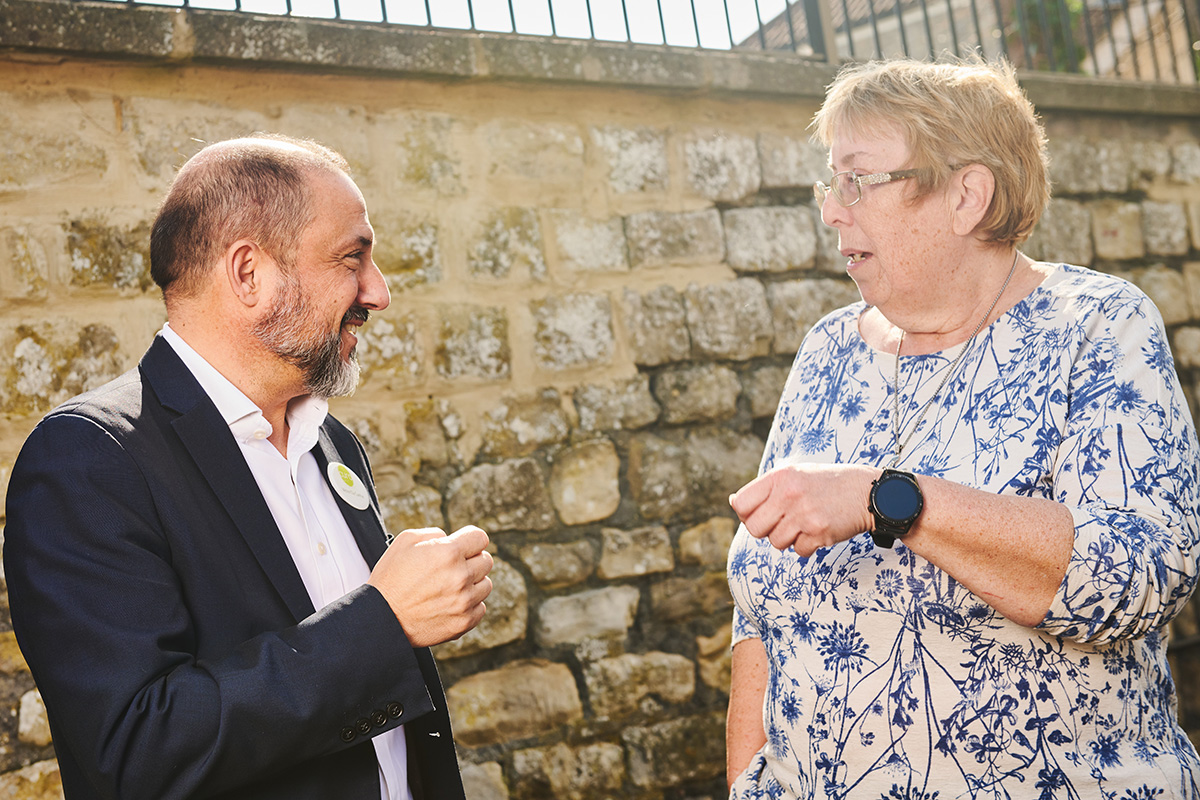
Mr da Cunha asks Ms Hawkins what she would like to see her rent money spent on.
“Locally, the maintenance of my home and the future of that, then my community around me and the areas I share with other people, and not a lot besides that,” she replies.
“So, everything else, you think we should stop doing [it]?” asks Mr da Cunha.
“I know you can’t stop doing it, but should it be coming out of my rent? Some of it, maybe. But all the things you’ve talked about? The fire safety and decarbonisation? I feel that’s kind of not my problem. That was regulations that have come in later as a result of something.
“Is it fair that I am paying for somebody’s lack of forethought when they were building something? When I am counting every penny when I go to the supermarket, it’s difficult for me to want some of my money to go elsewhere,” Ms Hawkins says.
Mr da Cunha understands his tenants’ frustration over seeing their rent leap at the same time as they are dealing with a cost of living crisis.
“I think that’s precisely the conversation we need to have nationally. I feel that, at the moment, a lot of what we are trying to do is predetermined by legislation, rather than being about what the residents want,” he says.
Ms Hawkins does agree that some housing association income should go towards funding the next generation of social homes. And the importance of maintaining a sizable stock of sub-market rent homes across the country is another subject about which the two are fully in agreement.
“Very often, we are the reason we have key workers living in the city. If it wasn’t for social housing landlords in high-value areas like Bath, then society would collapse,” says Mr da Cunha.
“Nobody could afford to live here then,” echoes Ms Hawkins. “I do feel lucky, because I know what private rents are like, but it won’t be possible for people like me to live here soon if we keep selling it off and allowing them to not build more of it,” she says.
Conversations like this may not solve the problem when it comes to rent-setting, and how to pay for more and better social housing without putting an extra burden on the people who live in it. But as both tenant and landlord agree, a greater understanding of the challenges each group faces could be a good start.
Sign up to our Best of In-Depth newsletter

We have recently relaunched our weekly Long Read newsletter as Best of In-Depth. The idea is to bring you a shorter selection of the very best analysis and comment we are publishing each week.
Already have an account? Click here to manage your newsletters.
Related stories