You are viewing 1 of your 1 free articles
Kingspan director learned about insulation change four years before withdrawing ‘not representative’ test from market
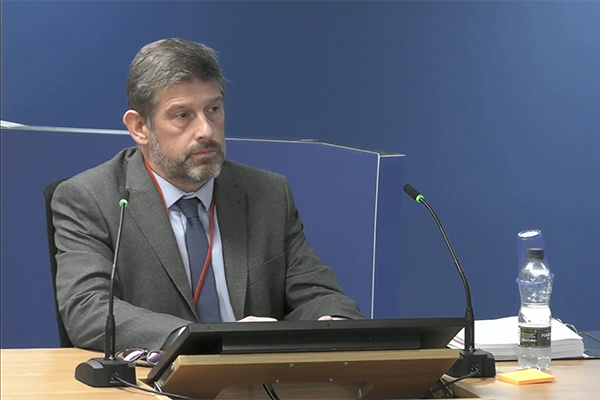
The Kingspan director who wrote to the Building Research Establishment (BRE) in October to withdraw the testing for the insulation product used on parts of the Grenfell Tower learned about the issues relating to the test four years ago, the inquiry heard today.


 A Kingspan director learned about issues with the 2005 K15 fire test four years before asking the BRE to withdraw it #UKhousing
Adrian Pargeter, director of technical, marketing and internal affairs at Kingspan, told the inquiry he was first made aware in 2016 that the 2005 test widely used by the company to promote its Kooltherm K15 product was carried out on “old technology” that the insulation giant stopped producing in 2006.
In October this year, Mr Pargeter wrote to the BRE on behalf of Kingspan asking to withdraw the 2005 test, which he said “was not representative of the K15 product which has been sold by them from 2006 onwards”.
He wrote: “As part of our co-operation with requests from the [Grenfell Inquiry] we have undertaken a comprehensive review of all past and current test data which relates to K15, including the BS 8414 test.
“Through our review we have now concluded that tests carried out in 2005 and 2014 featured a product that was not sufficiently representative of the product currently sold into the market.”
Read more

 Kingspan claims about suitability of its insulation for high rises ‘a house of cards’, inquiry hears
 Kingspan director denies firm made ‘deliberate attempt to deceive’ MPs on post-Grenfell fire testing
However, Mr Pargeter revealed today that he was first told the product tested in 2005 differed from that being sold from 2006 onwards by his colleague Gwyn Davies four years ago, before the fire at Grenfell.
When asked by Richard Millett QC whether he did anything after 2016 “to investigate how it could be” that for roughly 10 years “K15 was being sold to the market which was not the same product as had been the subject of the 2005 test”, Mr Pargeter said he had not.
“Once the Grenfell Tower fire had happened, were you not concerned from June 2017 that customers were still buying K15 on the basis of a BS 8414 test, which was a test done on a different product?” Mr Millett asked.
“No, because I didn’t expect there was any difference in the fire performance,” replied Mr Pargeter, adding that Mr Davies had told him the new K15 product would not perform differently in a fire.
“That was a belief based on no science, no independent assessment and no test,” Mr Millett said.
Mr Pargeter also did not include any information about the product change in his first witness statement to the Grenfell Inquiry, written in 2018.
The inquiry later heard that Kingspan took the decision to remove the 2005 test from its website in March 2019, while it commissioned a new fire test into the K15 product.
Mr Pargeter said Kingspan did not withdraw the 2005 test while the 2019 test was being carried out because “we needed to understand what the implications were so at the same time of withdrawing it we could provide test evidence and opinion on the implications”.
In February 2020, Kingspan received a report confirming that K15 had passed the 2019 test.
When asked why it took the company nine months to write to the BRE asking it to withdraw the test, Mr Pargeter said: “We were just so busy, we didn’t really think about writing out to the fire engineers again until about August, September and then we started to put this letter together.”
Mr Pargeter said the reason Kingspan came to the decision to withdraw the 2005 test was due to the “scrutiny” the firm was under as a result of the Grenfell Inquiry.
He said: “You’re looking at things in a different light and under greater scrutiny and you are overcautious… we thought it be prudent to withdraw that test.”
Mr Pargeter will continue giving evidence to the inquiry tomorrow.
Sign up for our weekly Grenfell Inquiry newsletter
Each week we send out a newsletter rounding up the key news from the Grenfell Inquiry, along with the headlines from the week
Already have an account? Click here to manage your newsletters
Related stories