You are viewing 1 of your 1 free articles
New report calls for ‘Olympic authority-style’ bodies for housing delivery
Councils will need strong compulsory purchase order (CPO) powers if the government is to hit its social housing delivery targets, according to new research from the Purposeful Finance Commission (PFC).


 New report calls for ‘Olympic authority-style’ bodies for housing delivery #UKhousing
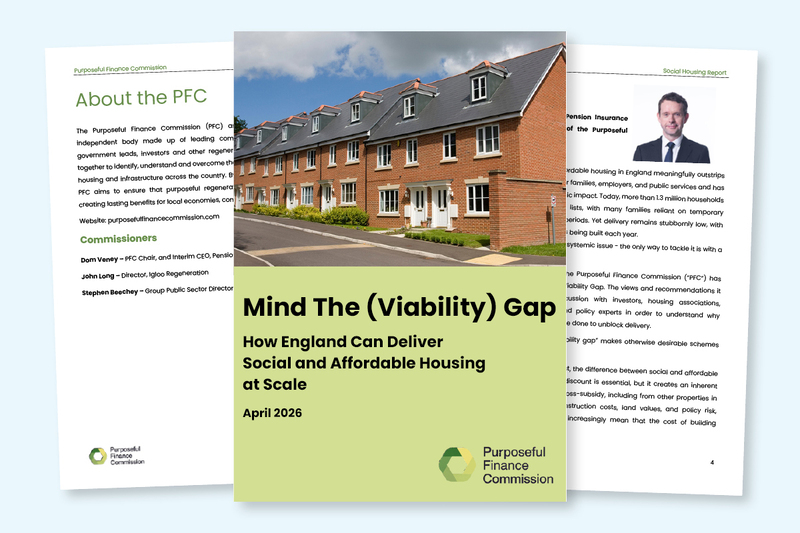
The PFC’s Mind the (Viability) Gap report was led by Pension Insurance Corporation (PIC), Wates Group and Igloo Regeneration, and looks at how, despite this social housing waiting list of 1.3 million households, fewer than 100,000 social homes are built each year.
The research recommends giving the new construction regulator statutory powers to “cut through 12 fragmented regulatory bodies and force co-ordination on the projects that matter most”.
This should also be backed by Olympic authority-style bodies for major housing schemes. These could provide “a clear mandate, real capital and accountability on delivery”.
Read more



The report also suggests establishing a national library of pre-approved, regulation-compliant housing designs to streamline planning and consultation.
The planning and funding of water and sewage infrastructure alongside new housing schemes is also pivotal, it argues, highlighting that constraints have stalled the delivery of around £25bn of homes.
The PFC believes that reforming CPO powers is central to unlocking underused sites.
It suggests that councils should be able to acquire stalled or underused land at value closer to its existing use, and stresses that any acquisitions must be safeguarded to ensure fairness to landowners, protect social value and support timely delivery.
The report highlights that removing hope value could make sites that would otherwise be financially unviable accessible for social housing, but also flags that it could discourage certain landowners from bringing sites forward.
Since the government’s recent CPO reforms, councils and Homes England can now act without ministerial approval in most cases, with inspectors signing off where objections are lodged.
According to the report, sector leaders see this as a “vital opportunity” to unlock new social housing, but caution that clear guidance and oversight will be needed to prevent disputes or delays.
Dom Veney, chief executive of PIC, said: “These reforms are about aligning incentives, reducing unnecessary delay and turning institutional capital into homes that last.”
Stephen Beechey, group public sector director at Wates Group, added: “Earlier co-ordination, clearer accountability and a stronger focus on whole-life value are essential if public investment is to translate into homes at the scale and quality communities need.”
The report also stresses the importance of public-private collaboration and meaningful community engagement to ensure that new homes contribute to thriving, sustainable neighbourhoods rather than simply increasing housing stock.
John Long, development director at Igloo Regeneration, said: “This is a landmark piece of research that will be instrumental as we enter the next stage of delivering vital housing across the UK.
“At Igloo, we have long championed building on brownfield land that would otherwise be unviable, so the actions that the government have taken with new delivery vehicles such as Platform4 is a real step forward.
“However, these initiatives must be paired with meaningful collaboration between the public and private sector, alongside community engagement to ensure that we are not just delivering houses, but creating thriving neighbourhoods that are valuable for people, place and planet.”
Sign up to Inside Housing’s Development and Finance newsletter
Sign up to Inside Housing’s weekly Development and Finance newsletter, featuring a round-up of business, development and regeneration news and analysis.
Already have an account? Click here to manage your newsletters.
Sign up for Housing 2026
Join us at Housing 2026 and hear from the sector’s most influential voices. Leading housing organisations curate their stages, showcasing the speakers and discussions that matter most.
Take part in purposeful, tech-enabled networking – see who’s attending, handpick the people you want to meet, and engage in meaningful, in-person conversations.
Connect with every key decision-maker under one roof, from local authorities and housing associations to investors, developers and operators.
Related stories