Dispatches from Build More Homes and New Towns Summit 2026
The UK’s development sector gathered in London this week to discuss the challenge to deliver 1.5 million new homes, covering everything from regeneration to leveraging private capital. Eliza Parr rounds up the key points


 Dispatches from Build More Homes and New Towns Summit 2026 #UKhousingThe UK’s development sector gathered in London this week to discuss the challenge to deliver 1.5 million new homes. Eliza Parr rounds up the key points #UKhousing
This week, the Build More Homes and New Towns Summit saw hundreds of key leaders from across the development sector gather in London to discuss UK housing delivery.
Just a day beforehand, bidding closed for Homes England’s strategic partnership route under the Social and Affordable Homes Programme (SAHP), as well as for the London programme.
The summit also came hot on the heels of the launch of the new National Housing Bank, which aims to bring in £53m of private capital to boost housing delivery.
Despite some uncertainty around the potential impact of conflict in the Middle East, optimism about the sector’s ability to deliver seemed high. Here are Inside Housing’s key takeaways from the day.
Is it time for a regeneration minister?
Two or three years ago, regeneration was a “dirty word”, said Catherine Ryder, chief executive of PlaceShapers, during a session on ‘creating places’. She said the focus was all on new homes.
But she strikes a more optimistic note about 2026: “I feel like because we’ve got better at articulating the need and the benefits of regen, we’re talking about it again.”
During the same session, Lord Best, co-chair of the All-Party Parliamentary Group on Housing and Care for Older People, said that regeneration is particularly important in the North.
“I think a lot of people in the three Northern regions think that the obsession with 1.5 million new homes is missing the point,” he told attendees.
Lord Best pointed to Northern Housing Consortium’s Renew inquiry, which he chairs and which seeks to raise the importance of housing-led regeneration in the North. He gave attendees a “taster” of its findings so far, highlighting the need to boost both skills in the sector and the political profile of regeneration.
Read more


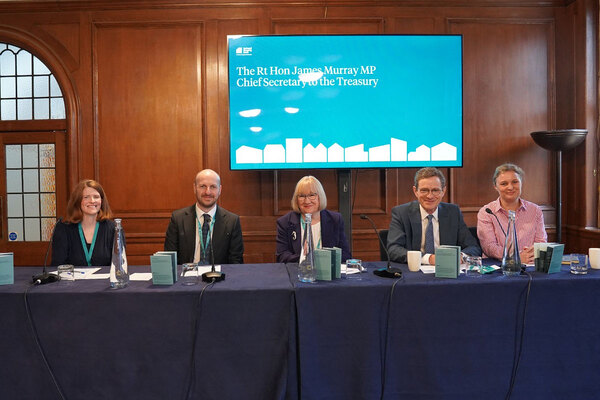
This should include a “national strategy for regeneration”, to go alongside the long-awaited national housing strategy, and also potentially a new regeneration minister.
He said: “I suspect that in a year’s time when we finally recommend these things, a minister for regeneration would be a very good idea within [the Ministry of Housing, Communities and Local Government] – a proper minister, somebody who thinks of little else, and for whom it’s not too much trouble to travel away from London and the South East.”
In a comment piece for Inside Housing as part of its Spotlight on Regeneration series, Pat Ritchie, Homes England’s chair, signalled earlier this week that the agency is ready to partner on housing-led regeneration delivery, but stressed the importance of public-private partnerships.
But one development director told Inside Housing during a coffee break that the “elephant in the room” with regeneration viability is that the grant programme is 10 years long but schemes usually take much longer. This makes financial planning much less certain for providers and councils.
Ms Ryder also said during the session that the sector needs more money in general: “There’s a little bit of money kicking about, there’s the Pride in Place programme – we just need more of it.”
She recognised, however, that this is difficult within the current political environment.
New towns and infrastructure-led delivery
In a session on the lessons learned from previous new towns, attendees were asked to raised their hands if they thought new towns are the solution to the current housing crisis – only one or two agreed. Most opted to say new towns are instead “part of the solution”.
Last month, the government confirmed its shortlist of seven sites for new towns, down from the 12 that had been recommended by the New Towns Taskforce in September. Proposals for these schemes – which include two regeneration projects – are now out for consultation with the public.
John Lewis, Peabody’s executive director for the shortlisted Thamesmead new town in London, told Inside Housing that the housing association is in a “wait and see phase” while the consultation is ongoing. The government is yet to confirm any specific funding or delivery vehicles for particular sites.
The summit also held a session on the importance of infrastructure-led new towns. Nigel Hugill, chief executive of Urban & Civic, said that large sites like new towns “deliver things that are simply not possible with infill”, and this is the “fundamental reason there’s been a switch in government policy”.
Scott Black, chief operating officer at Places for People, said his organisation is focusing on early delivery of infrastructure. He pointed to Places for People’s Gilston new town scheme, which has planning consent for 10,000 homes.
He added: “We’ve got £1bn worth of infrastructure to put in, and most of that we want to do early.
“We’re £100m in already, and we haven’t put a spade in the ground... it’s taken us 15 years.”
On delivery vehicles, Alison Crofton, chief property officer at Homes England, said development corporations may not be the right solution for every new town on the government’s shortlist.
She said: “It probably will be the solution for some of those on that list, but it absolutely won’t be the solution for everywhere, and that is completely, categorically agreed throughout all the parties that we talk to.”
Boosting capital
In order to significantly boost the delivery of new homes, Homes England has been very clear that the sector needs much more private capital.
During the summit’s opening session, Simon Century, the agency’s chief investment officer and chief executive officer of the new National Housing Bank, said that the “whole of the sector needs to step up” across all players and all tenures.
When one attendee asked how Homes England is addressing a “growing narrative about the financialisation of housing”, Mr Century said both the agency and the government have clearly shown a “very, very strong desire to significantly increase the amount of institutional capital in the market”.
“We’ve laid out very specifically our own very clear objective, signed off from the most senior fellows in government, that we’re trying to raise £53bn of private capital. That’s a pretty direct statement in terms of what our ambition is,” he said.
“We need something or someone to say ‘now we’re going to build MMC’. Build it and they will come”
Mr Century was also asked for more details of the £2.5bn of low-interest loans earmarked for the social housing sector through the bank. He did not give much away but said providers will have more detail about the rollout “by the summer”.
He said Homes England sees the loans working “as a combination and as a package” with grant funding, which will make them “extremely impactful”.
In London, where providers will have exclusive access to £1.5bn of the package, the scheme is also yet to officially launch.
Tom Copley, deputy London mayor for housing and residential development, said: “We haven’t quite launched low-cost loans yet... but very keen to get them launched as soon as possible. And I don’t think we’re going to struggle to get this funding out the door.”
Do we need an ‘Elon Musk of MMC’?
To round off the day, a panel titled ‘What needs to change to deliver 1.5 million homes?’ looked how the housing sector can learn from experience. Along with debates about planning constraints and the role of institutional investment, the panellists also discussed the need to boost modern methods of construction (MMC).
Justin Young, chief executive officer at the Royal Institution of Chartered Surveyors, said one of his big asks of government is to “help us with... getting that message out so that people are absolutely accepting of the great quality that MMC can provide” and the speed it can enable.
MMC might, therefore, need a champion, suggested Elizabeth Froude, chief executive officer of Sage Homes.
“Doesn’t it just need someone who’s going to come and lead the charge? If you think about it, if we hadn’t had Elon Musk – and I don’t like him very much – none of us would be driving electric cars now.
“So we need something or someone to say ‘now we’re going to build MMC’. Build it and they will come.”
But Alexandra Notay, chief executive officer at the Housing Forum, said MMC is a broad umbrella term for lots of methodologies and is already “really embedded” in the sector, including panel systems.
She said the biggest failing of MMC in the UK – alluding to a series of factory closures over recent years – is the “lack of standardisation of components” and the “lack of collaboration”.
Ms Notay added: “This industry talks a very, very good game about partnership.
“But actually, if we’d had that collaboration in the early days of that volumetric MMC in the UK venture, and they’d been able to standardise things, I do think we’d have a lot more players doing it now. But it’s not gone, it is in the sector.”
Sign up to Inside Housing’s Development and Finance newsletter
Sign up to Inside Housing’s weekly Development and Finance newsletter, featuring a round-up of business, development and regeneration news and analysis.
Already have an account? Click here to manage your newsletters.
Related stories