You are viewing 1 of your 1 free articles
Latest housing research: the economics of housing
New research connects the economics of housing to wider societal outcomes, writes Kenneth Gibb, director of the UK Collaborative Centre for Housing Evidence, and member of the Thinkhouse Editorial Panel


 Latest housing research: the economics of housing #UKhousingNew research connects the economics of housing to wider societal outcomes, writes Kenneth Gibb, director of the UK Collaborative Centre for Housing Evidence #UKhousing
Thinkhouse is a website set up to be a repository of housing research. Its editorial panel critiques and collates the best of the most recent housing research.
Two contrasting papers have been published that connect the economics of housing to important aspects of place and time that shape housing and wider societal outcomes.
The first is a report for The David Hume Institute by my University of Glasgow colleagues Duncan Maclennan and Jocelyne Fleming. Titled Prosperity Begins at Home, the report is a tour de force.
Mr Maclennan and Ms Fleming argue for disruptive policy interventions to reset the Scottish housing system, framed by a firm desire to locate housing in terms of its relationship with, and opportunities to improve, Scottish economic performance. They view the housing situation as more of a evolving poly-crisis than a housing emergency. They contend that much policy has been virtue signalling rather than deliverable, system-coherent outcome improvements.
Read more



The authors argue that business as usual cannot continue and policy needs to disrupt the inefficient, unfair outcomes the system currently generates.
The government needs to de-silo housing, recognise its integrating role across government services (health and education), insist that non-housing departments formally and explicitly recognise how their actions affect housing, and work towards a coherent joined-up policy prospectus.
Three failing areas of the housing system are stressed (in both senses of the word): rising homelessness, rental pressures – private and social – and the falling rate of homeownership.
Interestingly, Mr Maclennan and Ms Fleming emphasise the need to support demand and not just focus on new supply. They argue that the latter should take a whole-system approach to policy interventions – something that should be recognised in England, too.
There is good material here critically examining the under-wiring of Scottish housing policy: the national planning framework, rebooting the Housing Needs and Demand Assessment system, and seeking further analysis on how land prices and the land market impact on, or are impacted by, the housing market.
The report contains nuanced careful policy analyses for private renting, homeownership, the future of the not-for-profit sector, making the case for a public health, whole-system approach to homelessness, and the small matter of housing tax reform.
The authors conclude that a long-term weakening of the moral commitment to spend on and deliver policies that improve the housing system and its outcomes has given us the housing system that the government is willing to pay for – which is categorically not enough. We need to disrupt and change systemically, as well as at more micro scales, and do so in ways that are consistent with wider trajectories implied by the system level strategy. This needs a new governance architecture as well as specific policies.
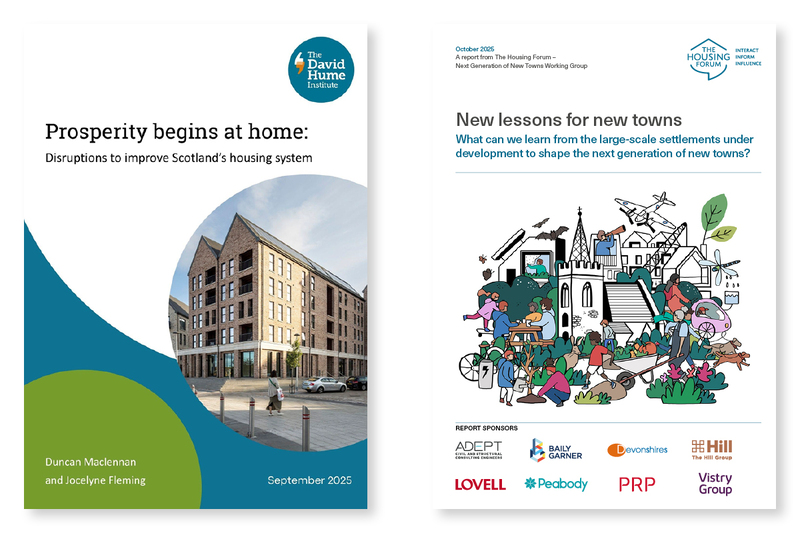
The second paper – New Lessons for New Towns – is by The Housing Forum and is concerned with the review of new towns. The paper uses recent case study experience to draw lessons for the proposed programme of new towns, largely from a housing and placemaking lens.
The tenor of the report is optimistic about the recently announced dozen successful new town applications. This report is a useful complement to the outpouring of work associated with the New Towns Taskforce. New towns will be a critical part of the Ministry of Housing, Communities and Local Government’s delivery plan even if, of course, the timescales are generational rather than electoral.
The case study research suggests the following requirements for all such investments:
- Flexibility built in from the start as the towns are likely to grow over decades into the future, but in a way that cannot be fully planned out now
- The housing offer should be varied by size, tenure and type, reflecting different age groups, generations and ethnicities
- The placemaking function and role of other critical place-based non-housing services cannot be underplayed – these are essential to working new towns
- Modern approaches to new towns that embrace climate change, regeneration and lower-cost living
- Stewardship must be present from commencement, with planned reinvestment and asset management at the core
The authors point out that there is a correlation between meaningful community engagement and delivery at scale. They also note that the early introductions of housing associations will support the process of complex development.
While housing can be built at scale, the report concludes that non-residential development can stall in the absence of a master developer.
Kenneth Gibb, director, UK Collaborative Centre for Housing Evidence, and member, Thinkhouse Editorial Panel
Sign up to Inside Housing’s Development and Finance newsletter
Sign up to Inside Housing’s weekly Development and Finance newsletter, featuring a round-up of business, development and regeneration news and analysis.
Already have an account? Click here to manage your newsletters.
Related stories