New research report explores potential enablers of accelerated housebuilding
Realising the 1.5 million, published as part of Housing 2025, is based on the results of a survey of 400 people across the English housing sector. Inside Housing and Social Housing report


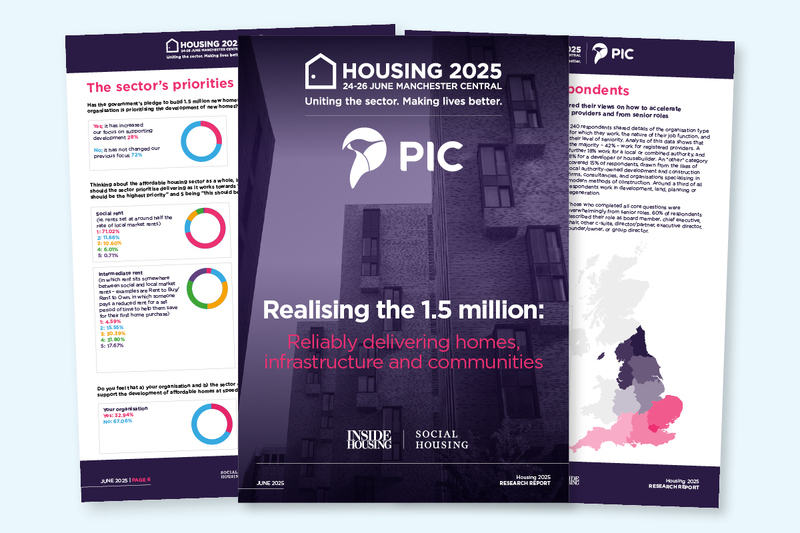 Realising the 1.5 million, published as part of Housing 2025, is based on the results of a survey of 400 people across the English housing sector #UKhousing #Housing2025

Key points
- Planning reform seen as offering potential for swifter delivery of new homes, with greater strategic planning across geographic areas and revised guidance on decision making particularly valued
- Around half of respondents to survey informing a Housing 2025 research report in association with Pension Insurance Corporation (PIC), Inside Housing and Social Housing believe deregulation will make a difference to ability to rapidly build homes
- Multi-sector partnerships seen as key to addressing the skills and education gap
A new report reveals cautious optimism that planning reforms and deregulation will serve to support accelerated housebuilding in England.
Realising the 1.5 million: Reliably delivering homes, infrastructure and communities explores possible means of rapidly increasing housing stock.
The Housing 2025 research report, published in association with Pension Insurance Corporation (PIC), Inside Housing and Social Housing is based on a survey of 400 people working in housing across all regions of the country.
It is launched against the backdrop of the government’s stated mission to create 1.5 million new homes by 2029, with a significant proportion of those to be affordable properties.
Ministers intend to support swifter housebuilding through planning system reform, deregulation and work to address the skills gap.
The research report explores views on each of those, as well as giving a sense of the existing mechanisms being used in the sector, as it seeks to rapidly deliver more homes.
With planning reform, four key measures emerge as those felt likely to make the most difference. These are greater strategic planning across wider geographic areas (named by 51% of respondents); updated guidance on which types of planning applications can be determined by council officers (50%); an increase in the minimum proportion of affordable housing required within new developments (47%); and revised housing targets for areas, based on current community needs (47%).
Deregulation
In addition to these measures – many of which are in the Planning and Infrastructure Bill currently working its way through parliament – the government’s broader deregulation agenda is greeted with fairly consistent enthusiasm.
Prime minister Sir Keir Starmer has previously indicated plans for “a raft” of deregulation policies, which he said would include “limiting the cynical legal challenges that block major infrastructure projects” and would “strip away the years of consultation that drown builders”.
Almost half of respondents (47%) said that cutting back on unnecessary regulation will help accelerate progress on affordable homes, arguing that current regulation is often challenging and consists of processes that add time rather than value.
Fewer than one in 10 expected a limited impact from deregulation. Around a third of this group were from local or combined authorities, a third from registered providers, and the remaining third from other organisations including consultancy firms.
While the research reports underlines a keenness for reforms to help support housebuilding, it also reveals mechanisms are already being used to support accelerated development.
42% of those surveyed for the report said their organisation is in partnership with one or more local authorities to support affordable housing development; a similar proportion spoke of partnerships with housing associations; and 39% of formal joint venture arrangements.
Around 35% are already using different funding models.
A keenness for longer-term certainty around funding streams, in turn enabling the confidence to create longer-term development plans, emerges as a key theme of the research – which was conducted prior to the Spending Review. The potential measures felt most likely to make a difference were subsidies for affordable housing and a 10-year rent settlement, both of which were announced by chancellor Rachel Reeves as part of the review.
A desire to bolster skills and education is also a central concern highlighted by the report. There was a widespread sense that partnership-led solutions, driven by multiple sectors, offer the greatest potential to address the skills gap. 44% named such solutions as being the most promising, with the next most frequently named – industry-led solutions – on 24%.
Hayley Rees, managing director of PIC Capital at the Pension Insurance Corporation, says: “PIC has been delighted to support this Housing 2025 research report, in association with Inside Housing and Social Housing, to help capture the practical steps that can be taken to boost the delivery of more homes to meet local need and investor demand.
PIC and the pension risk transfer sector, of which we are a part, expect to invest up to £200bn in UK housing and infrastructure over the next decade. This investment presents a fantastic opportunity to transform our cities and provide affordable, quality housing. By working together, we can ensure that more vital projects are developed, bringing tangible benefits to communities nationwide.”
Sarah Payling, managing director (housing) at Ocean Media Group, added: “The report shows how keen the sector is to accelerate the delivery of desperately needed homes. It demonstrates that organisations have been actively exploring mechanisms to support this, and highlights some key enablers which could make an even bigger difference.”
Related stories