Revealed: housing officers’ top priorities
We surveyed over 600 frontline staff to find out the biggest issues affecting their job, organisation and the sector more broadly. The results inform the work of a new website we have launched – Inside Housing Management. Katharine Swindells reports. Illustration by Michael Driver


 We surveyed over 600 frontline staff to find out the biggest issues affecting their job, organisation and the sector more broadly. The results will inform the work of a new website we have launched – Inside Housing Management. @Kathy_Swinds reports #UKhousing
Tina Stokes (not her real name) spends most of her days on the road, working for a housing association in the east of England as a tenancy enforcement officer. Her bread and butter is reports of anti-social behaviour (ASB) and tenancy breaches.
“It’s a very interesting job, but we are absolutely snowed under at the moment. It’s got heavier and heavier,” Ms Stokes says.
“You invest your energy into trying to solve these issues and make everything better for everybody, which you can’t always do. That’s the difficult side of it.”
As we launch Inside Housing Management, our new publication for professionals working in housing management, we wanted to find out what issues matter the most to frontline staff, and how we can provide them with information and tools to help address some of these concerns. The findings offer insight that we also hope will inform the rest of the sector.
We surveyed more than 600 frontline housing staff, working across the UK, and asked for the top five issues they worry about most when it comes to doing their job. The results were striking: the top issue was tenants with complex mental health issues, picked by 57% of respondents (see chart, below).
Read more



We also asked them what they thought were the most important issues facing their organisation as a whole, and top of the list was support needs of tenants.
“Tenants with complex needs are living in the community with little or no support from social services or police – there is no joint working with services and little understanding within other services about what housing can/can’t do,” wrote a customer liaison manager in the Midlands.
A location manager in the South East of England wrote: “I worry a lot about my residents and their care. I personally cannot support each one in the job I do as there is not enough time for me to go round, which is soul-destroying. I have in the past continually raised safeguarding concerns with very little action from other agencies, which I suspect comes down to a lack of funding.”

Survey respondents felt that housing providers have been left as the ‘last man standing’ when it comes to supporting tenants.
Paul Fiddaman, chief executive of 33,000-home Karbon Homes, isn’t surprised by the results. “There has been a hollowing out of local authorities and their inability to respond to some of these challenges effectively. And I mean no disrespect to local authorities, but they do not have the scale of resource to mirror what appears to be a burgeoning mental health crisis in the country,” he says.
“Housing officers are often the last people still present in communities that people can address their concerns to.”
The second and fourth-biggest issues for frontline staff were anti-social behaviour, picked by 46% of respondents, and tenants struggling financially (39%).
“To be able to help [tenants] help themselves is impossible now. It feels like I’m fighting fires with a cup of water,” wrote a community investment co-ordinator from the South East of England.
Frontline staff were keen to tell us about the positives of their job, particularly the impact they can have.
“My favourite part is the positive difference I can and make to people’s lives. There are a lot of daily challenges in social housing and these wins really make the difference for me,” wrote a community housing co-ordinator in the North East of England.
“We help to fix lots of issues. The people are what makes housing enjoyable,” wrote a housing manager
at a council in the South East of England.
“I like that my job is in the social housing industry, which is something that I can genuinely care about. Before I worked here, I was good at my job, but I just couldn’t care about it much,” wrote a community involvement officer in the Midlands.

But while that love of the job drives so many frontline staff, it can also add to the burden. Respondents wrote about working long hours above and beyond their contract, and worrying about their residents while on annual leave.
Donna Cezair, chief executive of 4,000-home Worthing Homes, says that while the organisation is investing in tenancy support co-ordinators for every patch, to provide a more specialised level of support separately to housing officers, Worthing Homes is also thinking about the impact on frontline staff, too. “We’ve created a well-being and inclusion co-ordinator internally to make sure that we’re doing much more around support for colleagues, thinking about compassion fatigue and trauma-informed environments,” she says.
In numbers
21%
Respondents who felt uninformed on regulation and policy
48%
Respondents undertaking a professional qualification
57%
Respondents who said tenants with complex mental health issues was an issue that worried them the most
In the list of worries, workload came third with 44% of respondents.
A senior housing officer in London wrote: “My current patch size is 1,300 properties, including tenants and leaseholders. I have to deal with all of the ASB, tenancy issues, fire risks and general queries that come through across my patch. We are under intense scrutiny, yet I cannot do a quality job with the volume of work that I get.”
Some of this comes down to the complexity of the cases and the support needs of the residents. “Housing staff are being expected to lead and be the primary ‘fixers’ in complex tenancy management. There’s a postcode lottery for the availability of support services to assist,” wrote a legal enforcement officer in the Midlands.
“We feel we no longer have time to work on early intervention or estate management due to the number of high and complex ASB cases we are faced with,” wrote a housing and neighbourhoods officer, also in the Midlands.
But respondents also told us that expectations have got higher, with residents seeking support from their landlord on more issues.
“It does seem to me that post-Covid, people are a lot more fragile and a lot less tolerant and more prone to be irritated by what might look like a relatively minor thing,” says Mr Fiddaman from Karbon. “But if your mental health is a little fragile, then small things become magnified and can cause problems, so you’ve got what looks like an escalation in all of that.
“And then I think you’ve got a kind of linked phenomenon of raised expectations in the sector, being encouraged to complain, and I think that’s right. But I think that some of that can be stretching the bounds of what is in our gift to be able to address.”
Conversations needed
Matthew Bailes, chief executive of 17,000-home Paradigm, says he thinks there needs to be a high-level conversation not just within organisations, but across the sector.
“The sector needs to take an elective view of what exactly is our role really. We’re going to have to think about just how far we go in supporting residents, and where you draw the line.
“And we need to look at when a general needs tenancy isn’t doing anyone any good, and people need to be in supported housing or something else. I think these are big strategic issues for the sector.”
But in the meantime, frontline staff are stretched thinner than ever, handling an increasingly large, complex and even dangerous caseload.
A community support worker in the East of England summed this up when they wrote: “Long hours, lone working, back-to-back 12-hour shifts; not being able to maintain the required level of concentration and ability to respond in a critical situation when supporting residents with addiction and mental health issues.”
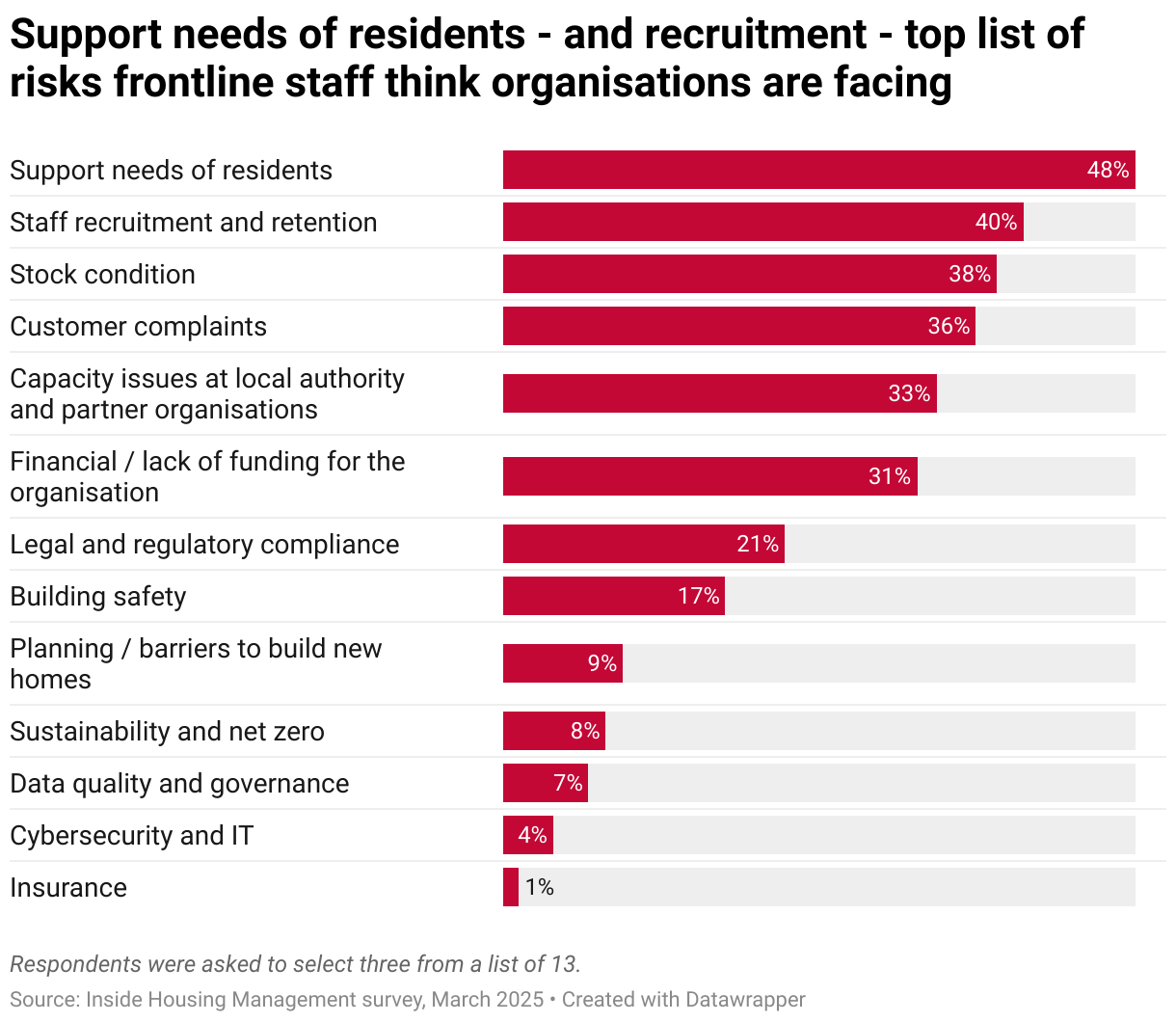
Perhaps it is unsurprising, then, that when asked for the biggest issues facing their organisations as a whole, 40% of respondents said staff recruitment and retention, higher than stock condition.
This is a major risk identified by organisations at board level: in Inside Housing’s Risk Register, which analyses 100 organisations’ financial reports for the key risks they are facing, staff recruitment and retention was the eighth most commonly cited. Tenant support needs were scarcely mentioned at all.
And, Mr Bailes says, this is where executives need to pay attention. The impact of increased support needs of residents, coupled with the lack of statutory and partner agency support, will be seen across the business.
“The demand and money that is spent dealing with this is significant. It may not be obvious from [our financial] accounts, but you see it in [the] condition of voids, staffing costs and other things. So it is a big issue.”
As we have been working to launch Inside Housing Management, we have been speaking to frontline staff up and down the country not only about these concerns, but also about the tools they need to address them.
Our aim with this new publication is to provide insight and resources to help them navigate these challenges.
Click here to read more and find out how to subscribe.
Methodology
Inside Housing Management surveyed over 600 frontline housing staff from across the country, to find out what issues they see as the biggest facing them, their organisation and the sector more broadly.
Almost three-quarters of respondents were from housing associations, with the rest coming from councils, supported and older people’s housing, and the homelessness sector.
Responses came from all regions and nations of the UK. The data was filtered to remove any non-applicable submissions.
Is there something that didn’t get airtime you would like to read more about? Contact us on editorial@insidehousing.co.uk.
‘We want to help’: the frontline voice
What is the one biggest issue you worry about when it comes to your job?
“[I’m not] able to be a friend, support worker, councillor, doctor and housing officer to every tenant” – housing officer, Greater London
“We have limited resources to be able to support every tenant who is struggling. If staff had more time and resources to regularly check in with all tenants, we might be able to prevent this or at least lessen the impact” – money solutions team lead, Wales
“[We’re] providing support for tenants on a range of complex [issues] due to the tenants not being able to access support through other channels. I will try to help regardless, but it highlights the lack of capacity in suitable services to cope with the demand” – housing support officer, Scotland
“I don’t want to leave my job as I am passionate about trying to help people, but the job comes with a lot of responsibility and this is not recognised” – support worker, North West of England
“My biggest concern is not having the right tools to do the job any more. I can see this having an adverse effect on our estates and communities, which are slowly unravelling” – community housing partner, Wales
“We have moved from being housing officers to glorified debt collectors. We’re rarely in the patch, so we’ve lost the ability to speak to tenants face to face, in their own home and spot other issues” – income officer, East of England
Introducing Inside Housing Management
Inside Housing Management is our brand new platform, which aims to be the comprehensive information source for professionals working in housing management and looking for learning and ideas to help them provide excellent services and develop their careers.
The results of our survey reveal how crucial this is. When asked how much they know about what their peers at other organisations are doing, less than one in 10 respondents said “a lot”, and more than a quarter (28%) said they knew nothing (see pie chart, above).
More than a fifth of frontline housing staff said they felt uninformed about regulation and policy in the sector.
Asked what the biggest worry in their job is, one housing options manager in the East of England wrote: “Not having the proper backing from senior management, and the lack of knowledge about the issues we face as a team.”
Alongside explainers, best practice, news, comment and insight, Inside Housing Management will offer CPD-accredited articles, tailored specifically for this housing manager audience, on topics including data security, tenancy fraud, fire safety and resident engagement.
This is crucial, as half (48%) of respondents told us they were undertaking a professionalisation qualification, either by requirement or by choice. As the sector’s professionalisation standards come into force, it is expected this will apply to increasing numbers of staff.
Asked what topics they would like to learn more about, respondents were split, with AI and new technology, and the welfare system commonly selected.
Also topping the list was “how to develop my own career”. Inside Housing Management’s goal is to promote jobs in the social housing sector, and encourage the workforce to stay and develop their careers here.
Subscribe to Inside Housing Management and sign up to the newsletter

Inside Housing Management is the go-to source for learning, information and ideas for housing managers.
Subscribe here to read the articles.
Already have an account? Click here to manage your newsletters.
Related stories