You are viewing 1 of your 1 free articles
Dangerous cladding products could be deemed ‘risk neutral’ under new guidance, manufacturers warn
Cladding materials such as those used on The Cube in Bolton, which suffered a catastrophic fire in autumn 2019, could be deemed “risk neutral” under new cladding guidance, a manufacturers group has warned.


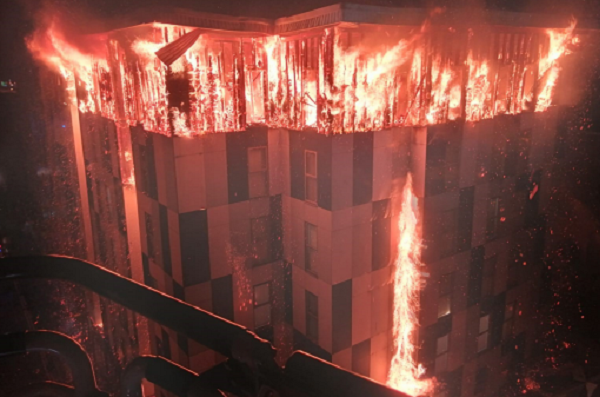 Manufacturers warn that cladding materials, such as those used on The Cube in Bolton, could be deemed “risk neutral” under new cladding guidance #UKhousing
The recently published PAS 9980 code of practice guides fire risk assessors on how to categorise the risk posed by a building’s external wall, with the government hoping it will result in more ‘proportionate’ assessments and fewer blocks being branded in need of full remediation.
But the Mineral Wool Insulation Materials Association (MIMA), which represents the manufacturers of non-combustible insulation, has warned that the document’s use of ‘calorific values’ to grade the risk of different cladding panels could allow dangerous materials slip through.
A government spokesperson rejected the analysis, saying it was based on a “selective reading” of the guidance and that it encouraged assessors to take other factors into account.
A spokesperson for leaseholders impacted by the cladding scandal warned that the guidance leaves “too much discretion to an industry which has already proved itself unreliable” and called for the government to get a “grip” of the crisis.
Read more
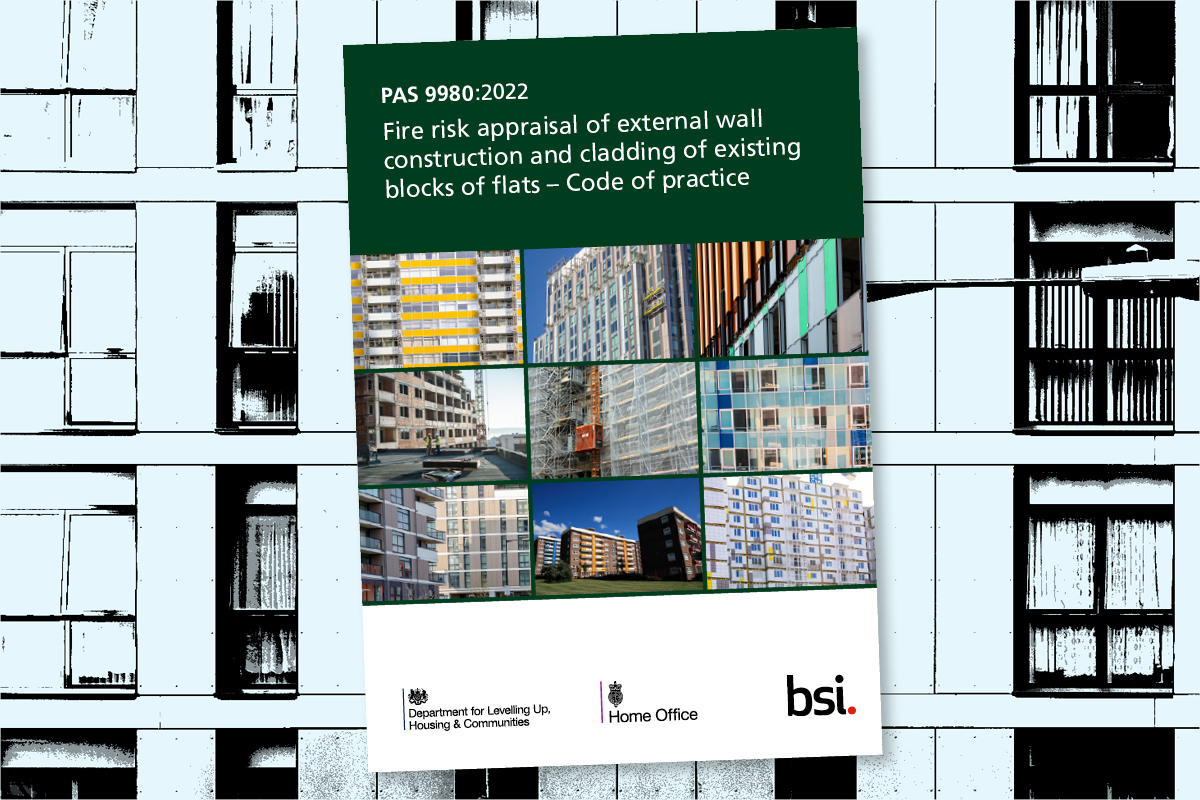

The PAS 9980 document replaces a series of government advice notes produced since Grenfell, which have been widely blamed for contributing to thousands of blocks with combustible materials on their external walls being denied mortgages.
The new guidance lists several ‘calorific values’ to grade the risk of various cladding products with materials, with a calorific value of between three and 35 megajoules (MJ) per kilogram considered “neutral”.
But the MIMA analysis noted that standard-grade high-pressure laminate (HPL) cladding, such as that used on The Cube, will produce between 18 to 20MJ of energy per kilogram when burned, placing them in this middle category, meaning it would be open to the assessor to deem the risk tolerable.
The guidance does state that the numbers are to be used as a “broad indicator only”, with other factors to be taken into account including the location of the combustible material and the extent to which it covers the building.
However, a spokesperson for MIMA said existing European standards for fire performance would be a more reliable indicator of risk, noting that even coal would produce a low enough calorific value to be deemed a tolerable risk under the PAS 9980 criteria.
It stated that a decision on the remediation of medium-risk buildings would be a matter for fire risk assessors and raised a concern there were not enough suitably qualified fire engineers to make this sort of judgement when such dangerous materials were involved.
Last month Clive Betts, chair of the Levelling Up, Housing and Communities (LUHC) Committee, wrote to the British Standards Institute (BSI), which published the guidance, asking for answers about the concerns.
Sarah Kostense-Winterton, executive director of MIMA, said: “We urgently need to address building safety and to do that, safety assessments have to be trusted by the insurance industry, mortgage providers and most importantly building occupants. We’re not confident that the new PAS 9980 methodology will deliver this.
“First, calorific values are not the best way of measuring the safety of external wall materials, and the fact materials with the calorific value of coal are deemed a medium risk by the PAS clearly illustrates that challenge. For example, a building with cladding similar to that which caught fire on The Cube student accommodation in Bolton would likely be deemed medium risk in principle.
“MIMA also has concerns about the number of people competent to carry out these assessments. There are not enough suitably qualified fire engineers in the country to cover the number of buildings that need to be assessed. This is significant given that it is ultimately up to the assessor whether or not a medium-risk building should be remediated.
“We already have fire safety standards that are better suited for an external wall assessment. Determining whether materials are combustible or non-combustible, using the existing Euroclass standards, is still the simplest and most robust basis for assessing whether materials are appropriate and safe for use.”
The MIMA’s members sell non-combustible insulation products, with their superior fire performance often emphasised as a selling point.
A spokesperson for the Department for Levelling Up, Housing and Communities said: “This analysis is based on selective reading of PAS 9980. While we recognise the potential dangers of HPL cladding and are acting to have it removed where necessary, how this interacts with other fire safety issues with a building is important in determining risk through PAS 9980 methodology.
“The document is clear that when evaluating overall fire risk of a building, assessments should include how the exterior of a building is constructed, fire hazards and the fire safety measures within the building – this analysis does not take this into account. ”
PAS 9980 was drafted by the consultancy C.S. Todd and Associates, in conjunction with a consultancy co-founded by former Building Research Establishment (BRE) scientist Dr David Crowder and other experts.
It was advised by a steering group comprising experts from organisations including the London Fire Brigade, BRE, the Construction Products Association and the Institute of Fire Engineers.
Dr Jonathan Evans, a facades expert and chief executive of cladding supplier Ash and Lacy, said standard grade HPL was “pretty close to being as dangerous” as the polyethylene-cored aluminium composite material (AM) cladding used on Grenfell Tower.
He added that using megajoules per kilogram as a measurement of risk showed “a degree of incompetence”. “It’s the amount of fuel per metre squared that really matters on a wall and crucially, how quickly that is released as heat,” he said. “We will eventually have a fatal HPL fire – no doubt.”
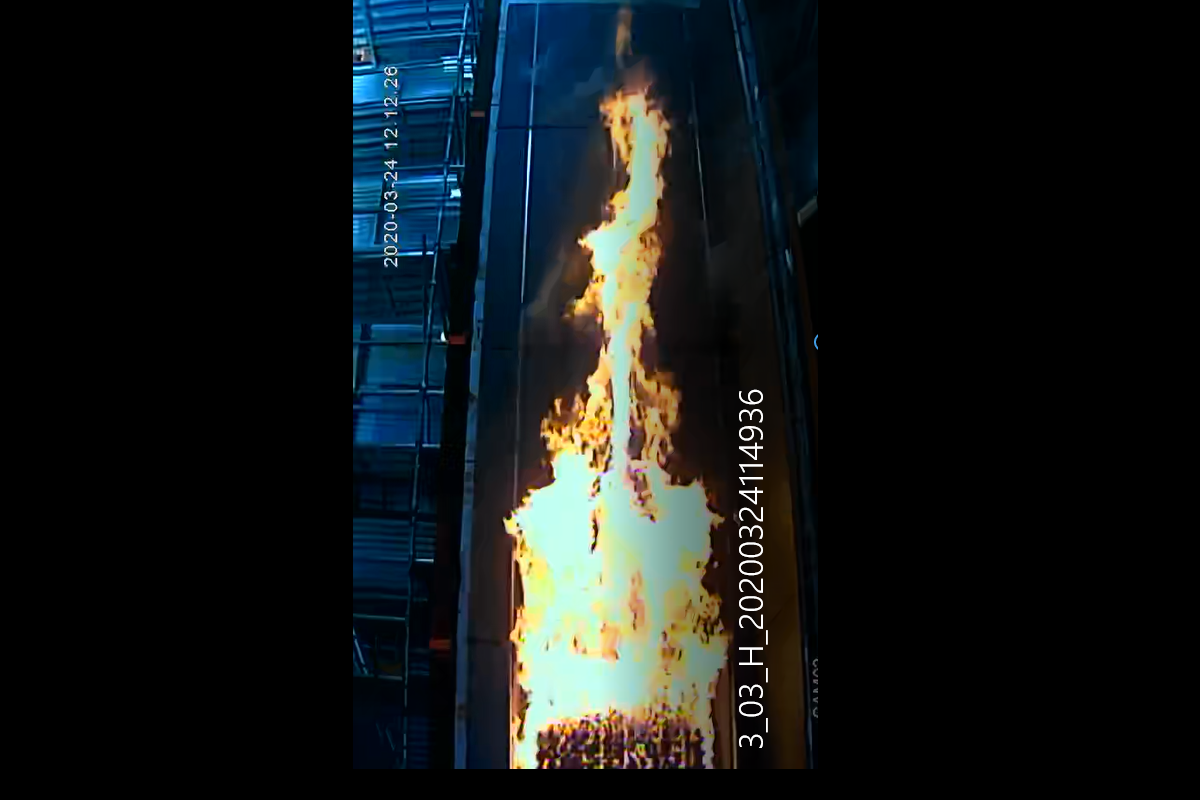
A test on standard-grade HPL in March 2020 saw it fail just seven minutes and 45 seconds into a 30-minute test, with temperatures exceeding 700°C.
Giles Grover, a spokesperson for the End Our Cladding Scandal campaign, added: “We agree with the need for a proportionate assessment of risk in buildings. But this analysis is just the latest sign that PAS 9980 has been poorly thought through and will struggle to deliver the results hundreds of thousands of leaseholders so desperately need.
“Far too much is left to the discretion of an industry which has already proved itself unreliable. We fear the worst of both worlds: unsafe buildings which are waved through as safe, safe buildings which are deemed in need of expensive remediation and ongoing – painful uncertainty for those forced to live inside them.
“We are already seeing real-world examples of the uncertainty caused by this guidance. The government must finally grip this crisis, acknowledge the mistakes of the past, set out much more clearly which buildings need remediation and ensure clearly, unobjectively and without condition that it is not the innocent leaseholders who meet the cost of paying for it.”
Sign up for our fire safety newsletter
Already have an account? Click here to manage your newsletters
Related stories