You are viewing 1 of your 1 free articles
Less than a third of Scottish landlords have budgeted for net zero, says regulator
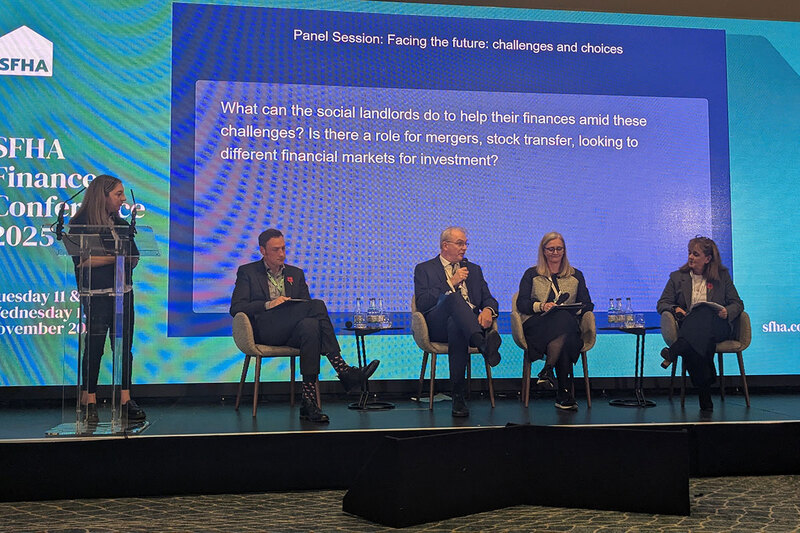
Less than a third of Scotland’s registered social landlords (RSLs) have made any provision in their financial projections for net zero, the Scottish Housing Regulator (SHR) has said.


 Less than a third of Scotland’s registered social landlords have made provisions in their financial projections for net zero, says the Scottish Housing Regulator #UKhousing
This is despite the “significant” cost estimates involved in achieving the climate goal, said Helen Shaw, director of regulation at the SHR, while speaking on a panel at the Scottish Federation of Housing Associations (SFHA) finance conference in St Andrews yesterday.
It comes as the Scottish government continues to develop a social housing net zero standard, which was proposed two years ago to replace current energy efficiency standards.
Speaking at the conference yesterday, Richard Meade, chief executive of the SFHA, underlined the need for “clear and fair” net zero and retrofit expectations for the sector, and stressed the need to explore more public funding to pay for this work.
Read more
Today, Màiri McAllan, the housing secretary, explained the reason for the delay in finalising the standard while taking questions from social housing leaders at the conference.
She explained that after taking on the role in June, she asked the government’s independent regulatory group to look at the “suite of commitments” related to decarbonising buildings, including the net zero standard, Passivhaus and the private rented sector energy efficiency standards.
Ms McAllan said she has asked the group to come back to her with a sequencing that makes achieving these goals “manageable” for housing leaders.
“It’s not delayed for delay’s sake. It’s delay with a view to getting a really clear idea of what’s manageable and implementable,” she told the room of delegates.
The benchmark as set out in 2023 would require social landlords to achieve an Energy Performance Certificate (EPC) rating of B by 2040 and scrap fossil fuel heating in their homes by 2045.
Last year, the SHR estimated that meeting the standard would cost landlords some £28,000 per flat and up to £42,000 per house, adding up to a likely total bill for the sector of between £4.6bn and £9.3bn.
At the conference today Ms McAllan was also asked if there should be more public funding to help social landlords meet these standards.
She did not rule this out, but stressed the squeeze on the government’s finances, highlighting that Scotland’s capital budget is expected to drop by 1.1% over the Spending Review period.
“I think the public purse has a really important part to play,” Ms McAllan said, adding that the government’s social housing net zero heat fund, which pays for energy efficiency upgrades to social housing, has been “extremely popular” and has already committed tens of millions of pounds.
“I think there is certainly a role for continued public investment,” she continued.
“But hopefully you can understand that I’m also trying to make a budget... to support you [in order] to manage cladding, to build more homes in the first place, to buy homes now to get children out of temporary accommodation.
“So as ever, it’s just a case of trying to make what feels like an ever decreasing pot of money go as far as it can, according to the priorities that hopefully we can agree we share.”
Ms McAllan also stressed this point when responding to a question on how the government’s planned £4.9bn investment in building affordable homes would be split between public and private sources.
“It’s incumbent on me, in a time when public money is as short as it is, to try and lever as much of that from private investment as I possibly can,” she said.
“Hopefully you can see we’ve been doing some of that within MMR [mid-market rent] projects, and we’re working with the Scottish National Investment Bank.
“But for today’s purposes and as far as I can confirm it before the budget, basically, I can say that £4.9bn will be spent and it will be incumbent on me and my officials to try and draw as much of that out from private investment.”

Related stories