Phasing out gas in European social housing: what the UK can learn
In this article written in partnership with Sureserve, a provider of energy, heating and compliance services, Jan Rosenow, professor of energy and climate policy at the University of Oxford, examines how Germany, the Netherlands, Poland and France have decarbonised their social housing


 Jan Rosenow, professor of energy and climate policy at the University of Oxford, examines how Germany, the Netherlands, Poland and France have decarbonised their social housing #UKhousing
Phasing out gas from social housing is crucial in achieving climate targets and protecting residents from unpredictable energy prices. In the UK, more than 80% of social housing relies on gas boilers, a reality that makes our climate targets unachievable and leaves residents exposed to volatile energy prices.
While we are starting to grapple with this challenge, our European neighbours are already miles ahead in executing bold, often more comprehensive strategies. Their experiences provide insights into how to phase out gas in social housing effectively and at scale.
Germany: quality over speed
Germany’s fundamental approach up to now has been a ‘fabric first’ strategy, which tackles the causes of high energy use. Rather than substitute a gas boiler for a low-carbon heating system, German policy opts for an ambitious deep retrofit of the building envelope.
This has included high levels of external insulation, excellent performance triple-glazed windows and very strict airtightness. The aim is to achieve energy savings of 75% or more.
This is a crucial first step in transitioning away from gas. But it has one downside: the cost. The German government, channelled through its state-owned KfW Development Bank, provides finance.
Read more



The government provides long-term, low-interest loans and significant grants, so social housing providers can focus on these complex developments. This is in sharp contrast with the UK’s stop-start funding programmes that can’t grow a market, so supply chains can’t expand and housing associations can’t plan more than one or two years ahead.
What is remarkable is that the KfW programmes have remained incredibly stable despite significant political turmoil and changes in government. KfW also offers support for new heating systems such as heat pumps. Importantly, KfW’s support for heat pumps is not a standalone offer, but is integrated into its broader retrofitting programmes, such as the Federal Funding for Efficient Buildings.
For instance, housing associations can secure loans of up to €150,000 (£131,000) per residential unit for comprehensive, energy-efficient retrofits. These projects often involve replacing gas boilers with heat pumps.
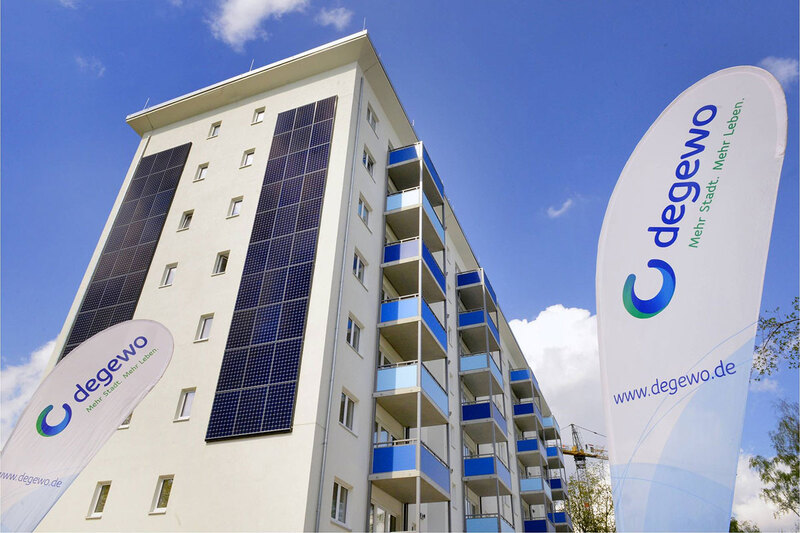
In Berlin, the social housing company degewo has undertaken projects where it combines deep insulation with the installation of heat pumps, often integrated with solar panels on the roof. This holistic approach ensures the heat pump operates at high efficiency, genuinely lowering bills and carbon emissions.
A project by the housing cooperative Wohnungsbaugenossenschaft Gartenstadt Süd eG involved installing ground source heat pumps and completely upgrading the building’s insulation and windows, effectively creating a future-proof, low-carbon heating system. The result: the tenants paid less than a quarter of the cost for heating after the retrofit.
This is a very capital-intensive approach, but for the residents in the retrofitted buildings, it means improved comfort and lower bills without relying on gas. It will be interesting to see how Germany maintains this path as the pace of phasing out gas for heating accelerates.
Netherlands: a focus on industrialisation
The Netherlands has faced a similar challenge with its large stock of post-war social housing and a heavy reliance on gas heating systems. Its solution, however, has been revolutionary. Instead of treating each retrofit as a bespoke construction project, the country industrialised the entire process through the Energiesprong programme.
This model is built on economies of scale and innovation. It has created a market for prefabricated retrofit packages, which can include new insulated facades with windows, and roof panels with integrated solar photovoltaics and heat pumps. These are manufactured offsite and then installed with minimal disruption to tenants, often in a matter of days.
The real genius of Energiesprong lies in its financing model. Housing associations enter into long-term performance contracts with retrofit companies, which guarantee that the retrofitted homes will achieve net zero energy use.
The cost of the retrofit is then paid back over decades, with the repayments often funded by the tenant’s future energy savings. It de-risks the investment for the housing provider and provides the contractor with the long-term certainty they need to invest in new manufacturing and skills. It also guarantees a direct, tangible benefit for the tenant: a warm home and a predictable energy bill.
Poland: leveraging EU funds for decarbonisation
Poland’s approach to retrofitting its vast stock of socialist-era housing offers a different, but equally important, lesson. Faced with a legacy of inefficient apartment blocks and reliance on coal-fired district heating, the country has leveraged significant financial support from the European Union.
Poland has been one of the largest beneficiaries of the EU’s Cohesion Fund and Regional Development Fund, with a substantial portion of this money earmarked for improving energy efficiency.
This funding has enabled many social housing organisations to undertake deep retrofits, which often include external wall insulation, window replacement and, crucially, a shift from fossil fuel-based heating. Many projects connect to district heating (which is currently still carbon-intensive) or use individual or communal heat pumps.
The Polish model demonstrates how external, long-term financial instruments can serve as a powerful catalyst for a nationwide retrofit programme, particularly in economies with limited domestic capital for such large-scale transitions.
France: the power of a national strategy
France has shown that having a clear, national roadmap is essential for making progress. It has a long-term strategy for building renovation with a hard target to have a low-energy building stock by 2050. This is backed by significant and consistent government funding.
For social housing, the government utilises public financial institutions to provide a combination of grants and low-interest loans, thereby creating a more stable funding environment. But France’s strategy isn’t just about money. It has made “one-stop shops” to simplify the process for social housing providers, offering a single point of contact for technical, financial and administrative advice.
This streamlined approach tackles the complexity that often slows down retrofit projects in the UK. Furthermore, the phased prohibition on renting out the least energy-efficient homes provides a powerful regulatory driver for action, giving housing associations a clear incentive to invest now rather than later.
What the UK can learn
The UK’s approach to social housing retrofits often feels like a series of fragmented, short-term experiments rather than a coherent, national strategy.
We have a lot to learn from our European counterparts. We need to move beyond simple stop-start grant schemes and embrace long-term, stable funding models that encourage more comprehensive retrofits.
Importantly, replacing the heating systems at the same time as improving the fabric efficiency of buildings is a must if we want to move away from gas. Finally, we must establish a clear, long-term policy framework. France is a great example that provides social housing providers with the confidence to invest in the future.
Sureserve’s latest funding webinar
Sureserve’s webinar, Diversify your retrofit funding: Exploring options to make grant funding go further, will show you how to find and secure monies from lesser-known sources in the social housing grant and loan industry. Watch it below.
Sign up to Inside Housing’s Sustainability newsletter
Sign up to Inside Housing’s weekly Sustainability newsletter, featuring our in-depth coverage of the sector’s journey to delivering net zero.
Click here to register and receive the Sustainability newsletter straight to your inbox.
And subscribe to Inside Housing by clicking here.
Already have an account? Click here to manage your newsletters.
Related stories