London: A pan-London approach to deliver place-based decarbonisation
A place-based decarbonisation approach delivers retrofit projects in a way that prioritises local needs, issues and circumstances before designing any implementation


 A place-based decarbonisation approach delivers retrofit projects in a way that prioritises local needs, issues and circumstances before designing any implementation #UKhousing
Go back to the Cities Encyclopaedia
We know decarbonising homes is crucial for achieving emissions targets and reaching net zero. In 2022, emissions from residential buildings accounted for a fifth (20%) of greenhouse gas emissions in the UK. However, decarbonising homes, for example through low-carbon heating or energy-efficiency measures, is complex. There are expensive upfront costs for homeowners, disruption for residents and intricate installation requiring specialised skills. Without external intervention and support, emissions from housing will continue to be a barrier to achieving net-zero targets.
A place-based decarbonisation approach delivers retrofit projects in a way that accounts for some of these complexities, as it prioritises understanding local needs, issues and circumstances before designing any implementation. One place-based model which embeds these principles is the net zero neighbourhoods (NZN) model, which was developed by the Cities Commission for Climate Investment. The approach is designed to mobilise blended finance, including private sector investment, to deliver place-based climate infrastructure that has been co-designed with the community. It packages local net-zero projects centred around residential retrofit into attractive investments that create long-term certainty for investors. The model has the potential to overcome cost issues by acquiring the required upfront investment from financial institutions, thereby freeing up budgets for other pressing issues in the sector, such as affordable housing.
Read more
Local authorities are well-placed to test this approach, as they have pre-existing relationships with local communities and can use their own housing stock to implement the model. However, to build investor confidence, the NZN model needs to be demonstrated in a number of areas, and this takes funding, resources and expertise. The London Net Zero Neighbourhoods Cohort was set up in autumn 2023 to ensure efficiency and capitalise on this innovative approach. It brings together 12 pathfinder boroughs that are developing NZNs and other similar approaches to place-based decarbonisation.
The cohort supports the development of these NZN plans into investment-ready proposals by focusing on collective learning between boroughs, identifying shared barriers and coordinating on solutions. Representatives from key partners including the Greater London Authority, London Councils and the Green Finance Institute are also involved. The cohort sits under the green-economy theme, led by the London Borough of Hounslow, within the London Councils climate programme.
The cohort has several strengths, one being the diversity in boroughs NZN approaches. This allows the cohort to coordinate more effective delivery through shared learning and collective commissioning of external support. This transparent approach will allow later adopters of the model to bypass certain challenges and progress more rapidly. Initial mapping of the breadth of approaches showed common-priority themes include community engagement, retrofit (central to the NZN model), heat decarbonisation, renewable power and green infrastructure. Exploration of more unique identifiers, such as
supply chain capacity or comfort-fee mechanisms, ensures a robust, scalable approach without duplication of resources and investment.
Due to the scale, urgency and impact of climate projects on Londoners’ lives, effective community engagement and co-design of these projects are imperative to success. It ensures projects reflect local needs, aid co-ownership and decrease the risks upon delivery. Some of our boroughs have already become leaders in this area. The cohort aims to harness this learning by producing a community design guide with best practice principles and case studies.
“Local authorities are well-placed to test this approach, as they have pre-existing relationships with local communities”
Delivering a just transition to net zero is a key priority throughout the cohort and the London Councils climate programme. Boroughs have outlined equity and a just transition as key considerations in their NZN plans. The model ensures that households retain a reduction in energy bills, and enables funding of collectively agreed local climate interventions such as more green and blue infrastructure. The cohort also proactively incorporates equity considerations within and between boroughs when selecting pilot areas.
The cohort is working collaboratively to identify and overcome the challenges and barriers at this level and within the wider landscape of this work. Boroughs are exploring options for obtaining the necessary funding to complete feasibility and implementation planning. While investors may be cautious about supporting early-stage development work, it is crucial to building propositions and a market that is robust and attractive to financial institutions. Blended financial structures are challenging to build and test without the right technical support. For example, while some of the payment collection routes for the NZN model can be tested through demonstrators, technical support is needed to support this process, and to build and test other revenue sources such as heat networks and community energy.
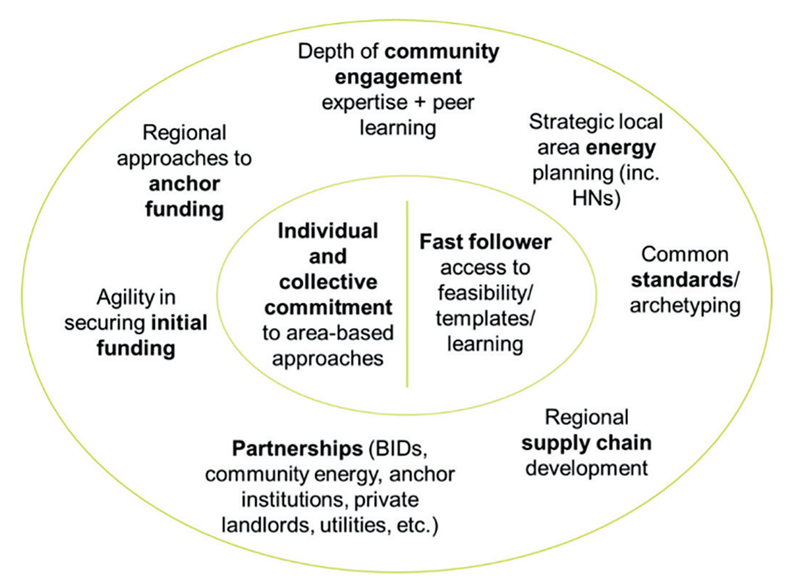
The availability of long-term, large-scale funding influences the progress of boroughs to deliver this work. Current grant funding alone is not adequate, and its short-term, competitive-bidding nature is neither an adequate nor sustainable way to finance the scale of the NZN model. The cohort is working to transition approaches from short-term funding to long-term finance and will engage with different kinds of funders, from philanthropic to institutional, to foster investor appetite.
One of the anchors for delivering London NZN demonstrators is a technical assistance facility (TAF). A TAF would provide the cohort with the necessary expertise, capacity and initial funding to enable NZN proposals to move from concept and early-stage feasibility to credible investor-ready business cases and potential demonstrators. Learnings from similar initiatives by combined authorities indicate that a TAF can support capability, capacity and help secure seed funding to move the cohort’s selected demonstrators from concept to detailed design and business case. The cohort is exploring avenues for collectively funding a TAF and mobilising it for the demonstrators.
“The cohort is working collaboratively to identify and overcome challenges and barriers”
To ensure knowledge, experiences and learnings are shared beyond members, the cohort established the London Net Zero Neighbourhoods Practitioners Group earlier this year. The practitioners group is open to officers at any stage of developing an NZN, or those who wish to learn more about this blended-finance, place-based approach to climate action. The group is intended as a way of sharing and solidifying the learning that is coming through from the cohort with the wider London audience.
The cohort is focused on shared learning, collective commissioning and collaborating on outputs to deliver net-zero projects while saving public resources. Co-ordinating this with economic, social and environmental benefits, the cohort accounts for a range of agendas to build to holistic, place-based regeneration.
What two of the key players said
Katherine Dunne, cabinet member for climate, environment and transport, London Borough of Hounslow
“Hounslow Council is proud to be leading the London Net Zero Neighbourhoods cohort. The cohort provides an opportunity for London to progress towards investor-ready net zero neighbourhood demonstrators, delivering positive change to communities with a multitude of co-benefits. Our work also signals to stakeholders the clear commitment from London’s local government to this holistic approach to place-based decarbonisation.”
Jacob Heitland, director of climate action, London Borough of Newham and member of the NZN cohort
“The London Net Zero Neighbourhoods cohort is an excellent example of how the climate programme uses the ambition and leadership of London boroughs to go further and faster on the complex and interconnected issues we are facing across the capital. Improving the health and energy efficiency of our neighbourhoods in a just manner requires this form of working together, and I’m looking forward to collectively solving it.”
This article was originally published in October 2024
Sign up to Inside Housing’s Sustainability newsletter
Sign up to Inside Housing’s weekly Sustainability newsletter, featuring our in-depth coverage of the sector’s journey to delivering net zero.
Already have an account? Click here to manage your newsletters.
Related stories