You are viewing 1 of your 1 free articles
 Suzanne Benson
Suzanne is the firm's national Head of Real Estate, working on major projects (including strategic land, joint ventures and regeneration) ...more
The Thinkhouse Review: a new government and a cost of living crisis – is homeownership still a priority?
Two substantial reports from leading thinktanks consider the twin questions of who owns and lives in our housing and how we can promote access to the market, particularly for first-time buyers. Suzanne Benson picks out the key details


 Two substantial reports from leading thinktanks consider the twin questions of who owns and lives in our housing and how we can promote access to the market, particularly for first-time buyers. Suzanne Benson picks out the key details #UKhousing
Perhaps a result of the ongoing uncertainty both around the future government and the arrival of double-digit inflation, August seemed to be a good time for researchers to focus on the question of homeownership.
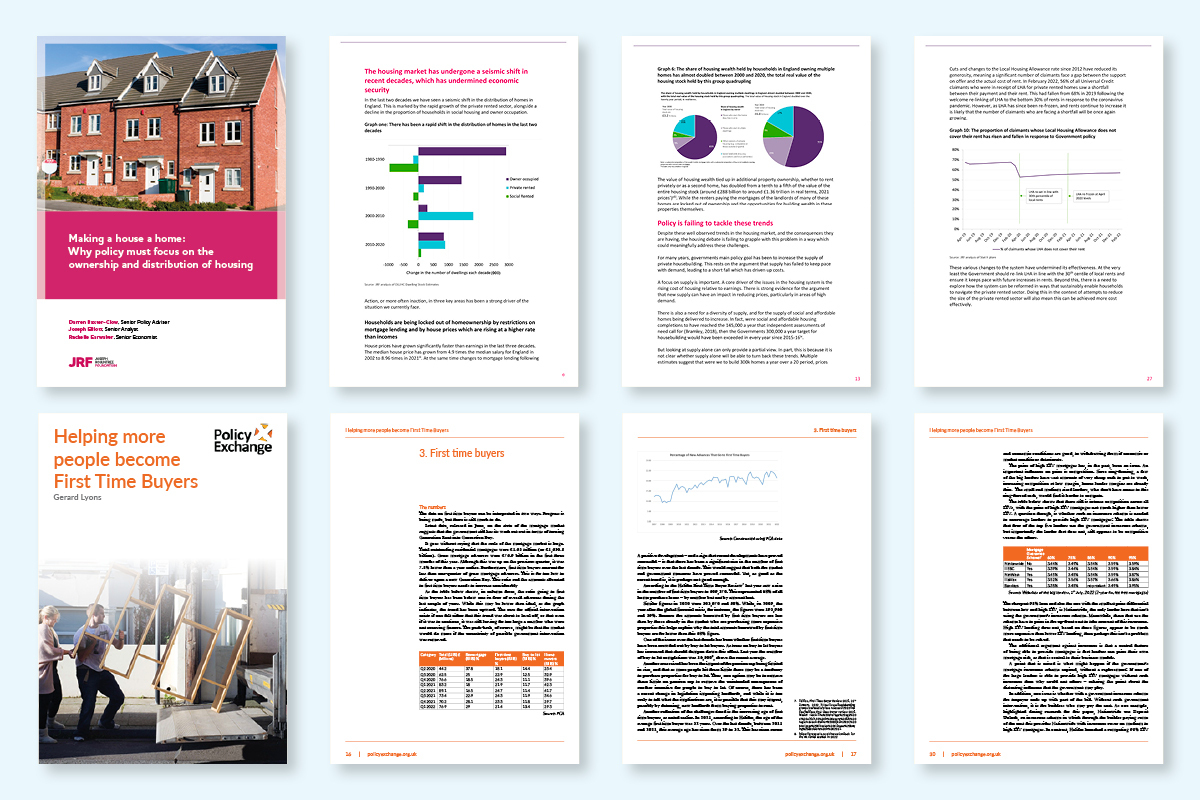
Two substantial reports from leading thinktanks – one from the Joseph Rowntree Foundation (JRF) titled Making a house a home: Why policy must focus on the ownership and distribution of housing and another from the Policy Exchange entitled Helping more people become First Time Buyers – consider the twin questions of who owns and lives in our housing and how we can promote access to the market, particularly for first-time buyers.
The JRF report takes a broad view of the market and flags the importance of understanding the composition of the current market in order to inform future policy decisions.
The authors acknowledge the need for new supply and the correlation between supply and rising housing costs, but highlight the importance of analysing who owns and lives in our existing 25 million homes. This is arguably the better source of data to start addressing the rising cost of housing.
Read more


The report’s authors identify four key areas for focus:
- Setting policy to create a smaller, higher-quality, better-managed private rented sector – interestingly this point focuses on discouraging private individuals from speculating in the market and using policy to focus the lending market more on first-time buyers. This is perhaps a shift from more recent policy, which has tended to seek a solution in the build-to-rent sector.
- Developing policies that proactively shape the market and offer direct routes from rental to homeownership – this does not address the current question mark over the gap to be left once Help to Buy comes to an end but instead focuses on reviewing barriers to accessing the lower end of the mortgage market, reviewing affordable homeownership products and encouraging largely public sector housing providers to engage more with the secondary market in order to bring more homes back into use.
- Looking to support households for whom homeownership is not feasible or desirable – this suggestion focuses on the gap between rental and the intermediate market, with a particular focus on collective schemes to access a level of ownership and support for saving. Both are areas of focus for providers in the affordable sector but often fail to get traction due to the current regulatory constraints.
- Finally, any reduction in the private rented sector needs to be managed equitably – this mainly focuses on levelling the playing field for lower-income renters through reforming the benefits system and improving the purchasing power of this group.
Overall, the report brings together some constructive thinking on the current state of the market and puts in the context of potential policy change – all food for thought for the incoming administration.
In the second report, Gerard Lyons, working with the Policy Exchange, highlights the housing market as one of the more critical challenges for the incoming prime minister, with a particular focus on moving renters into homeownership – a traditional key focus for the Conservatives.
As with the earlier report, the author identifies several main policy objectives, arguably ones with a more market-led emphasis.
The preferred option is to look at solutions that largely allow the market to provide its own solutions – with light-touch intervention from government. This is perhaps a direct response to the more active involvement of recent policies such as Help to Buy.
This option focuses on removing unnecessary regulation around access to finance and helping those who cannot save for a deposit. This is to be achieved in two ways: requiring rental history to count towards a credit score and working to restore 100% loan-to-value mortgages.
Although the aim of this is logical, the outcomes are potentially concerning – the increase in Financial Conduct Authority regulation of the mortgage market and the move away from 100% mortgages was a direct response to irresponsible lending practices. Any return to this approach undoubtedly carries a risk of less scrupulous lenders participating in the market.
“The third option acknowledges that there may be no universal solution and recognises that the ultimate answer may lie in a combination of policy intervention, mortgage guarantees and innovative mortgage products”
As a secondary option, the report suggests that the government considers extending and renewing its approach to mortgage guarantees to provide an effective insurance policy for increased lending to first-time buyers.
For some, this may be viewed as simply an alternative mechanism to Help to Buy – and one that supports rather than remedies rising house prices. It could, however, be a useful tool to maintain and increase lender confidence – particularly in more challenging economic times.
The third option acknowledges that there may be no universal solution and recognises that the ultimate answer may lie in a combination of policy intervention, mortgage guarantees and innovative mortgage products.
Although neither report can reasonably be expected to solve the conundrum of increasing access to homeownership for those who are currently excluded from the market, both do provide a balanced and well-researched approach to this challenging subject. One that we can reasonably expect to hear a lot more about as the new prime minister starts to set her own agenda.
Suzanne Benson leads the North West real estate team at Trowers & Hamlins

Related stories