You are viewing 1 of your 1 free articles
10-year plan will address ‘financialisation of housing’, Pennycook says
The government’s long-term housing strategy will address the “financialisation of housing” and end overreliance on speculative development, the housing minister has said.


 The government’s long-term housing strategy will address the “financialisation of housing” and end overreliance on speculative development, the housing minister has said #UKhousing
Matthew Pennycook told an audience in Westminster that the second year of the Labour government would see a “renewed focus on delivery”, as well as further reform of the country’s “broken housing system”.
He told the Fabian Society Housing Mission Summit at the Royal Institution of Chartered Surveyors on 16 July that there was “lots to be done” on a range of issues, from streamlining the planning system to tackling the dysfunctional land market, and improving the quality and design of new homes.
Read more

“We will have more to say about these issues and more in the long-term housing strategy we will publish later this year,” he added.
The government’s 10-year housing strategy will focus on affordability, supply and sustainability. Last month, Baroness Taylor, the Lords housing minister, confirmed that supported housing provision would also feature in the document.
In his speech to the Fabian Society on Wednesday, Mr Pennycook reiterated that the government had inherited an “acute housing downturn”, but said “there are clear indications that the bold changes we’ve made over the past year are working”.
He said: “Planning applications in the first quarter of this year were up 6% on the same quarter a year ago. The number of development sites coming onto the market is at the highest level since early 2017. Brick deliveries have increased by more than 20% compared with a year ago.
“And the grant funding support and regulatory certainty and stability we’ve given registered providers of social housing is allowing them to revisit their business plans with a view to maximising affordable housing delivery.
“These changes will take time to emerge in planning consents, in starts and completions, but we’re confident we’ve now turned a corner.”
The minister added that the government had returned housing to its “rightful place” at the top of the political agenda after years spent tucked away as a “second-tier issue”.
“As well as blighting countless lives, the housing crisis is damaging our economy and the public services we all rely on by consuming ever larger amounts of public money in the form of a rapidly rising housing benefit bill.
“This is a crisis of availability, affordability and quality, and it is entrenched.”
Last year, the Competition and Markets Authority concluded that sluggish housebuilding in England could be blamed on a reliance on “speculative private development” that did not meet the affordable housing needs of different communities.
Around 60% of all houses built between 2021 and 2022 were delivered by speculative private development, the watchdog said. This is when builders buy land, secure planning permission and construct homes without knowing in advance who will buy them or for how much.
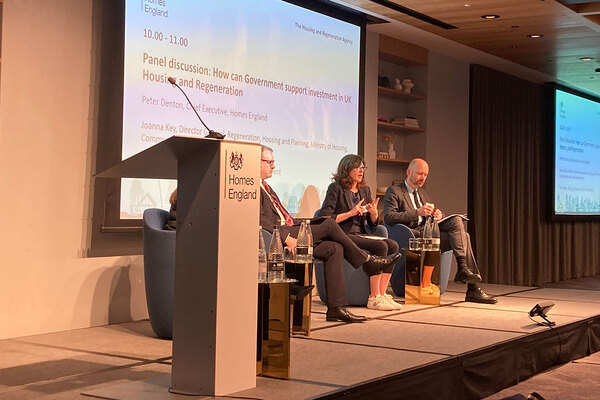
In November, Joanna Key, director general of regeneration, housing and planning at the Ministry of Housing, Communities and Local Government, outlined three things the government has to fix as part of its upcoming 10-year housing plan.
She said: “There’s been too many policy changes that have created a lot of uncertainty. There’s quite a lot of regulatory uncertainty [in] things like building remediation and other areas. And our partners lack the capacity to attract international investment.”
She said: “I’d like to give investors certainty, both in terms of policy and regulation, and make this investment in the housing market something that you could rely on. It will give you certain returns and will be a proper ethical investment.”

Related stories