ao link

You are viewing 1 of your 1 free articles

After more than 20 years of dispute, what will it take to regenerate the Carpenters Estate?

The regeneration of the Carpenters Estate is finally underway – more than 20 years since it was first proposed and more than a decade since it was the location of a headline-grabbing protest. Chaminda Jayanetti reports on the progress made, as part of Inside Housing’s Spotlight on Regeneration series

Linked InTwitterFacebookeCard
Aerial view of the Carpenters Estate in Stratford, east London
A decision to regenerate the Carpenters Estate in Stratford, east London, was first made in the early 2000s (picture: Alamy)
Sharelines

LinkedIn IHAfter 20 years of dispute, what will it take to regenerate the Carpenters Estate? #UKhousing

LinkedIn IHThe regeneration of the Carpenters Estate is finally underway – 25 years since it was first proposed. Chaminda Jayanetti reports on the progress made #UKhousing

The heart of the Carpenters Estate in Stratford, east London, is like an oasis: low-rise buildings and low-density development, surrounded in the near distance by tower blocks – some old, most new. This estate has been the site of one of England’s longest-running regeneration sagas, which now might have finally reached the beginning of the end.  

In the early 2000s, residents on the estate notified Newham Council of maintenance problems in the ageing buildings, which were built in the late 1960s and early ’70s. The council opted to initiate a regeneration of the whole estate, planning to demolish the three tower blocks. But more than two decades later, just 296 households occupy the estate’s 711 homes, with the tower blocks near empty.

Now, after more than 20 years of regeneration attempts that alienated residents and left the estate crumbling, work is finally underway – with the council insisting that this time, co-design is at the heart.


Read more

After 14 years of resident-led neighbourhood renewal in 150 areas, what is our legacy?After 14 years of resident-led neighbourhood renewal in 150 areas, what is our legacy?

Council tenant Adeel Nauyeck has lived on the estate for 30 years, including amid the uncertainty of delayed regeneration. He lived in the Dennison Point tower block on the estate, before being decanted to one of the maisonettes.

The Carpenters Estate came under the influence of the London Legacy Development Corporation (LLDC) after the capital was awarded the 2012 Olympics in 2005. Discussions started with University College London (UCL) to redevelop the estate, sparking protests from residents who feared that they would be pushed out for a new campus. They were even joined by UCL students and academics.

Mr Nauyeck says there were “terrible” levels of engagement from the council and the LLDC in the 2010s. “Everything was in neglect. Most of our green spaces, we had to chase the council to come and mow the grass, trim the trees. Most of the lights weren’t working.”  

In 2014, the estate hit national headlines thanks to a group of single mums who had been evicted from emergency accommodation in the borough and were facing relocation hundreds of miles from London. More than 400 flats on the Carpenters Estate had been sitting empty for years, but when the Focus E15 campaign group of mums investigated one block, they found the homes had running water, heating and electricity. Focus E15 and other campaigners then led an occupation of some of the empty flats in protest.

“Behind those boarded-up flats were actually decent places that people could have lived in with very little extra to do,” says Hannah Caller, a member of Focus E15, which organised the occupation.

Newham Council responded by moving 40 people into empty homes on the estate – although not the Focus E15 mothers, who were rehoused in private rented housing in the borough.  

Carpenters Estate residents came up with their own proposed masterplan that involved less rebuilding and more refurbishment, but these were ignored and resident steering groups were shut down. The UCL plans fell through in the face of opposition and the council started tendering for a private-sector joint venture partner instead.

New leadership and engagement reset

The turning point came in 2018. After 23 years as leader of Newham Council, Sir Robin Wales was replaced by Rokhsana Fiaz, who had campaigned on a platform of affordable housebuilding using council-owned land. Under Ms Fiaz, the council changed tack, ditching the joint venture plans and becoming the strategic master developer via its subsidiary, Populo Living.

“When I stepped in, there was a high degree of cynicism on the part of residents who had heard lots and lots and lots of plans for an incredibly long period of time,” Ms Fiaz recalls. “All I asked of those residents was, ‘Look, I can’t account for what happened in the past. I can account for what I’m promising.’”

Steering groups were set up to improve communication between the council and the estate’s residents and stakeholders.

A group of people releasing balloons outside one of the blocks on the estate
Focus E15 campaigners released balloons to represent the thousands of evicted and homeless people across London while homes on the Carpenters Estate sat empty (picture: Alamy)

“One of the drivers of the post-2018 reset under the current administration was this co-design, co-production process, and that remains pretty fundamental to the way the council’s approaching it,” says Darren Mackin, director of community wealth building at Newham Council.

“It is slow, it’s almost painfully slow at times,” he adds. “But I think it’s really important in these sorts of schemes.”

Mr Nauyeck sits on the steering group, which meets every month. “The architects call me and then they’ll talk about what the plans are. We’ll talk about things like letting policy [and] give some feedback on consultations that they will hold,” he says. 

When Populo Living started running engagement sessions with residents in September 2020, the Carpenters Estate neighbourhood forum wanted to keep as much of the existing housing stock as possible and maintain the distinct character in the development, explains Nick Clough, Carpenters project director at Populo Living.

Behind those boarded-up flats were actually decent places that people could have lived in with very little extra to do”

The new regeneration plan included keeping 40% of the estate’s existing homes, a lot of the streets and parks, and different neighbourhoods with their own character.

While the council wanted to densify the estate to increase homes, residents wanted to keep the low-rise nature of much of the housing – its ‘city-to-village’ feel, with green space and maisonettes at the heart of the estate and high-rise blocks around the outside. The compromise solution was to replace the central low-rise housing with mid-rise housing, gradually ramping up to the high-rise blocks at the edge of the estate.  

“If I’m still around when that is all done, then I’d be able to say, ‘We kept an eye on that and made sure that happened,’” Mr Nauyeck says.

CGI of the planned Carpenters Estate regeneration
A CGI of the planned Carpenters Estate regeneration, which has been co-designed with residents (picture: Proctor & Matthews)

Council town planners had also intended to bring people getting off at Stratford Station through the centre of the estate – until residents objected. They did not want West Ham supporters walking through the estate on the way to and from their home ground, the London Stadium (formerly the Olympic Stadium). The plans were then designed to divert visitors and fans down a high street with shops, keeping them away from the estate’s central park and play areas. 

“If you follow planning policy in a pure way, you don’t take in the heritage or people’s views, you end up with something relatively vanilla,” Mr Clough says. “So I think by doing genuine co-design, you end up with something that’s a little bit different.”  

The new plan was then put to a residents’ ballot in autumn 2021, around two decades after regeneration was first mooted. The result was revealed in December that year: 73% of votes were in favour, on a two-thirds turnout.

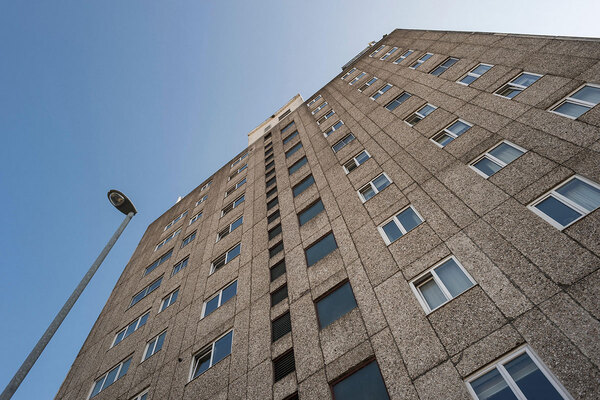
There are only about seven occupants left in the Dennison Point tower block, which is to be demolished. Two or three remain in the Lund Point block, which will be renovated. Many of the long-term residents who held out against earlier gentrification plans, who were in their 60s and 70s back then, have since passed away.

“I think working with the community from day one would be my biggest takeaway,” Mr Mackin says. “If you get it wrong, untangling it is extremely difficult.” 

Not smooth sailing

But approving the plans was only the beginning. “You couldn’t really have had to do a masterplan like this through a more difficult period,” Mr Clough says. 

The post-Grenfell second staircase rule meant some of the planned new lower-rise blocks had to be redesigned, which had knock-on effects on the roads and spacing around them.

Meanwhile, build costs rose around 30% since Mr Clough joined the project and the council’s estimated borrowing costs rose by two-thirds in two years. But as the regeneration is modelled on an equal split between social housing and build-to-rent at market rates, rising private rents in London cross-subsidise some of the increased build costs and maintain the scheme’s financial viability. 

As it stands, the Carpenters Estate regeneration is a 14-year programme to build or renovate 2,278 homes, with an estimated £1.5bn cost. Each delivery phase will contain both social housing and build-to-rent homes. The 50% proportion of social housing is lower than the 70% on the existing estate, but the total number – 1,081 social homes post-regeneration – will be much higher. 

The development will be tenure-blind. “We’re not putting the wealthy people on one street and the poorer people on another side,” Mr Clough states.

Lund Point on the Carpenters Estate with a new apartment building in the background
Lund Point on the Carpenters Estate in the foreground, which is set to be renovated, with a new apartment building in the background (picture: Alamy)

Work has started on retrofitting the James Riley Point tower block. However, as it is to be a decade before some of the final phases are due for completion, Populo Living is undertaking ‘meanwhile projects’ during the interim. These include two playgrounds, art trail murals and improvements to the estate entrance from the station.

Another project will turn the estate’s tenant management office into a community centre and events space, as well as convert garages into retail incubator spaces. 

Mr Clough says there is also a commercial purpose to these projects. “We’re delivering 50% social rent, and to do that we’ve got to rent out the private [homes] to pay for it. So if we don’t start changing the image [of the estate] and promoting it as a place to live, you won’t get the rents you need to be able to pay for it.”

There is enduring resistance to the regeneration from some of the estate’s leaseholders and freeholders, particularly landlords, based on how much the council will pay them under compulsory purchase orders. “Their concern is quite often, ‘Well, I’ll get that and yes I get an additional payment, but unless I’m very lucky, I’m not sure that that’s going to buy something equivalent in Stratford,’” Mr Mackin says. 

If you follow planning policy in a pure way, you don’t take in the heritage or people’s views, you end up with something relatively vanilla”

Ms Caller of Focus E15 is also sceptical about whether the 50% social housing commitment will be honoured. “Surely we know from looking around London that that’s not what’s going to happen. They’re going to just reduce and reduce and reduce the amount of social housing as far as they can,” she says.

Ms Fiaz is stepping down as mayor of Newham this year. Labour’s candidate to replace her is Forhad Hussain, who previously served in Sir Robin’s cabinet. Mr Hussain did not respond to Inside Housing’s request for comment, but Populo Living says that now the outline masterplan has secured planning approval, the social housing commitments would be very hard to renegotiate.  

A model for London regeneration? 

So why is the Carpenters Estate scheme progressing, when so much development across London is not? Just 1,239 affordable homes funded by the Greater London Authority were started in the first six months of 2025-26, compared with 25,658 in the full year of 2022-23.

Having prime location with good transport links drives up the potential cross-subsidy via private rents and commercial leases. Both Mr Mackin and Mr Clough point to the economic advantages of using council-owned land to bring down costs, with no private developer involved, enabling more social housing in lieu of profit.

“It’s quite controversial, certainly for private developers, because it shines a light on where that profit is going,” Mr Clough says. “It will demonstrate that if you go into a JV [joint venture], you’re giving quite a lot away.” 

Mr Clough says that if the government wants to see more projects such as the Carpenters Estate succeed, there need to be more robust programmes of funding.

“There are many small funds that just aren’t helpful ultimately, as they are time-consuming and come with conflicting requirements and deadlines,” he says. “What’s needed is not free money, but access to borrowing at decent rates that supports long-term commitments to spending and offers certainty for these regeneration projects.”


Sign up to Inside Housing’s Best of In-Depth newsletter


Sign up to Inside Housing’s Best of In-Depth newsletter, a weekly compilation of our best features and comment.

Click here to register and receive the Best of In-Depth newsletter straight to your inbox.

And subscribe to Inside Housing by clicking here.

Already have an account? Click here to manage your newsletters.

Linked InTwitterFacebookeCard
Add New Comment
You must be logged in to comment.