Brown opens the door for councils
In a last-ditch bid to save the UK from the worst ravages of recession, Gordon Brown has said that nothing will obstruct councils’ efforts to build more homes. Emily Rogers and Crispin Dowler examine the story behind the prime minister’s historic pledge - and its implications


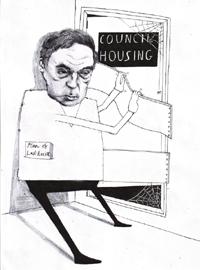
The prime minister dusted down the cobwebs and unlocked the door to council housing development departments last week.
After decades of decline in council house building to just 250 in 2006/07, Gordon Brown indicated in a speech at a New Local Government Network event last week that local authorities were now seen as an important part of the government’s development plans.

Source: Talya Baldwin/Illustration Ltd
But while he has used warm words before, Mr Brown suggested that this time the government was prepared to greet the idea of councils building a new generation of homes with more than a thin smile.
Indeed, councils that wanted to build more homes in a sustainable way were assured that the government would in future sweep aside ‘anything that stands in their way’.
Strong words, which largely caught the social housing world by surprise.
‘It struck me as a typical example of Number 10 making policy on the hoof and everyone else struggling to catch up,’ said one senior source.
But, despite appearances, Mr Brown’s announcement didn’t appear from a vacuum.
Inside Housing examines the story behind Mr Brown’s new plan and the key questions that councils and campaigners still want to see answered on potentially one of the most radical housing policy shifts since Margaret Thatcher introduced the right to buy in 1980.
What led to the prime minister’s announcement?
The Labour Party’s reluctance to give councils freedom to build and refurbish homes saw it defeated on its housing policy for three consecutive years at its annual conference between 2004 and 2006.
The pressure from members ultimately forced the government to set up a working group to look at new ways of funding council housing.
Daniel Zeichner, a member of the group, said last week: ‘The whole thrust of our work over the last few years has been to get to this position.’
Influential left-wingers, most noteably former deputy leadership hopeful Jon Cruddas, have also played a strong role in applying pressure.
Mr Cruddas reportedly turned down the role of housing minister last year after making it clear he wanted a radical move forward in council housing investment.
Mr Cruddas said this week that he was now ‘quite happy with the way the government has begun to change tack’.
An ongoing review of the entire housing subsidy system, being carried out by the Treasury and the Communities and Local Government department, has also played its part. Members of the review team, which includes councils, arm’s-length management organisations and housing finance consultants, have examined practical ways that councils could opt out of the subsidy system – effectively freeing them up to manage their finances directly and keep hold of rent money that is currently siphoned off by the Treasury.
Finally, Mr Brown admitted that good, old-fashioned desperation has played a part and that ‘old arguments and ideologies’ needed to be swept away to meet housing and employment needs in the current recession.
What are the implications of Mr Brown’s words?
Mr Brown’s speech thrust the spotlight onto councils and demanded they state clearly what obstacles have been stopping them from building.
Chris Leslie, director of the NLGN, said he saw Mr Brown’s announcement as the start of a huge test for councils. ‘Although I think elected members are enthusiastic, I think the machinery [of council-led house building] has been made dormant,’ he said.
Mr Zeichner added: ‘The ball is in councils’ courts now.’
Mike Owen, chief executive of ALMO Carrick Housing and a contributor to the housing finance review, said it appeared Mr Brown had also recognised that councils could deliver more homes if they were allowed to opt out of the current subsidy system and manage their own housing revenue accounts. The speech could pave the way for some councils to leave the system and start building homes this year, he suggested.
Ministers are also understood to be receptive to the idea of councils pooling their reserves to create a kind of mutual bank to fund build projects.
Are there any confirmed changes in store?
The Homes and Communities Agency, which funds new housing, indicated this week that Mr Brown’s speech heralded the introduction of a new grant regime for councils.
HCA chief executive Sir Bob Kerslake said that even if they could opt out of the current subsidy system, existing rules would make it difficult for councils to access grant.
The problem is that the HCA has been forced to treat money councils borrowed to build homes, on top of grant, as public subsidy. If a housing association bids only the grant is counted as public subsidy, making council schemes more expensive to the public purse.
Sir Bob said that he wouldn’t prejudge whether Mr Brown’s speech meant council borrowing would no longer count as public subsidy, but he added that ‘the signs are positive’ and that local authorities should ‘start to prepare now’.
What obstacles do councils want the government to remove from their path?
The review of housing finance is the big game in town here.
The Local Government Association argues that freedoms to allow councils to keep rental income from new homes, announced by housing minister Margaret Beckett last month, don’t go far enough.
The association wants councils to be allowed to keep ‘every last penny’ generated from all housing, not just new build, and for the right to be automatic, rather than just for specially applied-for schemes. It also wants freedom from existing borrowing rules, a spokesperson added.
What happens next?
April is likely to bring much more detail. That is when the review of housing finance is due to report and consultation closes on Mrs Beckett’s earlier proposals.
Most people are agreed on one thing: that the government can’t afford to mull things over for long. Labour party treasurer Jack Dromey said: ‘The government has been moving for some time in the right direction but not, until now, far enough or fast enough.’
Those were the days…
The last time there was a net increase in council homes was 1980.
- English councils made a net gain of 72,510 homes in 1980, by building 74,840 homes that year and selling just 2,330 through recently elected prime minister Margaret Thatcher’s new right to buy scheme.
Other defining moments of 1980:
- Ronald Reagan elected US president.
- John Lennon shot dead in New York.
- The Rubik’s Cube voted toy of the year.
- The world waits with baited breath to see who shot JR in TV series Dallas.


Related stories