You are viewing 1 of your 1 free articles
Five years and counting: new data exposes the reality of families trapped long-term in temporary accommodation
Newly published government figures shed light on the number of households in temporary accommodation for five or more years. Katharine Swindells analyses the data, to show the scale of the not-so-temporary accommodation crisis


 Newly published government figures shed light on the number of households in temporary accommodation for five or more years. Katharine Swindells analyses the data, to show the scale of the not-so-temporary accommodation crisis #UKhousing
Sammy Ward was terrified when she found out she was going to be evicted. A single mum with four children aged between one and seven, she knew there was no way she would be able to afford another private rented flat, so she was relieved when Enfield Council said she had been accepted for temporary accommodation and could begin bidding for a social home.
The temporary accommodation placement was in Basildon, far away from Ms Ward’s network of friends and family. She struggles with seizures, and this network supports her with childcare when she is recovering. But the house the council offered was larger than her flat had been, and it was only temporary, right? This was in 2016.
Read more
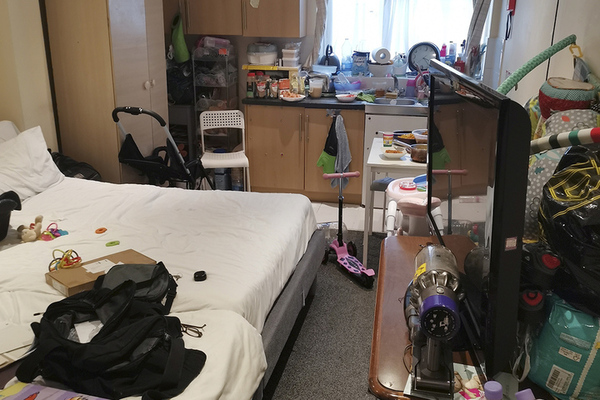
“I found it hard to dedicate myself to one job, because I never knew when we were going to get kicked out of here,” she says. “In my mind, I was always like, we’re going to be moving back to Enfield. But they’ve just left us here.”
Ms Ward is far from alone. Enfield Council has placed nearly 1,200 households in temporary accommodation for five or more years. These findings come from newly published government data, which Inside Housing has analysed to show the scale of the not-so-temporary accommodation crisis.
This new data comes following Inside Housing’s ongoing work to shed light on young children in temporary accommodation. The government has started publishing a new quarterly dataset, providing more detail on the ages of children in temporary accommodation, the types of temporary accommodation they are in, and how long they have been there.
Councils are required to provide temporary accommodation to homeless households that have children, are in some way ‘vulnerable’ (for example for medical or disability reasons), or are victims of domestic violence.
Across England, a fifth of households in temporary accommodation have been there for five or more years. A large proportion of these are families with children, 18,650 of which have been in temporary accommodation for five or more years.

Looking more closely at the data, you can see how many households have been living long-term in B&Bs or hostels, the type of accommodation that is the least suitable as it often doesn’t have a private kitchen or bathroom.
In London, the centre of the crisis, one in 12 families (8%) in B&Bs or hotels with children have been in temporary accommodation for five or more years: 300 families.
Experts working with families in this kind of accommodation highlight the damage caused by not having space to crawl and play, and the impact of poor nutrition caused by lack of access to a kitchen, causing conditions such as scurvy.

“The first 1,001 days of a child’s life are the most important for their development,” says Isabel Kaner, policy and campaigns officer at the Shared Health Foundation. “The government’s got a target of having 75% of kids to be school-ready by 2028. But that’s never going to happen when you’ve got kids growing up in B&Bs for years.”
“The capital’s homelessness emergency means that far too many Londoners find themselves in temporary accommodation – and for far too long,” says Grace Williams, executive member for housing and regeneration at London Councils. “It is hugely upsetting, especially when so many children are homeless. We know this can have serious consequences for their health, education and employment prospects.”
She adds: “These prolonged placements in temporary accommodation are in absolutely no one’s interests. The skyrocketing costs of providing temporary accommodation in the capital are the fastest-growing risk to boroughs’ finances and are pushing many towards bankruptcy. Boroughs are doing their utmost to move homeless families out of temporary accommodation as fast as possible, but the severe shortage of affordable housing makes this extremely challenging.”
In situations like Ms Ward’s, although the accommodation is not as unsuitable as a B&B, Ms Kaner says they still see a significant impact on children’s mental health. “Their parents are panicking because they’re left in limbo about their housing application and when they’re going to be put somewhere permanent. Kids absorb that stress, and then that affects them for years.”
Ms Kaner also highlights the damage to children caused by out-of-borough placements when it comes to accessing mental health and special educational needs services, or the NHS. “If they have been moved out of area, they’re more likely to fall off support systems. When they move, they often get dropped off the waiting list or out of having appointments. So getting support that they need is also impossible, adding to their stress.”
After four years living in Basildon, with no word from the council and never placing more than 600th on the bidding list, Ms Ward finally realised Basildon was her home. The children had made friends at school, Ms Ward got a job as a youth support worker, and they decorated the house.
“Because we’ve been here for so long, we’ve made this a home,” she says. “I’ve not sat down and explained to the kids ‘this is only temporary’, because once we got past four years, I thought we were here for good.”
“These prolonged placements in temporary accommodation are in absolutely no one’s interests. The skyrocketing costs of providing temporary accommodation in the capital are the fastest-growing risk to boroughs’ finances and are pushing many towards bankruptcy”
In March this year, after nine years, they found out they were being evicted by the private landlord of the temporary accommodation. Enfield Council decided Ms Ward had to find a private rented home, something she is appealing. And even if the council does agree to place her in different temporary accommodation, Enfield says it could be anywhere within a 75-minute radius of her eldest daughter’s school. Ms Ward has tried to join Basildon’s homelessness register, to try to stay closer to their home, but it has refused.
“It breaks my heart watching my kids cry. My son had a meltdown the other day because he doesn’t want to pack up his room. He doesn’t understand that we have to leave,” she says. “I’ve become so stressed out since March that I started having seizures again. I’ve never had that many in my whole life. I’m just trying to get a stable council property. My children deserve stability.”
Enfield did not respond to Inside Housing’s request for comment.
A spokesperson for Basildon Council says: “Every local authority operates a different allocations policy, which would make transferring of housing applications problematic. This is a question for Enfield to comment on – they are the authority who placed the household in temporary accommodation out of borough for five-plus years, advised the household to move into the private sector, and apparently advised about further temporary accommodation placements.
“The question as to what support is available is [for] Enfield Council to answer. If Enfield have an ongoing temporary accommodation or other accommodation duty towards the family, then they are required to ensure they discharge this through one of the set methods.”

Ms Kaner says that the new detailed government data on temporary accommodation is crucial for campaigners. “Half our battle is that there actually isn’t a huge amount of data out there. So when we’re trying to argue for policy change and stuff… we can’t actually get anything changed to help these kids without having some sort of evidential basis for it.”
Newham in east London has England’s highest number of households that have been in temporary accommodation for five or more years.
Amar Virdee, cabinet member for housing needs, homelessness and private rented sector, says: “Newham, more than any other council in the country, has faced – and continues to face – a very high number of residents presenting themselves as homeless. To that end, our housing team have been at the forefront of producing effective solutions to find ways to handle cases, diverting many people away from temporary housing.
“But a combination of fewer properties available to rent, increased demand for housing within Newham from bodies that are outside of the borough, a reduction in council homes as a result of Right to Buy, the increased cost of renting, has meant continued pressure on the service. Added to all this is the fact that the most obvious solution, to build more homes, is both a slow and costly process.”
A Haringey Council spokesperson said: “Like every London borough facing the on-going housing crisis, a combination of right-to-buy and a shortage of social housing (increasing private accommodation rents) has left us with insufficient settled accommodation of our own to offer, particularly family-sized homes."
"We cannot stress enough the enormity of the challenge in finding suitable homes for all our residents facing homelessness. In response, we have an extensive housing strategy to address both the rising demand and shrinking supply. The road ahead is challenging, but we remain committed to ensuring every resident in Haringey has access to a safe, secure, and permanent home.”
An Ealing Council spokesperson says: “Like many other councils, Ealing is facing unprecedented demand for temporary accommodation, driven by a national housing crisis and a steep rise in homelessness.”
“We’ve worked hard to move families out of unsuitable hotels and into more appropriate placements, including private sector leased homes and permanent housing. We know B&Bs are not suitable for long-term stays; they often lack kitchens and have shared facilities, and we are committed to reducing their use. But the scale of the crisis means that even councils with strong records on homelessness prevention are being forced to rely on expensive and unsuitable options.”
“We have a number of programmes in place to improve the quality of accommodation and the lives of those in temporary housing. In 2024-25, we spent £29.4m to support households in temporary accommodation, a reflection of both the scale of the challenge and our commitment to addressing it. Alongside this, we continue to bring empty council homes back into use and deliver one of London’s largest council homebuilding programmes.”
Other recent longform articles by Katharine Swindells
The yimby council leader in London who still lives with his mum
As Greenwich embarks on a programme of regeneration and development, Katharine Swindells talks to Anthony Okereke, leader of the borough, about how the council is tackling homelessness, rogue developers and nimbys
How Croydon Council got its regulatory notice lifted
Four years ago, the disrepair at Croydon’s Regina Road Estate shocked ITV viewers and led to regulatory intervention. The council has improved services, but the journey back to compliance was not simple. Katharine Swindells reports
How many toddlers and babies are living in temporary accommodation in the UK?
The government does not publish data on the numbers of young children in temporary accommodation, despite evidence that it has highly damaging impacts on child development and well-being. This live data dashboard uses Freedom of Information requests to track the numbers of under-fives living in temporary accommodation and B&Bs. Katharine Swindells reports
Lessons from a London council that drastically reduced the number of children housed in B&Bs
Inside Housing’s data dashboard shows that Greenwich reduced the number of young children staying in B&Bs by over 90% between September and December 2024. Katharine Swindells speaks to the local authority to find out how it did it
Sign up for our homelessness bulletin

Already have an account? Click here to manage your newsletters
Related stories