KHT: ‘We have cut through red tape’
‘It was about removing red tape and the regulatory burden. We were finding that everything we wanted to do which was different or new we were having to wrap up in regulation. The number of hoops we needed to jump through was holding us back,’ says Bob Taylor, chief executive of Knowsley Housing Trust in Merseyside.


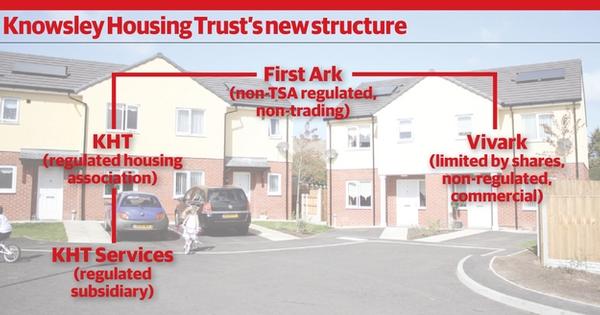

Mr Taylor is talking about KHT’s groundbreaking move to form a non-registered parent company, which took over the housing association last November. The move was a sector first following rule changes introduced by the Tenant Services Authority’s regulatory framework introduced in April 2010.
The parent, First Ark, was formed as a non-registered, not-for-profit company to oversee KHT’s strategy and focus on ensuring value for money. An unregulated, non-charitable trading arm called Vivark was also set up to carry out non-social housing activities, such as providing environmental improvements for other organisations and attract private finance by issuing share capital. ‘We’ve talked with a private sector organisation about how it might come in and provide the working capital and the finance and take a stake in the company,’ says Mr Taylor, who declines to provide further details.
Mr Taylor, who has worked for KHT since its stock transfered from Knowsley Council in 2002, says the association wants to expand its non-core activities, providing more financial advice to tenants, green improvements and sharing services, such as repairs, with other organisations including health trusts and local authorities. Mr Taylor says First Ark allows the opportunity to enter into joint ventures and partnerships with other organisations more quickly. ‘We want to create a group which is a social enterprise which includes a landlord, rather than a landlord with a few extras,’ he says.
Avoiding the Tenant Services Authority’s regulatory framework, diversifying and attracting new sources of finance were motivations for establishing First Ark, but Mr Taylor says it has other advantages.
The structural overhaul swept away managerial committees, merged services and cut 75 jobs saving £700,000 a year - £21 million over the course of KHT’s 30-year business plan. First Ark will let KHT’s board and area boards including tenant representatives focus on providing housing to the local community. ‘Instead of saying we want to be in control of everything, we understand the business needs to grow but we also need to concentrate on Knowsley and the community.’
The KHT model relies on the commercial subsidiary making a profit to cross-subsidise its social housing, which could leave the association more exposed to market conditions. There is also scepticism in the sector about whether KHT’s approach allows it to do substantially more than landlords without non-registered parent companies.
James Tickell, director of consultancy Campell Tickell, says: ‘A number of our clients have been looking at setting up non-registered parent companies but as yet the business case has not been overwhelming, they will be looking at Knowsley carefully to see what they will get out of it.’
One of the biggest challenges for KHT, along with many landlords in the north, is how to make the government’s affordable rent programme pay.
In all but small pockets of KHT’s patch, social rents are close to or identical to rents at up to 80 per cent of the market rate, says Mr Taylor, meaning the increased rental income is unlikely to increase the group’s borrowing capacity much.
Instead, KHT is using land as the ‘cornerstone’ of its bid for development grant. KHT had 18,000 homes when it formed but has sold off or demolished old stock leaving it with 13,387. The demolitions left land it can use for development at no extra cost. Mr Taylor hopes the land, along with a refinancing package agreed with lenders which has brought in an extra £40 million of borrowing, and government grant will allow KHT to build 500 homes by 2015. This is less than the average of 150 to 200 built annually by KHT over the past four years.
Mr Taylor’s plans to grow through sharing services with other organisations move closer to reality if an application by three midlands housing associations to gain VAT exemptions on shared services is successful. Bromford, Orbit and Midland Heart are currently trying to persuade the taxman that this should happen.
Doing the right thing is very much the focus of KHT’s restructure, says Mr Taylor. Perhaps mindful of possible concern about the use of non-TSA regulated organisations, he says: ‘I’m adamant that in five or 10 years this kind of structure will become normal. Otherwise, all the extra things that we can do to help people will either not be done at all, or done by a bunch of private sector outfits whose sole intention is to make money.’
In numbers: Knowsley Housing Trust
£56.12 million
turnover 2011
£3.75 million
surplus 2011
13,387
number of homes
£160 million
current borrowing
£200 million
expected borrowing by 2013

Related stories