Homes England director addresses concerns around SAHP annual profiles as CEO predicts ‘real slowing down’ in delivery
Homes England’s director of affordable housing has responded to concerns about grant funding availability and annual drawdown constraints, as Karbon Homes’ chief executive predicted a “real slowing down” in delivery as a result.


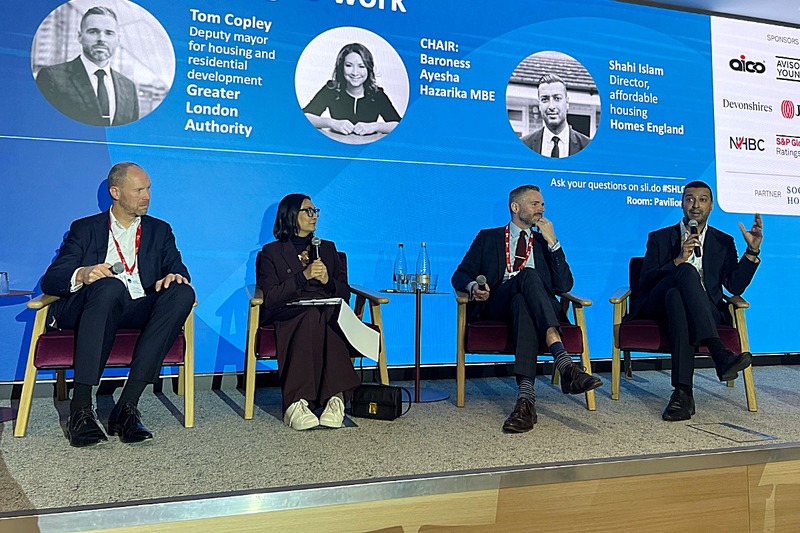 Homes England’s director of affordable housing has responded to concerns about grant funding availability and annual drawdown constraints, as Karbon Homes’ chief executive predicted a “real slowing down” in delivery as a result
At the Social Housing Leaders conference in London yesterday, sector leaders discussed the impact of budget pressures in the Social and Affordable Homes Programme (SAHP) on the speed of delivery.
Paul Fiddaman, chief executive of Karbon Homes, said Homes for the North, an alliance of 18 housing associations, bid for roughly 48,000 homes under the SAHP, but received funding for only 27,000. He also pointed to the “constraints” on Homes England’s continuous market engagement (CME) process over the next two to three years.
“So what I guess we’re going to experience is a real slowing down in the delivery of affordable homes at a time when we need much, much more,” he told the conference.
Read more


On an earlier panel, Shahi Islam, director of affordable housing at Homes England, said the “huge pipeline” brought forward by providers, against a backdrop of “competing budget pressures”, meant the government’s housing agency had had to introduce “priority criteria” for assessing bids as fairly as possible.
“The pipeline is so huge that we’ve had to make difficult choices as to what we can fund and when,” he added.
But Mr Islam defended the government and Homes England’s ask to providers to reprofile their grant drawdown in light of “annual budget pressures”.
He said: “I will defend some of that annual budget profile piece because, rightfully so, the government wants to make sure that when we deploy grant funding, protection is in place to make sure that we’re not just giving out grant funding and then delivery comes through as well.”
The CME process is experiencing huge demand, Mr Islam said, due to bids coming in from strategic partnership bidders who missed out as well as local authorities, as a result of prime minister Andy Burnham’s push for a council housebuilding revival.
Sector leaders recently raised concerns about the lack of funding available under CME and the risk of smaller providers being “crowded out”.
In a question to the panel, one audience member said: “Regional managers have advised significantly early cashflow constraints for CME. Contracts requiring grants in the next 12 to 24 months will really struggle.”
In light of this, Mr Islam was asked how Homes England was “lobbying” the government to “reprofile cashflow” of SAHP grant.
In response, Mr Islam said the agency was “working closely” with the Ministry of Housing, Communities and Local Government (MHCLG) on the annual profiles.
He said MHCLG did “understand the budget pressures that we’re facing at the moment” and had “visibility on the pipeline and the pressures”.
Mr Islam also said Homes England was working with MHCLG “around whether they can access additional funding in-year”.
On CME funding, he said the agency was trying to give grant certainty to partners so they can start on site this year, while moving their profiles into the following year.
“That gives them grant certainty. They can cash flow this financial year and then draw down the grant next year as well. So there are a number of programme management tools we’ve introduced to help partners access CME despite the budget pressures that we’re facing,” Mr Islam said.
In London, providers have raised concerns about SAHP allocations from the Greater London Authority (GLA). In October, Inside Housing reported that a significant number of landlords had only been granted 40% of what they bid for.
Providers have received their grant offers and responded, but the GLA is yet to publish the final allocations.
Speaking on the same panel as Mr Fiddaman, Ian McDermott, chief executive of Peabody and chair of the G15 group of large London landlords, urged the GLA to speed up publication. He said SAHP allocations had been “an enormous frustration”.
Mr McDermott said: “We still don’t know what others have been allocated, and that’s a problem because… we want to talk to local authorities if they have the money and we have the sites about how we might work in partnership.
“We can’t do that until we have visibility of what the allocation is. So speeding up the process that’s already happening is really important.”
At the HOMES UK conference this week, Tom Copley, deputy mayor of London for housing and residential development, assured providers that the full grant allocations would be confirmed before Christmas, but could not give an exact date.
Mr McDermott also criticised the process for being “very heavily influenced by procurement rules” rather than speed of delivery.
He said: “If you’re simply not targeting the sites that are underwater at the moment, the ones that are shovel-ready and that are ready to go, if those aren’t being targeted and you’re worrying more about fair and transparent allocation, actually, you’re not going to get the capital building.
“You’re not going to get anybody building. So just make sure we learn that lesson with the next round of CME.”
Sign up to Inside Housing’s Development and Finance newsletter
Sign up to Inside Housing’s weekly Development and Finance newsletter, featuring a round-up of business, development and regeneration news and analysis.
Already have an account? Click here to manage your newsletters.
Related stories