You are viewing 1 of your 1 free articles
RBKC had no humanitarian lead for disaster after senior officers branded themselves ‘too busy’, Grenfell inquiry hears
The Royal Borough of Kensington and Chelsea had no one in a “pivotal” leadership role for its humanitarian response at the time of the Grenfell Tower fire, after senior directors branded themselves “too busy” to take on the responsibility, the inquiry heard today.


 RBKC executive directors who were ‘too busy’ to take on humanitarian role fed into poor response to Grenfell fire #UKhousing
 The council’s head emergency planner today said he was “gobsmacked” and “knocked for six” by the comments, which left the council without a manager to co-ordinate the response. He accepted the council was “ill-prepared” to respond to a disaster as a result.
The inquiry also heard RBKC had a third of the number of managers believed necessary to implement its emergency plan. A longstanding reliance on asking staff to volunteer for the roles undermined its ability to fill them.
The inquiry, which is investigating the chaotic response in the days after the fire in June 2017, previously heard that RBKC’s response “collapsed”, with bereaved relatives and survivors who had fled the tower abandoned without support or information.
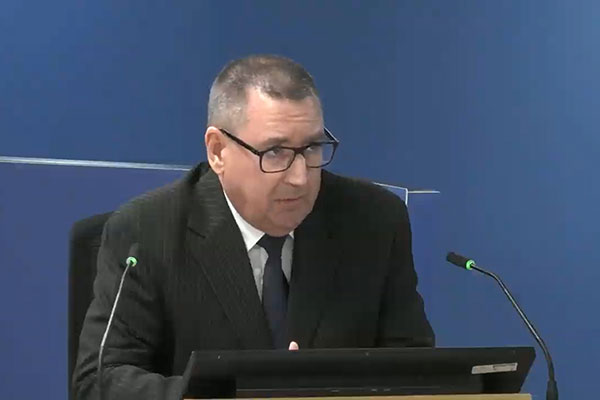
David Kerry, the council’s former contingency – or emergency – planning manager, was giving evidence about why the council did not have a humanitarian assistance lead officer (HALO) at the time of the fire, something he accepted was a “significant deficiency”.
Mr Kerry, who held the contingency planning role between October 2005 and September 2019, had carried out an assessment of the council’s compliance with London-wide standards for emergency planning in 2016.
This revealed that there was no HALO at the council, a role that involves bringing together organisations such as the police and the voluntary sector to oversee the humanitarian response. It is usually filled by a director responsible for adult social care.
Richard Millett QC, lead counsel to the inquiry, asked Mr Kerry if he agreed that the HALO role was a “pivotal one” in the event of a significant emergency such as the Grenfell fire. Mr Kerry agreed.
He said he had “met with... the then executive directors of the departments that dealt with adult social care or with children’s services, and talked to them about this”.
“I’m afraid the response from them was less than satisfactory,” he said. “The response from one was, after we finished speaking, ‘But isn’t there somebody else who can do this, such as the British Red Cross’, and the response from the other was, ‘The chief executive needs to understand we are very, very busy as executive directors and it really is too much to ask us to take on these extra roles’.”
Mr Kerry identified the two directors as Jean Daintith and Anne Marie Carrie.
“To say that we were gobsmacked would be an understatement … we had a conversation for a while and got absolutely nowhere and that was the end of that meeting.
“But I’m afraid, at that point, that rather knocked us for six. I don’t think we ever recovered from that,” he said.
Mr Millett asked: “So cutting to the chase, does this mean that there was no effective HALO arrangement or operational capability or plan for a HALO arrangement at the time of the Grenfell Tower fire?”
Mr Kerry said “no”, adding, “We would have relied on the London framework … and mutual aid for that”.
“Is it fair to say that, leading up to June 2017, the absence of an operational HALO appointment was a significant deficiency in RBKC’s ability to deal with not just the aftermath of the Grenfell Tower fire, but any serious emergency?” Mr Millett asked.
“I think I would agree with that statement, yes,” Mr Kerry said.
Read more
The inquiry also heard that the number of ‘council silver’ staff was fewer than a third of what it should be at the time of the fire.
Gold/silver/bronze is command terminology used by many agencies in response to an emergency in the UK.
The gold group covers strategy, while the silver group covers implementation of the strategy, and the bronze, also known as ‘operational’, refers to the people carrying out the plan.
Council gold is usually the chief executive of a local authority, supported by executive directors.
Council silver would usually be the staff responsible for ensuring that the organisation is responding to the incident through the strategy, and is made up of senior managers.
The council’s Borough Emergency Control Centre (BECC) supports the silver group to coordinate and manage the response to a major emergency or “significant business continuity disruption”.
The BECC is staffed by council employees who are volunteers, called incident response officers.
A report, produced by Mr Kerry for the council’s management board in October 2014, identified a “significant shortfall” in the number of trained volunteer emergency management staff.
“Traditional recruitment methods no longer generate new volunteers.
“Demands from the ‘day job’ are curtailing attendance at required training sessions and emergency exercises. Support is now sought from executive directors,” it said.
Mr Kerry said in the report that a minimum of 10 members are required for the silver team, while there must be a minimum of 20 incident response officers.
The report went on to state the number of borough silver staff was three, and would soon reduce to two. The number of incident response officers was 10.
In comparison, neighbouring Hammersmith and Fulham Council had eight borough silver and 20 incident response officers.
The inquiry heard that, in response, Nicholas Holgate, the council’s chief executive, suggested that trained staff from Hammersmith and Fulham could be approached to cover RBKC, but still suggested recruiting fewer staff than Mr Kerry had said was required.
Asked about this, Mr Kerry said he could not remember being in the meeting.
“It had been the philosophy at RBKC for as long as I was there... to seek volunteers for these roles,” he said.
He said he had produced other reports expressing the “same concerns and considerations”.
“I think, at this time, I was actually asking for consideration about nominating individuals, making it part of their job to get the numbers up.
“But that was not how RBKC was doing it. And to be fair, that wasn’t how most councils did it.
“Most councils relied on volunteers as well. It wasn’t working and I said so. But that was the decision,” Mr Kerry said.
The inquiry heard that, in 2018, a year after the fire, the council was still using the volunteer system.
Mr Kerry said “even after Grenfell” it took a while to get the number of staff sorted, “because it was still volunteers”.
“We had an incident one Saturday where we only just got away with it and I put in a report then. I very bluntly said we were at risk of failure … and we need to do something. At that point the board coughed up some money.
“So we had the authority by the time I left to get people in positions, on rotas, with a fee for that,” he said.
Pressed further on the incident, Mr Kerry explained it was a fire that cut the water and electricity supplies to a block of flats in Chelsea.
He said they kept getting “answer phone after answer phone after answer phone” as they tried to contact the list of volunteers. “It was Saturday,” he said.
However, he said the need for support was so small it did not become a problem.
Mr Millett later summarised the problems with contingency planning at the council before the Grenfell Tower fire as a lack of sufficiently trained staff, the adequacy of the training exercises, lack of a HALO, and problems identifying vulnerable people.
“Looking at all of those things in the round, do you accept that, at the time of the Grenfell Tower fire, RBKC was ill-prepared to meet its duty as a category-one responder in a major emergency?”
“Having heard all of this, I’m not in a position to say anything other than yes,” Mr Kerry said.
He put it down to “lack of corporate management support” for the issue of staffing and training.
“We did what we could with what we had, but limited with perhaps lack of corporate management action and lack of management scrutiny….
“Put that in the bigger picture of 33 boroughs all trying to do some of these things 33 ways at the time, I would suggest there is something systemically wrong there in terms of the capital city’s municipal resource being fragmented in that way…
“I think that’s probably still the case today, frankly,” Mr Kerry said.
He added: “If you take the combination of our limitations as individuals, the limitations of the management support … it paints a very unpretty picture.
“I will take responsibility for certain parts, but I will say the authority should take responsibility for others... My name was on the door, but I wasn’t the key decision-maker on some of these matters.
“All I can say is – to the people of Kensington – I am painfully aware the authority could and should have done better on the day.
“I still stand by the fact that this was an incident that was far bigger than any one local authority in London could deal with.”
The inquiry will continue to hear evidence from Mr Kerry tomorrow.
Sign up for our weekly Grenfell Inquiry newsletter
Each week we send out a newsletter rounding up the key news from the Grenfell Inquiry, along with the headlines from the week
Already have an account? Click here to manage your newsletters
Related stories