



‘Tilt’ towards council housebuilding will not lead to ‘demise’ of housing associations, Rayner says
The government’s “tilt” towards council housebuilding should not lead to the “demise” of housing associations, housing secretary Angela Rayner has told MPs.


 The government’s “tilt” towards council housebuilding should not lead to the “demise” of housing associations, housing secretary Angela Rayner has told MPs #UKhousing
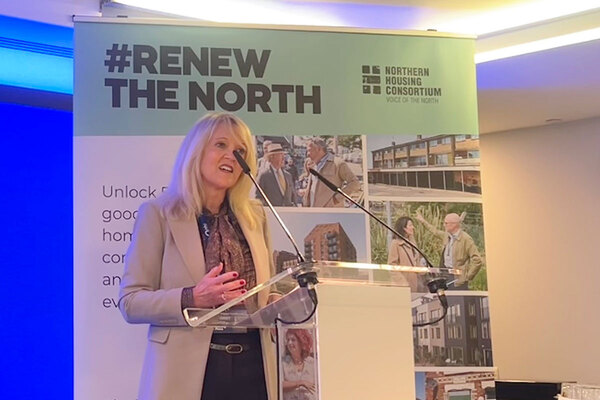
Speaking to the Housing, Communities and Local Government committee this morning, Ms Rayner argued she had “eliminated the risk” of slower overall housing delivery as a result of focusing more heavily on councils.
She also suggested that the government was aiming to boost the delivery of social rent homes from all providers, not just councils.
Ms Rayner said prime minister Andy Burnham’s commitment to return to post-war levels of council housing delivery was not a “change of policy”.
“What I would say is it’s been tilted more heavily towards supporting councils in building the council homes that they need,” she told the cross-party committee.
Andrew Cooper, MP for Mid Cheshire, said there was an “understandable level of concern around uncertainty” in the social housing sector about the government’s council housebuilding push. He asked whether there was a risk that tilting “too much towards council housing” would slow delivery.
In response, Ms Rayner said: “That would be a risk, and that’s why I’ve eliminated that risk.
Read more


“If you saw the allocations that were given from the £10bn that I announced in [my current tenure] to social housing, a lot of it went to social housing providers.
“We recognise that social rent is the most crucial thing... and therefore housing associations make a vital contribution.”
Ms Rayner recognised that some councils do not have sufficient capacity or funding to build, but said there was “a lot of appetite out there”.
She added: “I wouldn’t say that our programme for council housebuilding is at the demise or disadvantage of social housing providers, because actually we’re not building enough.
“We delivered over 10,572 homes last year, which was the biggest amount since records began in the early 1990s. But we know we need to ramp that up.”
When asked what she was doing to tackle housebuilding viability issues, Ms Rayner suggested the government was focused on stimulating the social rented sector.
“It’s been this tilt moving towards the social rented sector for building homes, so we’re filling in a bit of a gap to what’s starting to appear because of the global economic situation we face,” she said.
On the private housing market, she said developers would only build “if there is demand for it”, but added, “the biggest demand that we see at the moment actually is in the social rent sector”.
The National Housing Federation (NHF) welcomed Ms Rayner’s recognition of the “vital role of housing associations in meeting the government’s housing ambitions”.
Will Jeffwitz, head of policy at the NHF, told Inside Housing: “Solving our housing crisis and delivering a generational boost in new social homes will only be achieved through councils and housing associations working in partnership.”
He added: “Alongside needing clarity on [continuous market engagement] funding for individual schemes, an increase in the level of grant funding available at the next Spending Review will unlock the full potential of social housebuilding.”
During the committee session, Ms Rayner refused to downgrade her target to build 1.5 million new homes during this parliament, despite recognising the challenges the government faces in meeting it.
“I do not accept that I need to readdress that target. I know it’s a challenge,” she told the committee.
The housing secretary also revealed she was working with the work and pensions secretary to clamp down on rogue providers of exempt accommodation. Ms Rayner said, alongside the new supported housing regulations, they were looking at how to tackle those providers that “quite frankly, shouldn’t be in the system”.
A new licensing regime for supported housing will come into force by 2027, but Ms Rayner suggested the government needed to go further.
“When I’ve looked at this, and I’ve looked under the hood, there are a lot of issues in here. There’s different regulations, different oversight mechanisms, and quite frankly, I’m not satisfied it’s where we need it to be,” she told the committee.
MPs also grilled Ms Rayner about her decision in September to pause and review local government reorganisation (LGR) in light of legal advice. Ms Rayner defended her decision as necessary to allow time to review the risk of legal action against the government’s policy.
“I’m not saying all areas would end up in court, but some areas inevitably would, and I’m just being honest that we knew that. I know that. That’s why I took the decision to pull it back,” she told MPs.
The housing secretary said the government was still committed to pressing forward with LGR “as quickly as we possibly can”.
Jonathan Brash, MP for Hartlepool, asked the housing secretary to explain why there had been a three-year gap between the Ministry of Housing, Communities and Local Government (MHCLG) finding out about possible criminal charges related to the Grenfell Tower fire and its public disclosure this year.
Ms Rayner said her predecessors had made this decision on “legal advice to protect and preserve the investigation”.
“We did it not to conceal but to preserve, and that was from the previous government. And I agreed with their decision and took that course of action,” she told the committee.
The committee raised concerns about delays to the designation of new towns’ locations. The government is currently analysing responses to a consultation on its draft programme for new towns which ran earlier this year.
Tom Riordan, permanent secretary at MHCLG, told the committee the government response will be published early in the new year, and clarified that this will be “nearer to January than June”.
Sign up to Inside Housing’s Development and Finance newsletter
Sign up to Inside Housing’s weekly Development and Finance newsletter, featuring a round-up of business, development and regeneration news and analysis.
Already have an account? Click here to manage your newsletters.
Related stories







