How to work alongside the healthcare sector
Inside Housing and Aico convened a discussion on how partnerships with the NHS and other organisations can help tenants’ well-being. Here is the learning that emerged. Photography by Jonathan Goldberg


 Inside Housing and Aico convened a discussion on how partnerships with the NHS and other organisations can help tenants’ well-being. Here is the learning that emerged (sponsored) #UKhousing
In association with:

Two years ago, board members at Prima Housing Group asked a probing question: could they be sure there was no Awaab Ishak-like case in their own organisation?
As a relatively small housing association – Prima manages around 3,000 homes in the Liverpool City Region – senior managers had been relatively confident about their knowledge of its properties and tenants. “We’d thought we really knew our homes and residents,” remembers chief executive John Ghader. “But when the board said, ‘Hand on heart, can you say you haven’t got one of those cases?’, we couldn’t.”
Awaab’s death, from a severe respiratory infection caused by untreated mould in his parents’ home, has prompted this sort of soul-searching at social landlords across the country. Housing leaders are questioning how to swiftly build a comprehensive picture of their tenants’ well-being.
As has been emphasised by organisations like the National Housing Federation, an increase in partnership working – particularly with the NHS – will be crucial to this work. What is far more open to debate, however, is the precise nature those partnerships should take and how they can best be built.
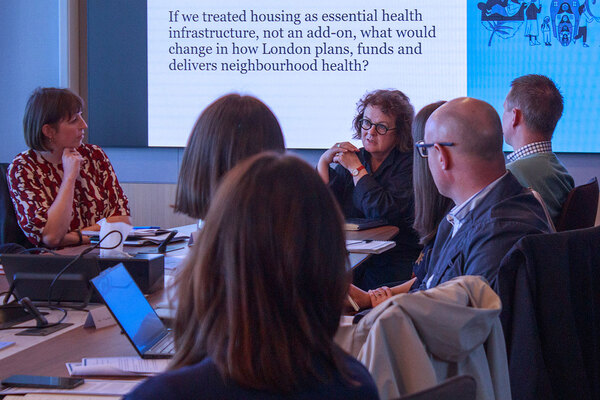
That is why Inside Housing convened a roundtable debate to explore the issue. Forming part of the Healthy Homes campaign, run in association with safety technology specialist Aico, the event brought panellists together for a discussion at the Royal College of Nursing in central London.
Read more


Dealing with data
For Mr Ghader, it is data-centric partnerships that will help landlords develop a deeper knowledge of tenants’ well-being. Prima is working with local social enterprise Fusion21 and Mersey Care NHS Foundation Trust on the Healthy@Home initiative, which seeks to combine health and housing data in one database.
“The idea is that it will flag up information [that suggests a resident is experiencing well-being problems],” explains Mr Ghader. “For our part, we’ll make sure there aren’t issues that are housing-related, or [situations] where we might be able to help with minor adaptations or rehousing options. And if it’s a health issue, then it’s over to our health colleagues.”
Mr Ghader adds that he is “really enthused” by what the partnership might achieve, with the first pilot of the database currently scheduled for later this year. But he is also honest about the challenges he encountered when getting an information governance agreement in place.
All parties sharing data in the planned database, right down to each individual GP practice, must be in agreement. Mr Ghader says that Prima’s partnerships are still a work in progress, after 18 months of effort, “but that hasn’t stopped us meeting operationally with the integrated care team [within healthcare]”.
Such challenges are not unique to Prima. Harriet Brown is head of localities at Midland Heart and previously worked as head of housing health partnerships across Worcestershire. In that role, she worked on a project to push housing data out to the NHS. Initially, the plan was to roll out the approach across the whole area, but the information governance proved too tricky.
“So we went down to one primary care network and one housing association, to try to prove that overlapping that data and being proactive would work,” she says.
Her message is that building partnerships is a case of “finding someone in your system who is prepared to, or invested in, making that change”.

The golden thread
Over in the North of England, Sarah Roxby has long been engaged in that sort of hunt for likeminded people. Ms Roxby, executive director for customer and communities at Vico Homes, wants to take discussions around evictions, homelessness and childhood trauma to partners who can help intervene.
She has also built an understanding of the issues affecting healthcare partners and how Vico can help.
“I’ve been going in particular to the health and well-being boards, to social care meetings, to mental health trust meetings. And if somebody mentions winter pressures you think, ‘Right, let me get in there because I can help,’” she says.
“If somebody’s mentioning delayed discharges [from hospital], I’ll get along to that meeting as well. You start to get your people who you can then work with.”
It is what Kate O’Driscoll, policy and programme manager for Local Government East, a cross-party organisation working on behalf of local authorities in the East of England, characterises as “the golden thread” connecting health and housing organisations.
“One of my reflections... working with regional partners and councils and housing associations, was having that golden thread which can speak both to those working on the frontline and to system leaders. The problem is so massive that I think knowing where to start is really hard.
“So [there’s a need] to spend time trying to understand the problem that’s trying to be addressed collectively, and what each role can bring.”
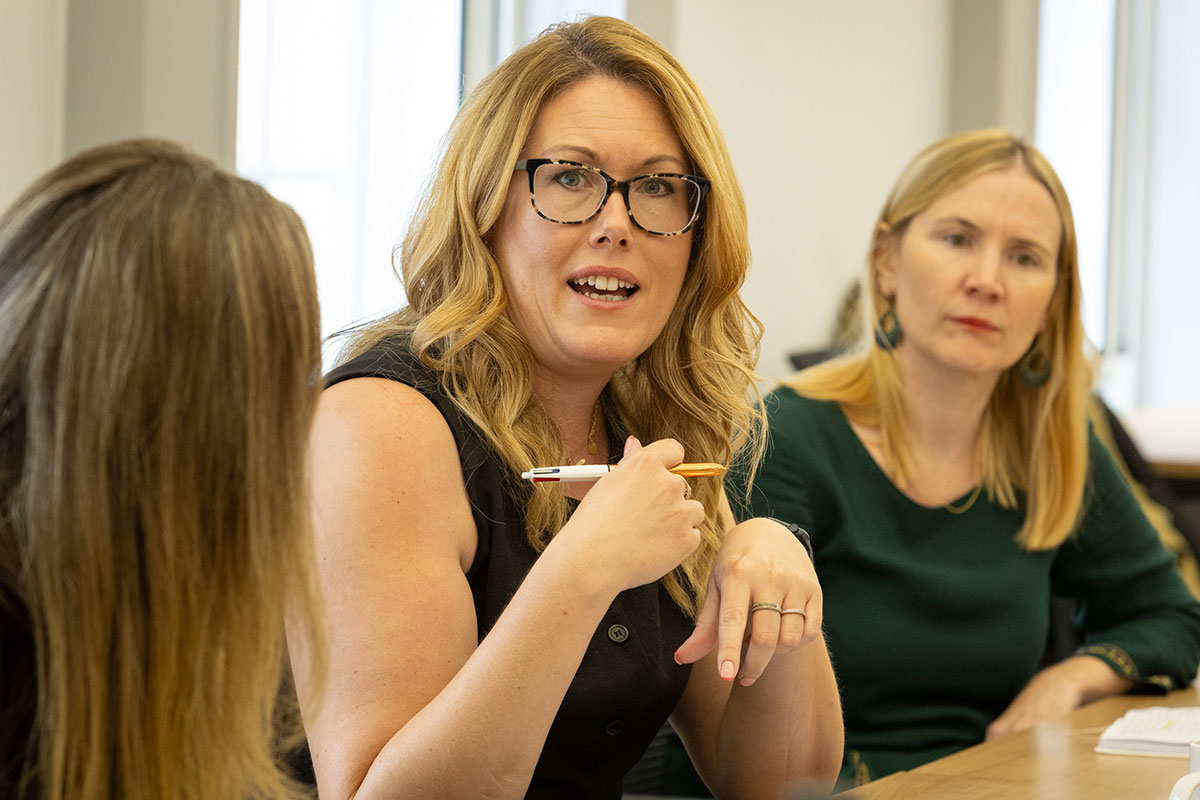
Leanne Monger, deputy place partnership director at NHS Nottingham and Nottinghamshire Integrated Care Board, agrees that finding a shared language is important to forming a successful partnership.
“Both sides say they find each other really complex and hard to penetrate – health says that about housing and housing says it about health,” says Ms Monger.
“But it’s very much two sides of the same coin, and there’s so much we can be doing together.”
Take, for instance, the work being done at Hampshire and Isle of Wight Healthcare NHS Foundation Trust to improve support for those at risk of homelessness. Jon Pritchard, the organisation’s associate director of population and health equity, recounts how “real friction” had built up between the community mental health team and the local authority housing team because of the scale of need.
Housing staff were identifying those in need of mental health support and so were constantly on the phone to clinicians who were already overstretched. The decision was therefore taken to second some mental health workers to housing teams, on a pilot basis.
It was hoped the move would enable earlier intervention, before someone tipped into crisis and so became homeless – leading to housing need – or required urgent and intensive healthcare, leading to pressure on NHS services.
Health and the home
Collecting data on the partnership’s impact has been important in acquiring longer-term funding, Mr Pritchard says.

One of the clinicians seconded to his housing team reported that 69% of the people they worked with were not previously known to secondary healthcare services.
“We can evidence that by having somebody in that role, it’s reducing demand on our mental health services, it’s reducing our bed pressures, it’s avoiding evictions, it’s keeping people safe and well in the community, and keeping families together.
“A trust starts to be built, people start to see change, and then you can take that evidence to another local authority and say: ‘Look at the difference we’re making over here; let’s do something similar.’ You’re not starting from scratch each time.”
The roundtable discussion keeps coming back to how important and valuable it is to be able to link the health information of a particular person to their housing situation. As a doctoral researcher at the University of Bath investigating links between housing and mental and physical health, and co-chair of the Healthy Homes Research Network, Faye Sanders says: “One of the biggest challenges [researchers] are facing is that we
do not have enough data.
“We’ve got very in-depth data on UK population health but very poor data on housing quality and what we do have is very challenging to access. It’s even more challenging to link that data to health outcomes. We have armies of researchers, but that data is not there.” There are multiple reasons for these challenges, Ms Sanders continues.
One is that the health research world has not traditionally considered housing issues. The other is that the housing world has sometimes been reluctant to collect or share data on the condition of properties.
“I think there is a bit of a fear there in terms of what that data is going to show and who is accountable for the health effects,” Ms Sanders explains.

That is something Andrew Sturgess, regional director (South) for Aico, says he has witnessed. Aico provides technology which monitors the safety of homes, including sensors that can track the environmental health of a property.
“We’ll often have data people, retrofit co-ordinators and healthcare desperate for the live asset data we offer,” says Mr Sturgess.
“But asset management will be terrified, not because they don’t want to fix it, but because they don’t have the resources to respond to it accordingly.”
In this way, building partnerships for healthy homes will not only require collaboration beyond the boundaries of a housing provider. It is likely to also require greater collaboration within organisations. “Housing has been very siloed in how it has worked,” argues Jenny Danson, who has worked in social housing roles for 20 years. “There has been the asset side, the customer side, the finance side, but in my view, you cannot separate your asset and customer side.
“Your customers are living in your asset, and how your customers live in that asset determines a lot about what you need to do with that asset.”
Last year, Ms Danson co-founded the social purpose company Healthy Homes Hub. Healthy Homes Hub is designed to share best practice and advocate for healthy homes, in part by breaking down silos and encouraging collaboration within providers. Interest in the hub to date suggests, Ms Danson says, a growing understanding of the scale and significance of health and housing issues.
That significance is a point which Ms Roxby powerfully summarises, in what effectively serves as a rallying call for stronger partnerships between healthcare and housing.
“Fundamentally, a warm and safe home underpins people’s well-being and their health,” she says. “It’s the first line of defence against ill health.”
Participants
Martin Hilditch (chair)
Editor, Inside Housing
Harriet Brown
Head of localities, Midland Heart
Jenny Danson
Co-founder, Healthy Homes Hub
John Ghader
Chief executive, Prima Group
Leanne Monger
Deputy place partnership director, NHS Nottingham and Nottinghamshire Integrated Care Board, and non-executive director, Nottingham Community Housing Association
Kate O’Driscoll
Policy and programme manager, Local Government East
Jon Pritchard
Associate director of population and health equity, Hampshire and Isle of Wight Healthcare NHS Foundation Trust
Sarah Roxby
Executive director for customer and communities, Vico Homes
Faye Sanders
Doctoral researcher, University of Bath
Andrew Sturgess
Regional director (South), Aico

Related stories