You are viewing 1 of your 1 free articles
 Toby Lloyd
Toby Lloyd is a housing and regeneration policy expert and independent consultant. In 2020-21 he served as the chair of No Place Left ...more
Are street votes the only way to intensify our suburbs?
Street votes could give homeowners an incentive and an opportunity to initiate gentle densification in their area, leading to more homes in better neighbourhoods without ruining the countryside, argues Toby Lloyd


 Street votes could give homeowners an incentive and an opportunity to initiate gentle densification in their area, leading to more homes in better neighbourhoods without ruining the countryside, argues @tobylloyd #UKhousing
With 426 people for every square kilometre, England is quite densely populated, relative to other countries.
But as Twitter’s premier mapping guru Alasdair Rae points out, measuring ‘arithmetic density’ at a national level is pretty meaningless, because it takes no account of how concentrated the population actually is.
For instance, Spain has huge amounts of unpopulated space, which drags its average density down to a low-sounding 93/km2, but Spain’s cities, where almost everyone lives, are among the most densely populated places in Europe.
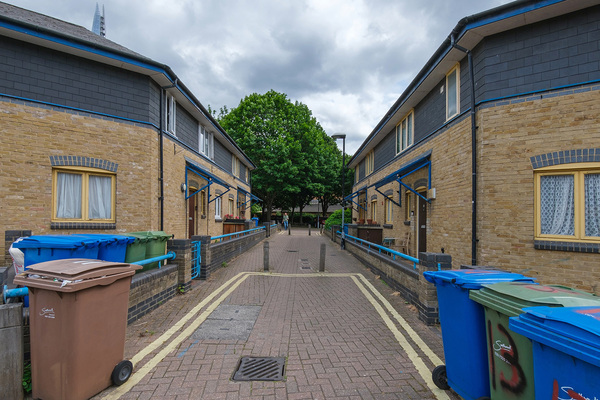
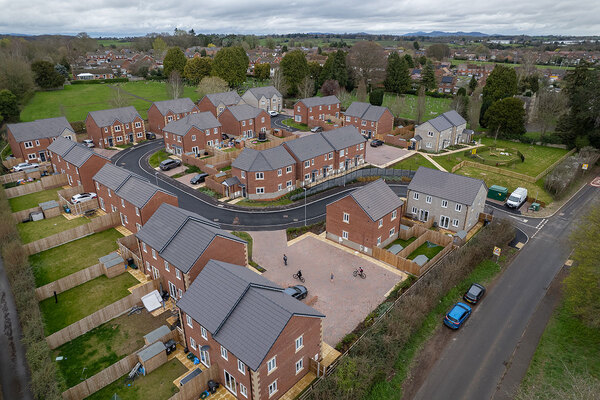
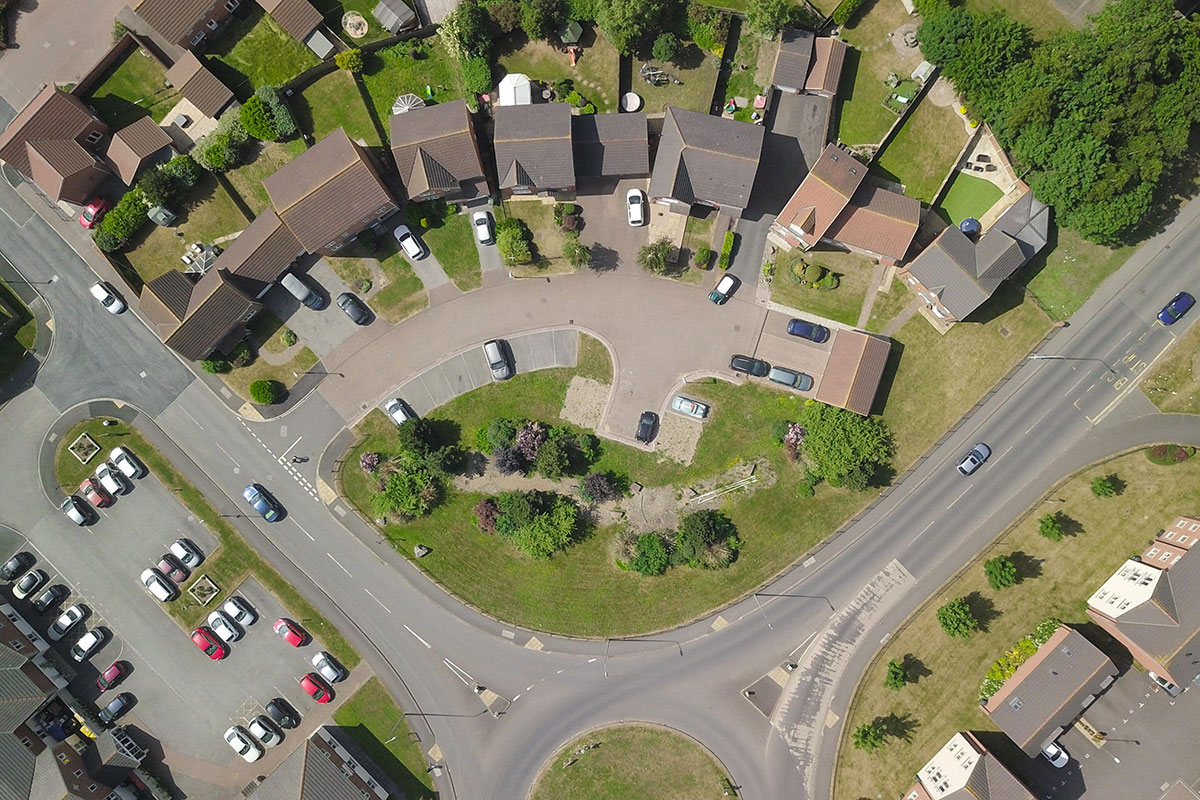
England is the opposite: not much emptiness, but not many really dense places either. In other words, we have a lot of sprawling, low-density sort-of-urban areas. By one definition, 55% of the total population of England and Wales live in suburbs.
A recent Centre for Cities study argued that this pattern of relatively low-density suburbs is bad for productivity, as it reduces the number of people who can access centres of employment efficiently.
This decrease in the ‘effective size’ of big cities is estimated to cost the UK economy £23.1bn each year.
Read more

By reducing the size of the labour market for businesses, as well as workers’ access to high-paying, high-productivity jobs and activity in city centres, poor public transport accessibility in big cities diminishes agglomeration effects and, by extension, productivity and economic performance.
For instance, Rome and Manchester are the same size but Rome is 55% more productive, partly because a much larger share of its workforce can travel into the city centre by public transport (Centre for Cities).
I’m very happy to blame crap public transport provision for the sprawl and low productivity of our secondary cities: the No Place Left Behind Commission I chaired last year majored on the need for vastly improved local and regional public transport.
We need reliable, accessible bus, tram and train services to make our towns and cities productive and healthy, and to connect rural areas with the rest of the country.
And we need them urgently if we expect these places to take a lot of new housing without creating massive resistance as the roads fill up.
But what the Centre for Cities study points out is that the causality flows the other way, too: we can’t make proper local and city transport networks truly viable unless the population density increases.
Otherwise we’re talking about a lot of largely empty buses travelling long distances between dispersed, low-density settlements. And that means we have to talk about increasing density and upgrading the urban form at the same time as demanding investment in better transport.
“Our suburbs are seemingly impossible to redevelop because they are divided into millions of plots controlled by millions of individual economic actors called ‘homeowners’”
European cities have a much more mid-rise built form and apartment living is more common, so a greater number of people reside close to public transport.
British cities’ reliance on terraced and semi-detached housing has had the opposite effect, reducing commuting by public transport and the efficiency of the networks.
Suburbs are the natural places to be focusing development on.
There are loads of them, many have a lot of under-utilised space that could be harnessed to provide much-needed homes, and most suburbs would themselves be improved by having more people and more economic activity in them.
So why do we ignore these places, preferring instead to eat into the green belt?
Our suburbs are seemingly impossible to redevelop because they are divided into millions of plots controlled by millions of individual economic actors called ‘homeowners’.
Trying to assemble enough land to build anything significant in this context is nigh on impossible. As a developer, the best you can hope to do is squeeze an apartment block onto a plot that previously had a single, detached house on it.
If you’re lucky you might get away with a tower – but more often it will be a smallish block of flats that doesn’t upset the aesthetic of mid-20th century suburbia too much.
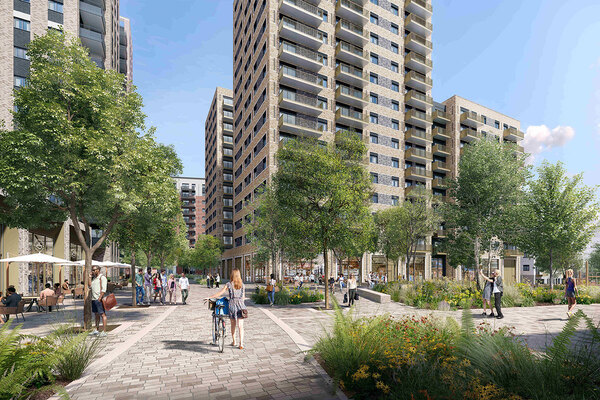
But redevelopment of whole blocks to create new, denser neighbourhoods? Maybe even with liveable streets, parks, local shops and services, too?
You know, all those things that gentle density can provide – and that generate thriving, productive, fun places?
That would require buying out hundreds, even thousands, of private owners, all of whom would have the right to say no. Which many would do, in rather more colourful language. It only takes one or two homeowners to refuse and the whole deal is off.
Assembling big bits of land, plot by plot, like this, just doesn’t happen except in the most exceptional circumstances. Large-scale developers find it far easier to concentrate on places where they can get hold of enough land to build a lot of homes at once.
Which usually means greenfields on the edge of town, ex-industrial inner-city sites, or social housing estates. The result is a pattern of development that is distinctly sub-optimal. Intense competition for the few inner-city or green belt sites that become available pushes up the price for everyone. In-fill development squeezes overly tall towers onto tiny plots.
And most of all, yet more sub-suburban, car-dependent estates sprawl into the rural-urban fringe. None of these models builds the sort of places most of us really value.
“By giving individual homeowners an incentive and an opportunity to initiate densification themselves, this approach might just provide the spark that gets a local initiative going”
This is the context we should be using to think about the idea of street votes, put forward by Create Streets and now taken up by the government in the Levelling Up and Regeneration Bill.
Contrary to some media reports that this would give homeowners a veto over their neighbours’ conservatory plans, the idea is to allow streets to opt in to gentle intensification, within design codes and with appropriate contributions to infrastructure and affordable housing, if two-thirds of residents agree to it.
By giving individual homeowners an incentive and an opportunity to initiate densification themselves, this approach might just provide the spark that gets a local initiative going – and might be able to overcome the instinctive resistance to change that seems to characterise a lot of suburban homeowners.
I know I would give short shrift to any spivvy developer who knocked on my door trying to buy my home for redevelopment.
But if me and my neighbours could get together and come up with plan that turned that dead space on my street into a pocket park and added another storey or two to the terrace, provided a couple of new affordable homes, and made us all a decent profit? That I might be interested in.
That’s what the street vote concept proposes, and at the very least, it has to be worth trying, because literally no one has a better idea for how to densify our ageing suburbs.
And if it works, even if only in a small minority of our suburbs, it could be the long-sought-for holy grail of housing policy: more homes, in better neighbourhoods, without ruining either the city or the countryside.
Toby Lloyd, housing consultant and former Number 10 advisor

Related stories