




How can we accelerate the response to the climate emergency in the housing sector?
Dr Gemma Burgess and David Cowans call for more collaboration and evidence-gathering, to ensure that carbon-zero changes made to residents’ homes are really improvements for the tenant


 Dr Gemma Burgess and David Cowans call for more collaboration and evidence-gathering, to ensure that carbon-zero changes made to residents’ homes are really improvements for the tenant #UKhousing
Together with Unlock Net Zero and the Wheatley Group, Places for People recently hosted a COP26 fringe event to spark collaboration about how we in the housing sector can contribute to the delivery of net zero. We all recognise the urgency of the climate emergency, and the housing sector must respond rapidly to the net-zero agenda.
Buildings are responsible for approximately one-third of worldwide carbon emissions, and energy use in our homes accounts for 14% of all emissions. Yet government deadlines for decarbonisation have been missed and policies revised.
“As an owner and manager of over 219,000 homes, how can Places for People, and other large-scale property owners, plan effectively for a zero-carbon future?”
As an owner and manager of over 219,000 homes, how can Places for People, and other large-scale property owners, plan effectively for a zero-carbon future?
Places for People and the University of Cambridge are working together to explore the main challenges and opportunities in delivering net-zero new-build housing, putting the needs and aspirations of the residents of affordable housing at the centre. With the recent policy announcements, we have clear government aspirations for a net-zero future. These will only be achieved if we consider the financial investment, the technology and the people.
Is a lack of funding the real challenge? A key problem is knowledge about and trust in the technology. Most of us have, until recently, given little thought to our gas boiler save to get it serviced once a year, let alone made an effort to really understand how it works. Yet now we must all become experts in air-source and ground-source heat pumps, or at least trust in the information that we are given when we are told these are the future.
Read more

But where do we find the information about what technology to invest in, how do we know it works, how can we be sure that it will last us the next 20 years and that it will be reliable and easy to maintain? How do we know what the next big thing will be and where this idea might come from? How can we be flexible and adapt to future ideas?
These are difficult enough questions to think about in the context of our own individual homes. But as a large-scale housing provider, it is crucial to get it right. Any investment must be of benefit to the people housed. It would be unethical to experiment and fail in the homes of customers, many of whom are low-income households or vulnerable in some way.
This does not mean that investment should not be made in the retrofit and development of new net-zero homes. Places for People is learning how to invest in retrofitting existing properties and in the development of new sustainable communities. For example, on one development, Places for People has transformed more than 100 properties into highly energy-efficient homes that are not only helping to reduce costs for customers but also improving their well-being.
“Any investment must be of benefit to the people housed. It would be unethical to experiment and fail in the homes of customers, many of whom are low-income households or vulnerable in some way”
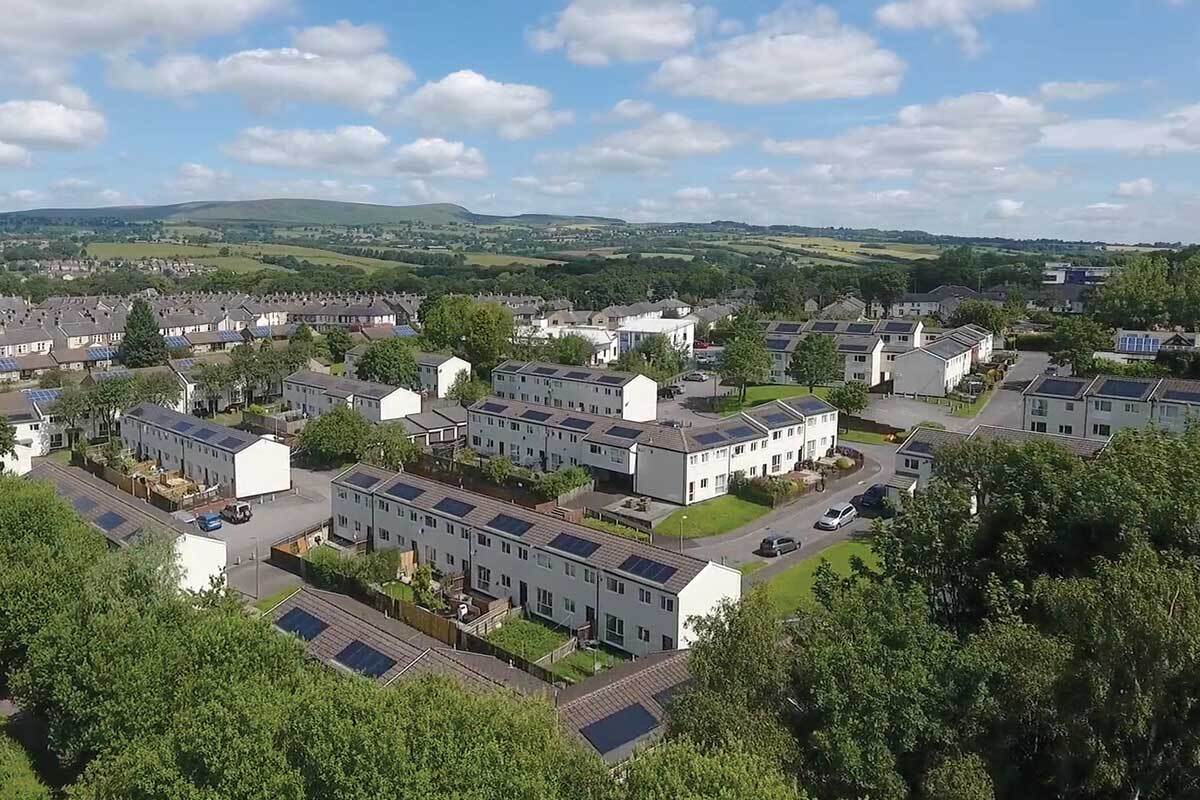
The project in Padiham, Lancashire, involved 1970s-built properties with various design flaws that were causing a number of issues, including damp, mould and draughts. Heat was generated by old electrical storage heaters and the majority of customers were using pre-payment meters.
This resulted in high energy costs and a struggle to stay warm. To tackle these issues, Places for People worked with European partners to deliver a transformational large-scale refurbishment targeted at reducing customers’ energy consumption by 75%.
Places for People secured a grant (€1m) from an EU-funded research and innovation programme and invested a further £1m in the project, which forms part of DREEAM, an initiative aiming to demonstrate that renovating at a larger scale enables better integration of renewable energy and is more cost-effective.
Energy-efficiency measures in each home included new highly efficient storage heaters, solar panels, external wall insulation, energy-efficient windows, internal ventilation and new hot-water systems. The electric storage heating was installed to futureproof against the decline of gas as a source of fuel. Customer engagement was a fundamental part of the project’s success.
“Some customers’ bills have been reduced by more than half, most damp issues have been eliminated and customers feel warmer and happier”
Extensive consultation with residents ensured that people could have a say in the design process and understood the project drivers. Feedback so far has revealed that some customers’ bills have been reduced by more than half, that most damp issues have been eliminated, and customers feel warmer and happier and have a real sense of pride in the community.
But collectively, as an industry, are we creating a robust, accessible evidence base of what works? Are we sharing best practice and learning from what doesn’t work as effectively as we could be? Do we really understand the costs in the short and long term? Are we creating homes and energy systems that work for the people who have to live in and use them? We advocate for more retrofit and net-zero pilots, but also for a compendium that brings all such pilots together in one place to facilitate learning across the sector.
A second challenge is about definitions. This might seem an academic point, but what exactly do we mean by a net zero or sustainable home? If we have no agreed definition of what we are trying to achieve, how do we know if we are delivering it? Are we clear as a sector what the outcomes we want to achieve really are? How can we come to an agreement as an industry about what net zero means and how this translates into specific outcome targets?
Where are the living laboratories that we can all learn from? What are the practical actions others are taking to respond to the climate emergency in their housing portfolios and future home designs, and how do we share the learning from these initiatives? This is a call for a more open, collaborative approach across the industry to share successes and failures.
A further issue is how best to put people at the heart of the net-zero transformation. We have to do more to understand how customers use and experience their home environments, and how they interact with their energy systems. Without being tailored to customers’ experiences and needs, new technology can fail to deliver on its sustainability promises. Environmental concerns and sustainability might not be customers’ top priorities. Without having evidence to show a direct connection between investment in net-zero homes and a reduction in energy bills and fuel poverty, how can we make a case to customers? How can we convince them that paying a higher price for a net–zero home will mean cheaper operational costs over the long term? How can we learn more about diverse customer experiences and feed this knowledge back into the design, installation and operation of new sustainable systems?
“We all feel intuitively supportive of a levelling-up agenda, but this is currently a nebulous concept. Do we level up by investing in people? Or in specific places? Perhaps the net-zero agenda gives us a clear opportunity to do both”
When we consider a net-zero future, we need to keep this household diversity in mind and ensure that we do not exacerbate existing inequalities or create new ones. The homes we retrofit and design must work for all people, in all places. We all feel intuitively supportive of a levelling-up agenda, but this is currently a nebulous concept. Do we level up by investing in people? Or in specific places? Perhaps the net-zero agenda gives us a clear opportunity to do both. With an aspiration to install a significant number of heat pumps, for example, but a shortage of skilled trades people to install and maintain them, there is a clear opportunity to invest in people on a large scale. And many areas of the UK have manufacturing capabilities that could be further invested in to create the scale of manufacturing that will be needed to deliver the technology and systems required to build net-zero homes and retrofit the UK housing stock.
A key tension we see is that net zero is moving fast in terms of technology and the policy agenda. This reflects the urgency of the climate change crisis, but delivery is much slower. We see a practical challenge for investors and housing providers as net-zero initiatives need to move quickly, but are not necessarily based on a robust underpinning evidence base, nor is there currently enough evaluation data from a review of such initiatives, as they are implemented to aid our understanding and inform how net-zero interventions should be developed. We need to keep up with the pace of change while also working to evaluate the evidence as we progress the net-zero agenda. Greater collaboration between organisations, including with research organisations, such as the collaboration between Places for People and the University of Cambridge, will help us to provide the evidence base needed to show that the housing sector is responding to the climate change emergency in the most effective ways.
In the spring, we will be hosting an event to discuss the key issues facing the affordable housing sector in relation to the net-zero goal, and we hope you will join us. But in the meantime, if you want to collaborate, share a bright idea or draw attention to evidence of cases where progress is being made – get in touch and let us know!
Dr Gemma Burgess, centre director, Cambridge Centre for Housing & Planning Research; and David Cowans, chief executive, Places for People

Related stories







