



What the sector can learn from the tenants’ climate jury
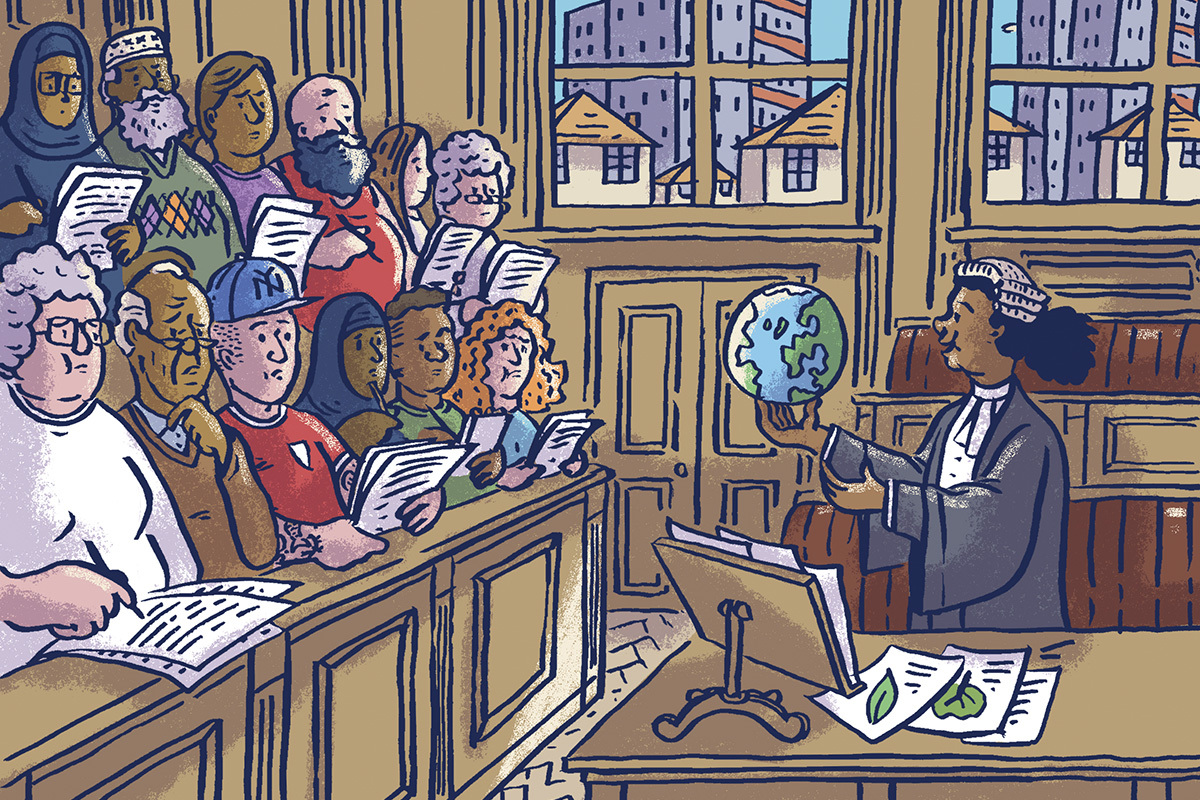
A jury of Northern social housing tenants has just produced a report to guide how they think their landlords should address climate change. Eve Livingston reports. Illustration by Dominic McKenzie


 What the sector can learn from the tenants’ climate jury – @eve_rebecca reports for @insidehousing #UKhousingA jury of Northern social housing tenants has just produced a report to guide how they think their landlords should address climate change. @eve_rebecca reports
When an invitation to apply for a role on the Social Housing Tenants’ Climate Jury arrived on her doormat earlier this year, Sharon Wood was interested. “I thought it sounded alright and I’d give it a go,” recalls Ms Wood, a Wakefield tenant with Yorkshire Housing for the past 31 years. “But I didn’t think I’d be successful so I didn’t think much about it. Then I was accepted – and in the end I found it far more interesting than I ever thought I would.”
Ms Wood is one of 30 social housing tenants from across the North of England who were brought together over the course of three months for the climate jury, the first of its kind in social housing. Commissioned by the Northern Housing Consortium (NHC) and delivered in partnership with five housing associations – First Choice Homes Oldham, Karbon Homes, Salix Homes, Thirteen Group and Yorkshire Housing – the jury published its final report this month, including 10 recommendations on how tenants, social landlords and others might work together to tackle climate change in their homes and neighbourhoods.
With the NHC estimating that more than one million social rented sector homes across the North will require retrofit measures to reach net zero, the jury focused on adaptations to existing homes rather than standards for new builds. Its recommendations include speeding up installation programmes and appointing dedicated staff to work with the community on green spaces, but also emphasise the need for clear and timely information for tenants, and information-sharing across the sector.
“The clear next step for us in the net zero discussion was about how to bring tenants alongside us and inject their voice into what is essentially a very complex process. And so I pitched the idea of a tenants’ jury”
“At the Northern Housing Consortium, our long-standing interest has been in the regeneration and quality of existing homes,” says Liam Gregson, member engagement manager and project lead for the climate jury. “And there’s a natural lead-in to conversations about net zero and decarbonisation: if retrofitting has to happen, how can we tie it into wider neighbourhood improvements?”
Read more





Retrofitting
This focus on retrofitting led to the NHC’s Our North Net Zero project in 2020. Retrofit practitioners delivered webinars to staff in the social housing sector, covering topics ranging from finance and improving the energy efficiency of buildings, to insulation and renewable heating technology. Also central to the conversations was the role of tenants and how to ensure they were involved in retrofitting processes.
“The involvement of tenants ended up being the thread that ran through everything,” says Mr Gregson. “It was clear to us all that customer satisfaction is a huge part of successful retrofit projects. If people aren’t communicated with and don’t understand what’s happening, confusion can happen and trust is eroded.
“The clear next step for us in the net zero discussion was about how to bring tenants alongside us and inject their voice into what is essentially a very complex process. And so I pitched the idea of a tenants’ jury, because it seemed very much to be in the zeitgeist.”
Citizens’ assemblies and juries on climate change have been increasingly used at national and local government level in recent years. In 2019, six House of Commons select committees convened a citizens’ assembly to engage with the public on measures to tackle climate change. At a local level, the format has also been adopted by authorities from Leeds and Kendal to London and Devon to discuss wider climate issues. In bringing together social tenants to focus on retrofit measures, though, the NHC’s project is unique.
The value of a jury format for the NHC was its ability to account for local demographics and bring together a group representative of social tenants across the North. Online weekly sessions of between two and three hours allowed more time for in-depth discussion, and expert commentators were invited to present to the jury and inform debate on various topics throughout the process.
The jury’s recommendations
- There is a need to take into account the urgency of the issue of climate change, and installation programmes need to be quicker.
- Housing associations need to work with contractors to ensure work is completed to the highest standard. An independent person or body should be appointed as a point of contact for tenants, to provide oversight to work, hold parties to account and mediate any issues.
- Because retrofit could be very disruptive, tenants need to have clear and timely information about timescales and cost.
- The best-quality technology should be used.
- Housing associations need to ensure good communication with tenants before, throughout and after any work carried out.
- Housing associations should collaborate with each other and local authorities, and other agencies.
- Raise awareness with everyone in our communities about how we can tackle climate change through a range of communication channels. Communication must use clear, accessible language at all times.
- People in care homes, older and vulnerable people should be made aware of what is happening. Good, clear information should be provided in a format they can understand.
- Housing associations should employ a local dedicated person to work with the community to open community centres and develop green spaces – ensuring that people are more informed about the spaces, having a more connected approach and access to the facilities.
- Housing associations should be proactive in training and employing their own skilled workforce necessary to complete the work within timescales by 2050 and to allow for any repairs and replacements.
‘Listen to tenants’
Jurors were given vouchers to thank them for their time, and were able to claim expenses and support in order to overcome barriers such as childcare needs and IT access. It was also important, says Mr Gregson, that the recruitment of jurors went beyond those most likely to self-select and reached those less likely to engage in such initiatives and with varying interest in and attitudes towards the issue of climate change.
“When you hear that thousands of people have been invited to apply and you’re one of the ones that’s been selected, it does make you feel a bit important,” says juror Thérèse Dixon, a tenant with Karbon Homes in Consett, County Durham. “We all took the task very seriously and got a lot out of being involved.”
“I learned a lot and it stoked a fire inside me to do more and look down different avenues,” agrees Ms Wood, who says the information and debate around retrofitting changed her view. “At first, you just think it’s going to cost a lot, but then you learn about the carbon footprint of new builds and the environmental impact of the manufacture of cement,” she reflects.
Terry Tasker, a Yorkshire Homes tenant of six years from Malton, North Yorkshire, was already a keen environmentalist before her participation in the jury. But, she says, it was her day-to-day experience as a social housing tenant that informed her contributions as much as her environmental knowledge.
“We are the ones who are living in the homes and who know and understand what can work best here,” she says. “My advice for any housing associations working on similar issues would be to listen to tenants and be led by them, and to make sure planning and communication is at the top of your list.”
“I think the sector is in a place where everyone is trying to understand what their contribution to the climate conversation is”
While the official jury process has come to an end, for many jurors, their climate change journey has just begun. “It’s made me think about the little things I can do in the house,” says Ms Wood. “We’ve been turning the central heating down, replacing lights with low-energy bulbs and using paper straws for the little one.”
“What I’ve taken from it is the fact we can all make small changes and that small changes together make big changes,” agrees Ms Tasker. “You’re never going to change the world overnight, but a lot of small changes can help.”
The jurors are hopeful, too, that a dialogue will continue. Alongside promoting the recommendations, Mr Gregson says, the role of the NHC will be to track this progress and share learning from the implementation of the recommendations.
“I think the sector is in a place where everyone is trying to understand what their contribution to the climate conversation is,” he says.
“I’d like to think we’ve created something the whole sector can use and take forward. We commissioned this but, at the end of the day, the jury has spoken without any input from us. Now the onus is on us to work with them, and with tenants more broadly, on what they’ve told us.”
Sign up for our asset management and sustainability newsletter

Already have an account? Click here to manage your newsletters
Sign up to The Retrofit Challenge Summit

A must-attend one-day summit for all those involved in the large-scale retrofitting of UK homes.
Join us on 24 March 2022 at the second annual Retrofit Challenge Summit, which will equip you with knowledge to fund, plan, procure and deliver retrofit projects at pace, at scale and right first time.
Related stories







