You are viewing 1 of your 1 free articles

Jules Birch is an award-winning blogger who writes exclusive articles for Inside Housing
Mr Gove was right. But what now?
Michael Gove was stating the obvious when he said the government shares the responsibility for Grenfell, but what does that mean for residents of buildings still waiting for remediation works? Jules Birch breaks it down


 .@michaelgove was stating the obvious when he said government shares the responsibility for Grenfell, but what does that mean for residents of buildings still waiting for remediation works? @jules_birch breaks it down #UKhousing
Michael Gove’s admission that “faulty and ambiguous” building regulations set by central government were partly to blame for the Grenfell Tower fire will come as no surprise to anyone who has taken even passing notice of the evidence at the public inquiry.
That a statement so blindingly obvious should be enough to prompt a worried look from one of the housing secretary’s media minders speaks volumes about the government’s stance up to now. It also begs significant questions about the administration’s approach to housing going forward.
The admission (and the look) came in an interview with the Sunday Times trailing the announcement on Monday that developers have six weeks to sign legally binding contracts to repair unsafe buildings or, in effect, lose the ability to build anything else.
As the housing secretary told Sophy Ridge on Sunday on Sky News: “The people who were responsible for erecting buildings which we now know are unsafe have to pay the costs of making sure those buildings are safe.”
UK-registered developers are liable for fixing the blocks they built themselves via the contracts. They’re also paying to fix other buildings via the Building Safety Levy. But this does not really capture all of those responsible.
Read more
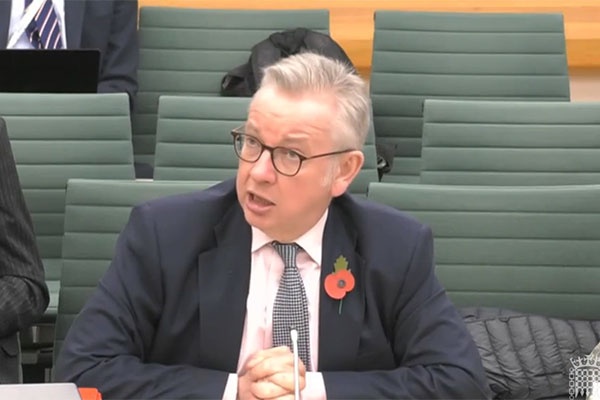

As the inquiry has revealed, the list of who is responsible includes just about every part of the construction industry, and especially product manufacturers. Mr Gove’s written statement on Monday does say that contractors and manufacturers are among those whose conduct is being investigated by his department’s recovery strategy unit.
The list now also includes a government that Mr Gove said “collectively has to take some responsibility” (meaning current and previous governments).
He went on: “I think there is a difference between presiding over a system that is negligent and actively exploiting it. But it is undoubtedly the case that the system of building regulations was not right.”
“Building safety and how to pay for it were the overwhelming priorities in Mr Gove’s interviews, but the questions for the future raised by the crisis also go further”
If that is the case, though, why did it not act on the review of regulations recommended by the Lakanal House coroner in 2013 or warnings from a group of MPs led by the late Sir David Amess over the next four years?
And it is hard to disagree with Jenni Garratt of the End Our Cladding Scandal campaign when she argued that the government responsible for that system should take its place in the “waterfall” of liability for building safety costs alongside developers and building owners to ensure that all leaseholders are protected.
Remember too that if taxes and levies on developers do not raise enough money to fix all of the buildings, then existing housing budgets will be the ‘backstop’ under the agreement between the Treasury and the Department for Levelling Up, Housing and Communities (DLUHC).
Building safety and how to pay for it were the overwhelming priorities in Mr Gove’s interviews, but the questions for the future raised by the crisis also go further.
Prominent among them is the future of the leasehold system that has been exposed by the building safety crisis as fundamentally unfair to leaseholders.
Mr Gove confirmed in the Sunday Times piece that he wants to abolish leasehold completely and told Sky News: “We want to introduce legislation in the final parliamentary session, so later this calendar year, to change the leasehold system. It’s not easy in legal terms because when you’ve got a tangle of property laws going back hundreds of years unsticking all of that is difficult but the fundamental thing is that leasehold is an unfair form of property ownership.”
This would be a huge development with ramifications across the housing system and across different tenures.
However, governments have promised to reform leasehold for decades and despite many different pieces of legislation, and the creation of commonhold as an alternative, it remains in place. Note, though, that “change the leasehold system” does not necessarily amount to abolishing it.
The abolition of leasehold would be a huge undertaking for any government, let alone one limping towards the next election under its third prime minister in a year and one already pledged to introduce another major piece of housing legislation in this parliament.
Perhaps Mr Gove and the DLUHC could introduce a combined leasehold and renters reform bill, but that would still be a big ask for a party whose political strategists will be focused on “scraping the barnacles off the boat” ahead of going to the polls next year.
The housing secretary also addressed a third key issue for housing in his interview, but his answer displayed none of the candour evident on building safety and leasehold.
“If the Conservatives have an over-arching idea on housing, it is that building more homes creates more home owners and more Tory voters in the future”
In the wake of his recent concessions to Conservative backbenchers on planning, Mr Gove said he is “definitely” still committed to the party’s manifesto target of 300,000 additional new homes a year, but dodged the question when asked how it can be achieved without local targets.
“The targets have operated as a stick, which can be handed to the developer or the planning inspectorate to beat a local authority or a community into submission,” he explained. “I don’t believe that is sustainable.”
Arguing that “our planning system hasn’t worked as it should for years”, he cited as evidence the fact that 60% of councils do not have up to date local plans. “A plan-led system is the best way of… making sure that we have more homes, but also the communities feel that they are shaping the places where they live, the communities that they love,” he said.
As he must know, the councils that do not have local plans are generally the ones that are least keen on new homes. The National Planning Policy Framework has penalised that kind of behaviour via the presumption in favour of sustainable development. Local plans enable them to set the terms for new housing in their area and protect themselves from speculative planning applications, but Mr Gove’s concessions to Tory rebels effectively take that stick away.
If the Conservatives have an over-arching idea on housing, it is that building more homes creates more home owners and more Tory voters in the future.
The inter-linked building safety and leasehold scandals have undermined that proposition for hundreds of thousands of home buyers and fixing them is vital to repairing it.
But it says little for the party’s long-term prospects that it has allowed that long-term vision to be sacrificed to short-term political considerations.
Jules Birch, columnist, Inside Housing
Sign up to our Best of In-Depth newsletter

We have recently relaunched our weekly Long Read newsletter as Best of In-Depth. The idea is to bring you a shorter selection of the very best analysis and comment we are publishing each week.
Already have an account? Click here to manage your newsletters.
Related stories