You are viewing 1 of your 1 free articles
Latest housing research: We can’t solve the housing crisis with more private homes
A new report argues that only a decisive shift towards social housing – breaking with decades of trickle-down thinking – can address the housing crisis, writes Alex Jones, strategic research manager at L&Q and member of the Thinkhouse Editorial Panel


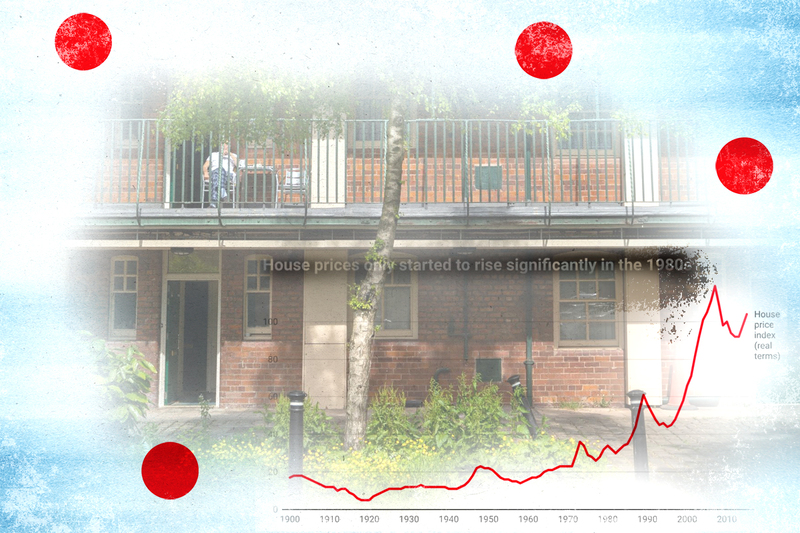 Latest housing research: We can’t solve the housing crisis with more private homes #UKhousing
Thinkhouse is a website set up to be a repository of housing research. Its editorial panel critiques and collates the best of the most recent housing research.
Of the eight reports published on Thinkhouse in February, the one that caught my eye was Build Up Not Trickle Down: The Case for Need-Led Housing Policy, authored by Shelter. The report argues that only a decisive shift towards social housing – breaking with decades of trickle-down thinking – can address the housing crisis and provide secure, affordable homes for those currently locked out of the market. I gravitated towards this report as I have a particular interest in the idea that new supply alone is unlikely to fix the deep housing issues in this country.
The underlying argument is that England’s housing emergency is the result of a long-standing and fundamental flaw in government policy: prioritising private market demand over actual housing need. For many decades, policymakers have assumed that building more private homes would improve affordability through “trickle-down” effects.
Read more



In housing terms, trickle-down economics means that building any home of any type is a positive thing, because it creates chains of vacancies in the market. Any new home will be bought by someone living in a less expensive one, and then they will sell their home to someone else lower down the ladder, and so on until it reaches the bottom end of the market, thus addressing housing need at all levels in a given area.
However, the evidence demonstrates that this approach is flawed, due in part to investment homes at the higher end of the market being left empty and breaking the chain. It’s also questionable whether the theory is applicable to a housing market in a city like London, which attracts buyers from all over the world and not just the local area.
The core problem is that the private housing market responds to demand, ie what those with sufficient purchasing power can afford, rather than responding to housing need. Developers slow or stop building when demand weakens, rather than reducing their prices, which prevents meaningful price drops. Meanwhile, millions face unaffordable rents, overcrowding or homelessness.
Although the government has taken welcome steps through the measures announced in last year’s Comprehensive Spending Review, its overarching strategy continues to rely heavily on boosting private supply. This includes relaxing planning requirements and reducing developers’ obligations to deliver affordable housing in the belief this will accelerate construction. The report argues that such policies echo failures of the past, prioritising developer interests and short-term economic growth over social outcomes.
The analysis shows that increasing private supply, even at historically high levels, would not significantly reduce prices or improve affordability for low-income households. Most housing transactions occur in the existing (not new build) market, and long-term structural factors – such as low interest rates, financial investment in property and credit liberalisation – are more impactful than any mitigating effect from new supply.
Even when new homes are built, evidence suggests the filtering effect is weak: affordability gains are marginal, often take years, and rarely benefit those excluded from the market altogether. In some cases, new luxury developments push up local rents through gentrification.
The report also highlights flaws in the planning and land markets. Land values have soared, capturing value for landowners rather than communities, while viability loopholes allow developers to negotiate down affordable housing obligations. Evidence captured from 23 development sites in London suggests instances of overpayment for land, on the assumption that affordable housing contributions can be reduced later in the process via viability assessments, resulting in the loss of nearly 1,000 affordable homes across the sites studied.
1,000
Number of affordable homes across 23 sites in London lost due to soaring land values and viability loopholes
90,000
Number of social rent homes Shelter argues need to be built in the next 10 years
Ultimately, the report calls for a needs-led housing model centred on large-scale social rent delivery. It repeats Shelter’s familiar call to deliver 90,000 social rented homes a year for the next 10 years, and recommends enforcing a minimum 20% social rent requirement on large developments, closing viability loopholes and empowering councils through compulsory purchase powers. Without such measures, the authors argue, the delivery of new homes, even at scale, will not meaningfully improve affordability or address homelessness.
Reading the report, it struck me that the government’s 1.5 million homes target doesn’t have a very clear objective behind it. Its stated economic aim is “growth, growth and growth”, and while large-scale private housebuilding may in theory be a good way to achieve this, there is little evidence that it would move the dial on the dual crises of homelessness and unaffordability.
This disparity, alongside the huge environmental impact of new build, places even more emphasis on the importance of building homes that will deliver outcomes we actually want, rather than just building as many houses as possible. The most direct way to do this is to build homes for social rent.
That is a very expensive thing to do, and unfortunately far easier said than done. Nonetheless, Shelter’s report highlights that a fundamental shift in the way we talk about delivering new housing, and the reasons we build it, is long overdue.
Alex Jones, strategic research manager, L&Q; and member, Thinkhouse Editorial Panel
Sign up to Inside Housing’s Development and Finance newsletter
Sign up to Inside Housing’s weekly Development and Finance newsletter, featuring a round-up of business, development and regeneration news and analysis.
Already have an account? Click here to manage your newsletters.
Related stories