You are viewing 1 of your 1 free articles
Danielle Lennon: how to make the switch from housing management to development
Jess McCabe sits down with Danielle Lennon, assistant planning director at Notting Hill Genesis, as part of Inside Housing’s series on women in development. They talk about making the switch from housing management to development, what it is like seeing a regeneration project deliver better outcomes for residents, and managing the “extraordinary” length of time to negotiate Section 106 deals


 Jess McCabe sits down with Danielle Lennon, assistant planning director at Notting Hill Genesis, as part of Inside Housing’s series on women in development #UKhousing
Danielle Lennon has been working in development since 2009, but she still checks in on her first project.
It is a regeneration of empty homes along the north circular in London that were owned by Transport for London, which planned to demolish them and widen the road.
This never happened, and they were sold to Notting Hill Genesis (NHG). “It’s quite a harsh environment,” she says. “They fell into disrepair, and some of them were unoccupied.”
Until that point Ms Lennon had been on the housing management side of the housing sector, managing a team in the lettings department, and she got involved in working with the tenants who had transferred over as part of the deal.
“Then I transitioned from the stock transfer and into the project management side of that whole project,” she says. This involved regeneration of these homes, infill projects and larger developments.
It was an eye-opening start in development for Ms Lennon, and she has since worked her way up to become assistant planning director at NHG.
We met over video call as part of Inside Housing’s series on women in development, to talk about what the job is like day to day, and how to progress in a development career.
Read more
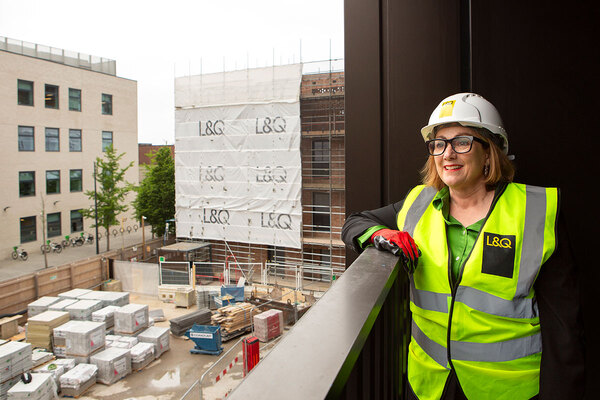

So how did Ms Lennon get where she is now? She studied business at Manchester Metropolitan University. “When I left university, for some reason I never wanted to work in the private sector. I went straight into working in the public sector.
“I worked temporarily in the NHS, and I worked at Lambeth Council. I worked at King’s College Hospital. And I then got placed – everything I was taking was temporary jobs – placed in a housing association in Balham [Thames Housing Association], which is not there anymore.” This was in 2005.
“I basically observed the housing officers, and I thought, ‘I could do that.’ So I then applied for a trainee job as a housing officer,” she says. From there she built a career in housing management, before making the switch to development.
Ms Lennon thinks she was subconsciously drawn to housing because of her own experiences in her childhood. “We weren’t in temporary accommodation, but we were homeless. We needed to go to the council [for housing],” she says.
“I didn’t connect any of the dots [at the time]. It’s only 20 years later,” she says, that thinking back on it she can see the influence. “I think it’s the right place for me, and I can make a difference.”
“I basically observed the housing officers, and I thought, ‘I could do that.’ So I then applied for a trainee job as a housing officer”
What does a typical day as an assistant planning director look like? Ms Lennon might meet with her team to go through the design of a new scheme, liaise with clients, speak to the council or the Greater London Authority, run appraisals on new schemes, or negotiate contracts.
She also has a stream of Section 106 negotiations running in the background. “You’ve probably heard that 106 is taking an extraordinary amount of time to negotiate, and some are more complex than others. And there’s just a huge expanse of time between the [planning] committee resolution to grant an application and then actually getting the 106 signed, and us being able to actually implement.”
How long is a huge expanse of time? “I’ve had years,” Ms Lennon says.
One of her big projects at the moment is a regeneration involving a Tesco store. But she has 830 homes in planning across different schemes.
“So I’ve transitioned from when I started in 2008 and doing that regen scheme, where we were doing some infill developments – some of the smaller ones we might do nine homes. Now I’m doing really large, complex schemes.”
She is particularly proud of a regeneration project she is working on right now, on the Curry Rise and Bray Road estate in Barnet, to be renamed Millbrook Rise. If it goes ahead, the project will see around 140 homes replaced by 329 homes.
The scheme is in the planning stage, but has already won a resident ballot – which are now required in London on regeneration projects. “We got 87% voting in favour of regenerating the estate,” she says. “We can go along and build anywhere. And obviously we are a big developer, and have been doing this for ages. But to actually have the community saying, ‘yeah, we also want this, and we do think it’s the right thing’. That is a seal of approval. You couldn’t ask for a better outcome, really.”
Our conversation also touches on what it is like to build a career in development as a woman. “When I was younger, I think that was much harder, because I would be intimidated by being in these teams where there’s a big team, but they’re mostly men. And you’re the person that’s leading the team.
“Navigating that, it was hard. And just getting the confidence to progress in my career, putting myself forward.”
She adds: “I always think back to when I was a planning project manager, and then I transitioned to being a planning manager. I saw the vacancy, and I said, ‘Well, I can’t do that because I don’t have a planning degree.’
“I spoke to one of my colleagues who said, ‘No, you do have most of the competencies to do this, and you should go for the role.’ And I literally would not have gone for the role had she not said, ‘No, you don’t need all these things.’”
“I would definitely encourage people to work in development. And you see the transformation of places, which is quite amazing. I’m proud to have a hand in that kind of thing”
After we speak, Ms Lennon emails to add: “This is something I’m very passionate about.”
She has been a diversity champion on NHG’s inclusion steering group, and promoted diversity and inclusion practices within development. She’s also liaised with the Greater London Authority (GLA) on its 2021-26 Affordable Homes Programme equality, diversity and inclusion (EDI) objectives – which required organisations to commit to advancing EDI as a condition of receiving grant.
Among the requirements of the programme, investment partners of the GLA must publish their gender and ethnicity pay gap data, and “collect and monitor workforce data to benchmark the diversity of their workforce against the London benchmark”.
Ms Lennon writes in the email: “I’m eager to see the development industry become more inclusive, ethnically diverse and in particular encourage the use of a diverse supply chain. Providing opportunities for those who have been traditionally under-represented to work in the sector.”
On our video call, Ms Lennon says that development is a rewarding career. “I would definitely encourage people to work in development,” she says. “And you see the transformation of places, which is quite amazing. I’m proud to have a hand in that kind of thing.”
That takes us back to Ms Lennon’s first development project, back on the north circular.
“I think the community were appreciative of the regeneration in that it was really blighted. We had 50 squats, we had fly-tipping. There was crime and anti-social behaviour. Everybody was insecure. They didn’t know what they were doing in terms of their tenancies. They didn’t know whether they were coming or going. And the place was just really, really bad, in a bad state.”
The council – Enfield – also welcomed the new development, given the shortage of new homes. “The housing crisis has been the housing crisis as long as I’ve worked in development,” Ms Lennon says.
Sign up for our development and finance newsletter

Already have an account? Click here to manage your newsletters
Related stories