You are viewing 1 of your 1 free articles
Dispatches from Housing 2025: day three
A round-up of the most important headlines from the final day of the Housing 2025 conference


 Dispatches from Housing 2025: day three #UKhousingA round-up of the most important headlines from the final day of the Housing 2025 conference #UKhousing
Day three at the conference is often not for the faint-hearted. After two full days of panels and discussions, combined with a lunch-time trip to a local curry house hosted by Campbell Tickell, and evenings full of more networking, drinks and, of course, karaoke.
Special mentions go out this year to a Wandsworth Council member’s cover of Don’t Speak by No Doubt and a BCP Council member’s rendition of Common People by Pulp. Even some Inside Housing team members belted out Teenage Dirtbag by Wheatus.
Read more



The last day was full of speculation akin to a Glastonbury line-up. Will Greater Manchester mayor Andy Burnham turn up? Is there a chance a cabinet minister will make a last-minute appearance?
One attendee and avid Liverpool FC fan was overjoyed to have taken a selfie with footballing legend John Barnes. With the rumour mill alight, attendees set their minds back to some of the serious challenges the sector faces.
Day three came to a close with senior government insiders explaining what to expect from recent building safety announcements, while retrofit, asset manager intentions, and how to better integrate health and housing outcomes were all at the forefront of the sector’s thinking.
There was strong support for Inside Housing’s Housing Management Matters. Plus, what are the wider unintended consequences of the Renters reform Bill?
See if you can spot yourself at the conference on day one, day two and day three.
Here is our round-up of what was discussed on Thursday.
Remediation Acceleration Plan is ‘imminent’

“We also committed that we would be coming forward with an update to the plan in the summer of 2025. Now we are in June, so you will work out that that means, we don’t have very long to wait. I can’t give you a specific date, but I can promise you it is very imminent.”
These were the words of Dafydd Williams, deputy director for engagement within the remediation policy directorate at the Ministry of Housing, Communities and Local Government (MHCLG), during a session on speeding up the remediation process.
He was joined on stage by senior directors at Salix Homes and Newlon Housing Trust. Both landlords set out the challenges they had faced during the remediation process: workforce, quality and procurement issues; tenant engagement; difficult asset management and development pipeline decisions to fund this work.
But it was the clarity going forward from MHCLG and Homes England that was going to address these issues and speed up the work. Much of the talk also looked at the news that the sector will get £1bn as part of new equal access to remediation funding.
Helen Fisher, programme director of the Cladding Safety Scheme at Homes England, said: “One of the changes we’ve made with the Cladding Safety Scheme is that we have benchmarked large sets of data.
“That’s been available now for the last four years. We don’t share what those benchmarks are, because we don’t like set targets as benchmarks, but we certainly have them. Every building will go through that analysis and that’s the same as we audit every fire approval, as well for proportionality and peer review with fire engineering.
“So I think that there’s a whole traction now of making sure you’ve got proportionate peer-reviewed work, and what we’re doing is the right mitigation or remediation and making sure that that’s really well managed. And making sure that there is fair, open and transparent procurement, making sure that is clear and I think that’s one of the cultural shifts.”
The need for clarity was highlighted in another session as Dr Syreeta Robinson-Gayle, head of affordable housing at Barratt, shared how blockages in planning and building regulation are beginning to be freed up.
Responding to a comment that three London boroughs have not made a housing start this year, Dr Robinson-Gayle said that many developers had a “clean break” in 2020.
“There were sites that we didn’t buy, or there were sites that we held off buying. Since 2020, we’ve struggled with planning changes, building safety regulation changes and building regulation changes,” she explained.
New campaign hard-launches at Housing 2025

Inside Housing and Inside Housing Management have hard-launched the Housing Management Matters campaign at Housing 2025.
Futures@Housing day was kicked off by Anna Highfield, best practice editor at Inside Housing Management, in conversation with Alyson Heald, partnerships director at L&Q, and Jamie Ratcliff, co-founder of Place Base, about the campaign and how housing management staff can build their careers.
Plus, we recorded an exclusive podcast episode on how the sector can better support housing management staff, with special guests Alison Inman, chair of Tpas, Anne-Marie Bancroft, a director at specialist housing consultancy Altair, and Kirsty Ellis, head of operations at Progress Housing.
Campaign supporters, including Tpas and members of Wythenshawe Community Housing Group’s scrutiny group, have all been photographed in front of our giant yellow campaign wall, and Housing Management Matters badges have become hot property among attendees.
Additional supporters include Tom Robins, chief executive of Switchee; Caroline Simpson, chief executive of the Greater Manchester Combined Authority; Stuart Macdonald, managing director at See Media; consultant Hony Premlal; Steven Henderson, chief executive of Wheatley Group; Susan Faridi, chief executive of Eldon Housing; Nick Murphy, board member at Trident Group; and Lara Oyedele, former president of the Chartered Institute of Housing.
Integrating health and housing outcomes
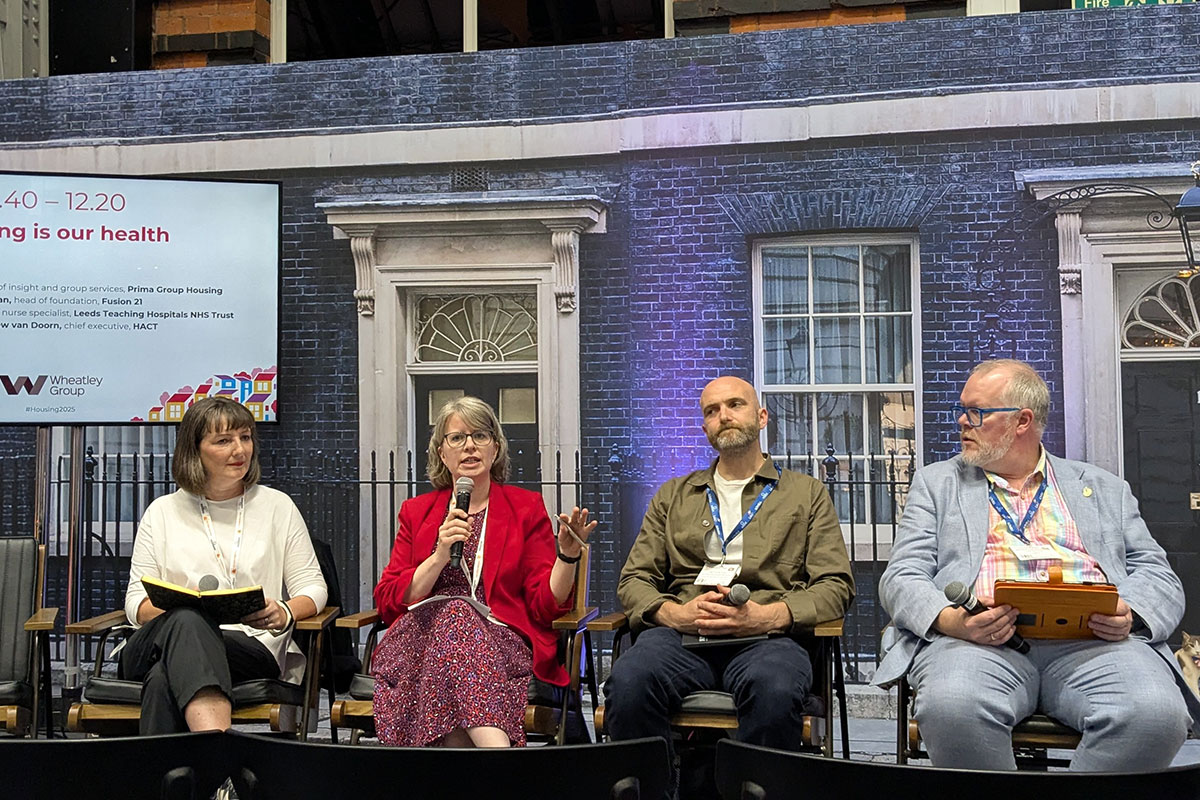
Pioneering projects linking illness with housing issues continue to move forward. Prima Group’s records now have a health sector link as well as the landlord reference number, so data between organisations can be matched, said Ailsa Dunn, executive director of insight and group services.
The aim is for the NHS to tell the Liverpool-based housing association when any of its 2,500 homes are linked to certain health problems, meaning they can look for a housing fix. But it has not all been smooth sailing, Ms Dunn admitted during the panel.
“Data protection and health data is obviously sensitive, so there are lots and lots of extra steps that we have to go through to be able to share that data,” she explained to delegates. “We haven’t got quite through the data protection and information governance route yet.”
A plan drawn up by an information specialist for the scheme was deemed not robust enough by the NHS, Ms Dunn added. So, instead, only an integrated care team will be able to see the new data dashboard and arrange any joint visits to tenants with Prima.
This work-around needs extra NHS resources, but Ms Dunn believes the pilot – due to go live at the end of this month after final sign-off – will be “really good” for the landlord because it is “making connections with health people that we didn’t know existed”.
The session also heard how a scheme in Leeds has seen success. Matthew Hick, a children’s respiratory nurse team leader at Leeds Children’s Hospital, explained how a pathway had been developed for asthma patients in high-risk categories following updated guidance on the illness in 2021.
This included people identified as having a housing problem. In drawing up this pathway, it meant the doctors now had a clear contact for concerns such as damp and mould and repairs.
“Our network changed dramatically overnight,” Mr Hick said. “We had a child that had been in hospital 17 times in 12 months. Two of those were life-threatening. She’d been waiting on the housing waiting list for four years prior to us getting involved.
“Eight weeks later, this child had been moved into a different home address due to this pathway. That child has been to hospital once since that house move. That’s significant.”
He added that they have multiple examples of this, with 68 families now through the pathway.
Institutional investors keen on stock to retrofit

Major asset manager Legal & General (L&G) is looking to acquire further stock that requires retrofitting from traditional housing associations.
Speaking on the panel during the ‘Attracting long-term institutional investment to boost housing supply’ session, Catherine Raynsford, managing director of stock acquisitions at L&G Affordable Homes, highlighted the “potential for institutions like Legal & General to participate in helping the sector to step change the delivery of affordable housing by acquiring stock that needs to be retrofitted”.
She said that while the new funding announced in the Spending Review is “incredibly important… it can only be used to the extent that you’ve got borrowing capacity”.
With investors keen on picking up the stock, another session focused on innovative ways to engage with residents on retrofit. Mhari Coxon, head of marketing at energy company Sureserve, said landlords should use “contagious engagement” to “infect people with the enthusiasm of others”.
Early adopters will champion retrofit in their community, she said. Using a void property to show “the potential of what you’re doing” tends to speed up adoption of retrofit by residents, she added.
Ms Coxon also urged landlords to use visual aids as part of their communication and create translated content for non-English speaking residents. Some AI translation tools now consider the cultural implications of language, such as the difference between individualist and collectivist vocabulary.
Lee Fazal, head of ECO delivery at Next Energy, explained the ways installers can engage with residents. “By partnering with foodbanks, housing groups and disability charities, we reach residents who might otherwise be missed,” he said.
“Vulnerability isn’t always visible. It can be financial, physical or emotional. We often meet residents who are isolated, digitally excluded or fearful of change. Recognising these signs is key to building trust and tailoring our approach.”
Will the Renters (Reform) Bill drive a takeover by institutional landlords?

Several panellists believed small private landlords could be pushed out of the sector because of the Renters (Reform) Bill, as their homes are snapped up by institutional landlords offering those homes to councils as temporary accommodation.
The bill includes a ban on Section 21 no-fault evictions, a new private rented sector (PRS) redress scheme, extra enforcement powers for councils, and new grounds for evicting tenants.
So what will the impact be on social housing provision and services? How can housing associations and councils work with the PRS on best practice and shared learning to create a fairer system?
Hakeem Osinaike, strategic director of housing at Southwark Council, said: “There is a feeling that the reason why the legislation might be passed is to move the country to institutional landlords.
“We’re seeing signs of that, but we’re only seeing it in build-to-rent, because of all the properties that are disappearing.
“So, in London, about 40% of the PRS has disappeared, but they’ve all been bought by institutions, hedge funders, and now they’re offering those properties to local authorities for temporary accommodation.”
Here are our round-ups of what was discussed at Housing 2025 on Tuesday and Wednesday.

Related stories