You are viewing 1 of your 1 free articles
How are social landlords being impacted by supply chain shortages?
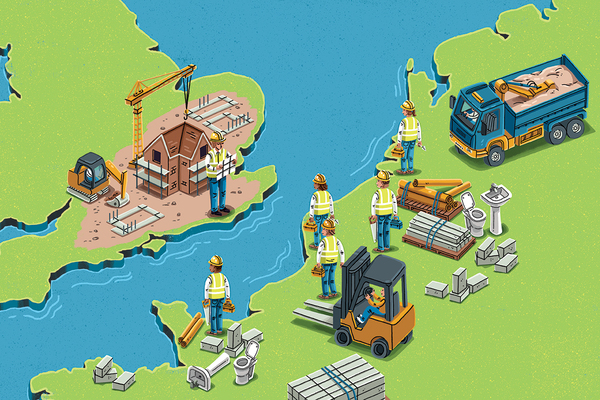
Global events including the pandemic and Brexit have created a “perfect storm” of materials and labour shortages. Gavriel Hollander explores the impacts on the housing sector. Illustration by Mark Long


 Global events including the pandemic and Brexit have created a “perfect storm” of materials and labour shortages. @Gavhollander explores the impacts on the housing sector for @insidehousing #UKhousing
“There’s been nothing on this scale before – it’s a worst-case scenario for all concerned.” This is Neil Butters’ grim view of the materials shortage that has been wreaking havoc across the housing market and beyond since the start of the summer.
As head of procurement at the Procurement for Housing (PFH) consortium, Mr Butters is well placed to assess the extent of the problems affecting the sector.
“The main shortages are around timber, but there’s also [shortages of] cement, aggregate, steel, electrical components – I could go on with the list but it’s pretty holistic,” he continues. “The pandemic has had a knock-on impact on production. Certain regions closed down due to outbreaks, production stops, supply chains break down – and so you can’t get the right products to the right places.”
“We’re seeing some labour shortages coming in again now, too, as people’s families go out in the world and are bringing COVID back home, which has an effect on prices for projects”
The pandemic effect has only been exacerbated by a trio of other events: the ongoing logistics backlog caused by the blockage of the Suez Canal in March; customs delays and a labour shortage as a result of Brexit; and the recent Californian wildfires, which have caused North American customers to seek more European timber, creating a demand-side squeeze.
All of this contributes to what Mr Butters calls “a perfect storm”. But just how bad is that storm? How is it changing housing associations’ plans? And what are they doing to shelter from it?
The data certainly backs up anecdotal evidence that parts of the sector are feeling the pinch. According to the Office for National Statistics’ latest construction material price indices, the cost of materials for new housing increased by 19.8% in the year to the end of July 2021, while repairs and maintenance costs were up 23%. The month-on-month increases for July (the latest available figures) were also hair-raising: 5.8% for new housing and 6.7% for repairs and maintenance.
Read more

Delays and price pressures
These price hikes may actually have as much to do with demand as supply. Travis Perkins’ latest ‘Repair, Maintenance and Improvement Index’, published in August, suggests that both sides of the equation are contributing to the problem. Its survey of nearly 1,500 tradespeople found that 95% expect their workloads to either increase or stay the same over the next two months, while 88% said materials shortages had impacted on their business in the past three months.
In his foreword to the report, Nick Roberts, chief executive of Travis Perkins, says: “It is clear… that these shortages are now having a significant impact in the form of planning challenges, delays to existing projects and new project starts.”
“A pre-pandemic price for a standard kitchen in a two-bed property was priced around £679. The same kitchen would now cost the same landlord £944.”
And as the supply chain is being put increasingly under strain, so are the customers – in this case, housing associations. Many are experiencing delays or price pressure on both their planned maintenance and new build programmes.
“We’re still seeing an average 10-week delay due to material shortages,” says Ali Bennett, development director at Raven Housing Trust. “We’re seeing some labour shortages coming in again now, too, as people’s families go out in the world and are bringing COVID back home, which has an effect on prices for projects.”
Ms Bennett says that pricing for new flats has been particularly impacted, with quotes coming in from contractors at £2,900 per square metre, compared to around £2,100 six months ago, before the Suez blockage and the easing of lockdown measures in the spring.
Mr Butters says that the cost of replacement kitchens, to use one indicator, has skyrocketed over the past 18 months. “A pre-pandemic price for a standard kitchen in a two-bed property was priced around £679,” he recounts. “The same kitchen would now cost the same landlord £944.” That works out at a 39% increase.
“We’re now getting to the point where kitchen manufacturers are saying you’re going to have to take these price increases or we’re no longer going to be able to supply to you,” Mr Butters adds. “We’re reaching that crunch decision point between the supply chain and the sector. [They have to decide] what they’re willing to pay to continue their planned works programmes.”
Some associations have been able to mitigate rising costs on new builds because they negotiated fixed prices before COVID-19 came around. But even large landlords with more buying power admit that they have had to make changes to their programmes.
Tom Titherington, chief investment and development officer at Sovereign, says the 60,000-home landlord has had to rein in its development ambitions in the short term.
“If you remember back to pre-Brexit, we thought there were going to be problems with logistics, we thought there were going to be problems with supply chain and we thought there were going to be delays. But we didn’t factor in the ongoing impacts of a worldwide pandemic”
“Most of our contracts are fixed price so theoretically the price increases don’t come to us,” he says. “But the supply chain issues and the absence of certain materials at certain points of time have really pushed out the delivery programme.
“While we don’t think that our numbers will be bad, it is clear we will not hit the 1,900 homes that we intended at the beginning of this year. It is hard to have certainty more than a couple of months ahead and the whole industry is unclear on future materials availability and labour supply.”
Of course, at least one of the issues affecting material supplies was foreseeable, but Mr Titherington says that associations have been caught on the back foot by so many crises arriving at the same time.
“I think the industry made contingency plans for Brexit and we certainly stockpiled materials – as did the supply chain – but there’s only so much you can make a contingency plan for,” he explains. “If you remember back to pre-Brexit, we thought there were going to be problems with logistics, we thought there were going to be problems with supply chain and we thought there were going to be delays. But we didn’t factor in the ongoing impacts of a worldwide pandemic.”
In numbers
19.8%
Increase in cost of materials for new housing in year to end of July 2021
23%
Rise in repairs and maintenance costs over the same period
88%
Percentage of tradespeople who say materials shortages have impacted their businesses in the past three months
Source: Office for National Statistics
Sheltering from the storm
Mr Butters suggests that associations re-examine their programmes – both on the new build and planned maintenance front – and work out where changes could be made. “We are recommending they look at the specification of the kitchens or bathrooms they’re looking to do, to see if there is leeway to do some value engineering.” However, he accepts that lowering specifications for components to the extent that it affects longevity could be “robbing Peter to pay Paul”.
At Raven, Ms Bennett says that the 7,000-home landlord has also avoided some of the worst effects of the shortages thanks to its membership of the Building Better alliance of housing associations and local authorities, which acts as a buying consortium for modular building projects. The first framework went live this year and, according to Ms Bennett, helps give suppliers certainty when it comes to their pipeline.
Above all else, Mr Butters believes the key to managing your way through this crisis is early engagement with supply chains.
“We are all in the hands of our suppliers,” he says. “They’ll be able to offer you the most up-to-date advice and understanding of where the current challenges are and a view of the future as well. If you are able to give them advance notice of what planned programmes you’ve got coming up, the more notice you can give them, the better.”
There is no immediate end in sight to the shortages, with construction still booming, the pandemic still affecting supply and other macro-economic conditions unchanged. Add into the mix the demands being placed on landlords by the fire safety agenda and the net zero carbon push, and it is difficult to see how supply and demand could ever even out.
But Ms Bennett thinks that, ultimately, the market will have to right itself, or nothing will get built.
“Prices will have to [come down] because that’s not sustainable,” she says. “People can’t build for that level of cost; they won’t be procuring stuff that costs that much so there will have to be an adjustment in the market.”
Sign up for our asset management and sustainability newsletter

Already have an account? Click here to manage your newsletters
Related stories