You are viewing 1 of your 1 free articles

Mind the gender pay gap
To mark the deadline for gender pay gap reporting, we republish this piece by Kate Youde from last August looking at the issues involved. Illustration by Andrew Lyons


 Mind the gender pay gap #ukhousing
This article was originally published on 31 August 2017
When Plus Dane Housing took a closer look at what it pays its staff, chief executive Barbara Spicer was surprised.
“I think if you look at us from the outside you’d think, ‘that’s a workforce that is quite prolific in senior women’,” she says, pointing out that about 70% of the 18,000-home association’s directors, executive directors and heads of service are women. “And yet… men are still paid more on average than women. That shocked me.”
In terms of mean average annual salary excluding overtime, the organisation’s male employees earn 8.8% more than women. The association is still exploring why that is, but Ms Spicer suggests it could be that there are more women in part-time roles. This statistic does not tell the whole story, however, and a closer look at pay paints a rosier picture for Plus Dane’s female staff.
Read more



As an employer with more than 250 employees, the organisation – like many social landlords – is required as of April this year to publish extensive data on its remuneration. This includes: the mean and median gender pay gap based on hourly rates of pay; the mean and median bonus gender pay gap; the proportion of men and women receiving bonuses; and the proportion of men and women in each quartile of the organisation’s pay structure.
Not to be confused with equal pay, which is about pay difference between men and women doing the same or equivalent job, the gender pay gap shows the difference in average hourly earnings between men and women. The UK gender pay gap is 18.1% across all sectors. Plus Dane is yet to release its figure publicly, but found its female employees’ hourly rate is actually 30.7% more than that of male staff. The association is still working to understand the figures, but Ms Spicer suspects the high proportion of women at the top of the organisation is a factor.
Barriers remain
Under the Equality Act 2010 (Gender Pay Gap Information) Regulations 2017, employers have until April 2018 to publish their 2017 figures. But Kate Watkins, an associate at Anthony Collins Solicitors who specialises in employment law, advises: “It’s good to make plans now and be prepared because it’s a bigger exercise than you might realise.”
She suggests associations should do a practice run and, if they have a gap, identify whether the problem is concentrated within a particular area of the organisation.
Her firm is compiling unpublished data from social landlord clients to establish a benchmark gender pay gap for the sector – “a tool to calm any sort of issues that come on the back of a significant gap”. To date, information from a handful of clients suggests it will be around 20% – slightly higher than the national gap of 18.1%.
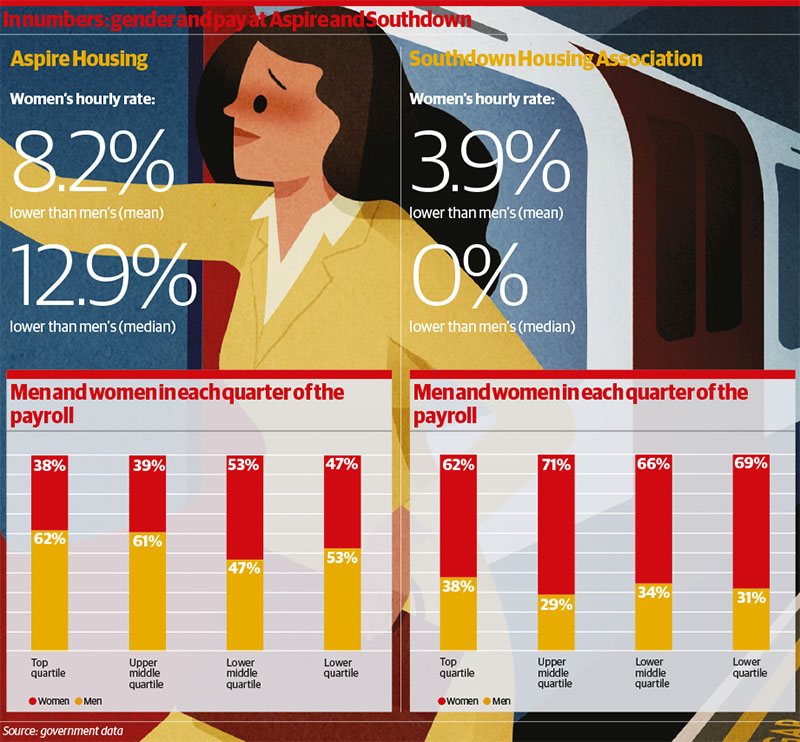
Aspire Housing, one of the first two housing associations to publish its data on the government website, has a median gender pay gap of 12.9%; Southdown Housing Association has no median gap. Neither organisation pays bonuses.
Ian Gleave, group head of HR at Aspire, expected the 8,500-home association’s results to be weighted slightly towards men because of two main issues: despite encouraging more women into trade roles, its operatives are predominantly male; and, while the association has a female chief executive, it is predominantly men who occupy senior management positions.
“[Gender pay gap reporting] is useful because it tells us there is still an issue… of how we encourage women to reach the top of the organisation,” he says. “And that there are still barriers to them doing that.”
A key consideration is helping women restart their careers after maternity leave, he says, adding that, historically, men may have been promoted while a woman at the same level was on leave and comes back to her same role. Mr Gleave says the association will ask women what they think is holding them back in terms of pay and causing the gap. It notified staff of the data via Yammer, an internal social network, and invited them to gather their thoughts ahead of the next quarterly staff forum.
Aspire Housing is also introducing a leadership and management development programme, with external mentoring to develop the careers of its female managers, and identify and help people who hope to be promoted into managerial roles.
Knock-on effects
Various issues could affect an organisation’s pay gap, including having a lot of female part-time workers or many roles that have traditionally been filled by men. Ms Watkins says the way in which salary sacrifice schemes are structured could also have an impact, as it tends to be women who take more advantage of these. “It’s gross pay [used for the calculations] – but it’s gross pay after salary sacrifice so you can’t add the value of childcare vouchers back in,” she says.
Employers can publish a narrative explaining any gap and planned action to close it. Aspire has produced a report but Southdown – two-thirds of whose 900 employees are women – has not. Vikki Hayward-Cripps, deputy chief executive of the 660-home association, which gets the majority of its income from providing care and support services, believes the reasoning is “too complicated to explain”.
“The bigger issue [for housing associations] is one of reputation within the workforce and potentially recruitment.”
She says: “It’s a statistical thing in terms of where men and women sit in the quartiles. We have no pay gap between full-time men and full-time women staff and no pay gap between part-time women and part-time men.”
Ms Hayward-Cripps says the overall mean gap is due to how men are distributed across the pay quartiles. Although there are more women in each quarter, the distribution of men across the organisation is higher in the top and lower middle quartiles.
She says Southdown is as flexible an employer as possible: a third of staff agreed changes to their work duties and patterns last year, while the landlord was named among the top 10 employers in 2016 by the work-life balance charity Working Families. The association also has a programme giving employees “information and encouragement” to think about promotions.
Employers must exclude from their calculations people on leave but not in receipt of full pay, such as those on maternity or long-term sick leave. Ms Watkins fears that a lack of inspection of how figures are calculated could leave “wriggle room” for employers on whose salaries they include.
Legally, there is nothing the government can do about gender pay gaps if an employer fails to produce the data, she adds. However she suggests the government or the Equality and Human Rights Commission might “name and shame” organisations that do not publish the information.
“The bigger issue [for housing associations] is one of reputation within the workforce and potentially recruitment,” says Ms Watkins. She suggests that if a female jobseeker is considering working for housing association X but sees that Y has a smaller gender pay gap, she may choose Y.
But gender pay reporting will catch the attention of existing staff, too. “It could cause employee relation issues, first and foremost because I think many employees don’t understand that gender pay is not the same as unequal pay,” says Ms Watkins. “I think the other issue is that it could uncover unequal pay issues if there is no justification for the gap.”
“There’s always been suspicion there may be unfairness in gender pay in housing associations.”
John Gray, branch secretary of the Greater London housing associations branch at Unison, advises any employee who feels unequal pay – which is illegal – is a contributing factor to an organisation’s gender pay gap to talk to their trade union. He adds: “There’s always been suspicion there may be unfairness in gender pay in housing associations so it’s a great thing that it’s being published.”
He is “really pleased” by the initial association responses, but adds: “The devil is going to be in the detail. I am going to be interested to see if there’s disparity in higher-paid staff and executives because social housing is predominantly a female industry.”
Melanie Rees, head of policy at the Chartered Institute of Housing, is unsure what gender pay gap reporting will tell the sector, or of its benefits. “It depends on what spirit it’s engaged with,” she says. “I think most organisations would come to do it with an intention of doing something [positive] as a result.”
Ms Spicer from Plus Dane says gender pay gap reporting is “really important”. But she recognises it is only one consideration in creating a balanced workforce that represents the community it serves: she says her organisation also needs to look at wider diversity issues and whether educational requirements for roles exclude people who take different routes into employment. “I think it’s really incumbent on all of us to say it’s not just about gender.”
Gender pay reporting explained

Under Equality Act regulations, employers (including housing associations) with more than 250 employees have until 4 April to publish information about their gender pay on their website and on a government website.
An employer must publish the results of six calculations for pay over a 12-month period:
- average gender pay gap as a mean average
- average gender pay gap as a median average
- average bonus gender pay gap as a mean average
- average bonus gender pay gap as a median average
- proportion of males receiving a bonus payment and proportion of females receiving a bonus payment
- proportion of males and females when divided into four groups ordered from lowest to highest pay.
The regulations specify how hourly pay, bonus pay and hourly rate should be calculated and in what circumstances agency workers and self-employed people should be included in the calculations
Results for individual organisations can be found on the government's gender pay reporting website here. Find results for housing providers by using the search boxes, or by filtering by sector.
Inclusive Futures

Inside Housing’s Inclusive Futures campaign aims to promote and celebrate diversity and inclusion.
We are pledging to publish diversity audits of our own coverage.
We are also committed to proactively promoting positive role models.
We will do this through the pages of Inside Housing. But we will also seek to support other publications and events organisations to be more inclusive.
Our Inclusive Futures Bureau will provide a database of speakers and commentators from all backgrounds, for use by all media organisations.
We are also challenging readers to take five clear steps to promote diversity, informed by the Chartered Institute of Housing’s diversity commission and the Leadership 2025 project.
THE INCLUSIVE FUTURES CHALLENGE
Inside Housing calls on organisations to sign up to an inclusive future by taking five steps:
Prioritise diversity and inclusion at the top: commitment and persistence from chief executives, directors and chairs in setting goals and monitoring progress.
Collect data on the diversity of your board, leadership and total workforce and publish annually with your annual report. Consider gender, ethnicity, disability, sexuality, age, and representation of tenants on the board.
Set aspirational targets for recruitment to the executive team, board and committees from under-represented groups.
Challenge recruiting staff and agencies to ensure that all shortlists include candidates from under-represented groups.
Make diversity and inclusion a core theme in your talent management strategy to ensure you support people from under-represented groups to progress their careers.
INSIDE HOUSING’S PLEDGES
We will take proactive steps to promote positive role models from under-represented groups and provide information to support change.
We pledge to:
Publish diversity audits: We will audit the diversity of the commentators we feature. We will formalise this process and publish the results for future audits twice a year.
Promote role models: We will work to highlight leading lights from specific under-represented groups, starting in early 2018 with our new BME Leaders List.
Launch Inclusive Futures Bureau: We will work with the sector to compile a database of speakers, commentators and experts from under-represented groups. The bureau will be available to events organisers, media outlets and publications to support them to better represent the talent in the sector.
Take forward the Women in Housing Awards: Inside Housing has taken on these successful awards and will work to grow and develop them.
Convene Inclusive Futures Summit: Our new high-level event will support organisations to develop and implement strategies to become more diverse and inclusive.
Related stories