You are viewing 1 of your 1 free articles
All eyes are on the Spending Review to solve the problem of how to ramp up development. Inside Housing gathered together our development panel to talk about what it will take to meet the UK’s ambitious housebuilding targets. Jenny Messenger reports
Housing associations have finalised their budgets and locked in development spending now the last financial year has come to an end. But any long-term certainty over issues such as the rent settlement and the next Affordable Homes Programme (AHP) is unlikely until the Spending Review in June.
The sector says decades of underfunding have taken their toll, forcing landlords to rein in development in order to continue investing in existing stock. Starts among the G15 group of London landlords, for example, fell by 34% in the first quarter of 2024-25.
For Scotland, the effects of a £200m budget cut for 2024-25 continue to be felt as the nation gears up for next year’s Holyrood election. And in Northern Ireland, the recent Programme for Government has set a target of 5,850 starts by 2027 – but currently the sector is managing only 1,400 a year.
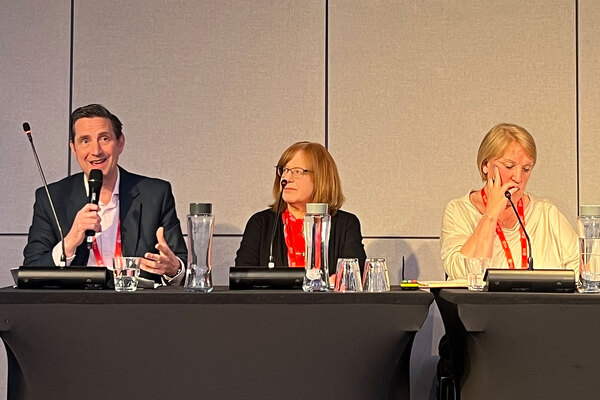
In these conditions, how can the sector recover enough development capacity to fulfil the UK’s housing targets? In England the government has pinned its ambitions on building 1.5 million homes within five years. Inside Housing’s development panel gathered on Teams to talk about what social landlords need from the government to contribute as many homes as possible towards that goal.
The event took place before chancellor Rachel Reeves announced a £2bn top-up to the AHP in late March.
We asked the panel – which is made up of some of the biggest builders of social housing across the UK – to share ideas about how to start more developments, their reactions to what has happened already and hopes for future policy changes.
In England, much of the lobbying has been around rent: a settlement that would see rents rise by the Consumer Price Index (CPI) plus 1% is on the table, and the sector has also been pushing for the government to restart a programme of rent convergence. The policy, which was scrapped by the former Conservative government in 2015, aimed to bring social rents gradually up to a “target rent”, and end the hodgepodge that sees residents paying quite different rents for very similar properties.
“Things like CPI plus 1% and rent convergence is just the bare minimum that we need to keep the wheels turning,” cautions Joe Marshall, regional managing director for the South at Sovereign Network Group (SNG).
Development directors on the call are split into those whose organisations have significant exposure to high-rise buildings – and the remediation or safety costs now associated with them – and those who do not.
Angie Hooper, new business director at L&Q, says the 109,000-home landlord has “over 2,000 buildings caught by the building safety review, which is diverting any development capacity away at the moment”.
“I’m slightly envious of what some of you have discussed this morning,” she says, alluding to the fact that the other participants mostly fall into the other camp. For landlords such as L&Q, access to building safety funds is key to their capacity to build more.
For the rest of the panel, the building safety picture is different. “We aren’t as encumbered as others are in the G15 in terms of building safety costs and remediation of fire safety issues,” Mr Marshall says.
Martyn Blackman, chief investment officer at Bromford Flagship, agrees. “The risk profile of our stock is relatively low. We’ve only got three high rises across 80,000 homes. We’ve not got the same drain on building and fire safety that maybe some of our peers have.”
With the Spending Review pushed back from spring 2025 to 11 June, Ms Hooper says the “big frustration” is the “delay in coming up with solutions”.
“By the time we’ve all got our heads around [announcements in the Spending Review] and understand what that means for all of us as organisations trying to contribute to the 1.5 million new homes that’s needed, the government will have lost a year already.”
Russell Baldwinson, executive director of development at LiveWest, says the landlord has been growing its development programme over the past two years, rather than scaling back. It plans to deliver 1,000 homes a year over the next five years, half of which will be for social rent.
“We’re in a financially resilient space, but obviously that’s not enabling us to significantly increase on our development targets, which I think is one of the challenges that a lot of organisations are facing,” he says.
For LiveWest, securing opportunities isn’t a barrier. Instead, the problem hinges on “the relationship between the cost of borrowing and the returns that we generate through our development activities. That is limiting what we’re able to do,” he says.
It is a similar story at Platform, where Paula Heatley, the landlord’s new homes delivery director, says its development programme is also continuing to grow.
“We’re not exposed to building safety in any significant way. We have 11 high rises across 50,000 homes and that has helped us to continue to grow our development programme.”
Mr Baldwinson points out that there will probably be “a three or four-year period leading up to 2029 where the focus of a number of organisations is going to be on building fire safety and legacy issues”.
“The quicker that can be worked through, the quicker those organisations will have capacity to develop homes,” he says.
What is the solution? For L&Q, it is not more land so much as about how to pay for developing it. “I actually own and control about 25,000 plots. About 2,500 of those can come forward in the next two years,” Ms Hooper says.
“But we need grant funding. We need access to the building safety funds,” she explains. “All the time that there is a delay to telling us how the [rent] settlement is going to look or what the Spending Review is going to look like, the temporary housing crisis is getting worse.”
One way of potentially increasing development capacity is through a merger, and the prospect of more merger activity is likely, according to many of our panellists.
Mr Blackman – who is joining the call on the day of Bromford’s merger with Flagship – says “consolidation is inevitable” to free up capacity.
“The smaller organisations aren’t going to be able to continue to deliver with the pressures they’ve got. I think there will be more and more merger activity in the coming years.”
The merger with Flagship, Mr Blackman notes, has created room in the business to deliver around 7,000 extra homes over the next 15 years, in addition to what the two organisations were delivering separately.
For Mr Marshall, there is a possibility that Sovereign and Network Homes would not have been able to go on developing at the same rate in London specifically if the organisations hadn’t merged in October 2023.
A legacy pipeline of Section 106 properties, as well as less exposure to contractor insolvency, have also helped SNG to protect its developments. The landlord completed 2,015 homes in 2023-24, up from 1,879, and ranked second in Inside Housing’s Top 50 Biggest Builders list last year.
The merger has “given us the mandate to go out and acquire new opportunities”, Mr Marshall says, and the landlord has ambitions to build 25,000 homes over the next decade. “But again, in that context of 1.5 million homes, it goes to show the scale of the challenge.”
New mandatory housing targets mean local authorities may find themselves having to aim for higher numbers of homes than they initially planned for.
Setareh Neshati, head of development at Westminster City Council, says current comparisons with the London Plan for Westminster look “very rosy”, but as the London Plan is updated over the next two years, things may change.
“Our focus quickly shifted to creating a new pipeline, because that’s where the pressure is, and that’s how we will be assessed going forward,” she says.
Ms Neshati says the council is currently on target and halfway through delivering its 4,000-home programme, and is about to start planning the new pipeline to make sure it keeps up with any revised targets.
“We have to try harder and be more creative. And I don’t know whether that’s even good enough.”
The panel met before the government published a consultation on its Planning and Infrastructure Bill, squarely aimed at increasing delivery. But members already had ideas about what could change. One came from L&Q’s Ms Hooper, who says “we need a tweak to planning committees”.
“If a scheme has been approved by an officer’s recommendation and fits into the local plan, the committee members will have already signed off the parameters of local plans. Why does it need to go to a committee to get an approval?”
A common theme throughout the discussion is long-term commitment – something echoed in conversations taking place across the sector.
“One of the things we’ve been talking to MHCLG [the Ministry of Housing, Communities and Local Government] and Homes England about is moving to a more long-term, place-based and scale-based investment model,” which would stretch 10 to 15 years, Mr Blackman explains.
Lindsay Lauder, director of development and regeneration at Wheatley, says despite the budget in Scotland being restored after a 26% cut for 2024-25, it has damaged development pipelines.
“There is a large onward impact in terms of the sites that have effectively been stalled,” she says, with some developments now prolonged over a number of years.
“I think really the big ask for us would be a longer-term commitment on funding. It’s got to be a multi-year funding package, as opposed to working on an annual basis,” she says.
Around 500 homes could be brought forward in a few months, Ms Lauder says, if the Scottish government could put together a catalysing funding package.
“We can play our part in that through the provision of land, through accessing partnership support for regeneration, and trying to create joint venture vehicles that would bring the private sector in, but it really needs to be more widely supported through investment in city strategies,” she explains.
Jan Sloan, executive director of development and new business at Clanmil, outlines a similarly tentative picture in Northern Ireland, where the sector’s capital budget has been “utterly decimated” over the past year and has only recently begun to recover.
After setting an initial budget for 2024-25 capable of delivering just 400 starts, the Northern Ireland Executive allocated an extra £24m in November 2024, which shifted that figure to 1,500 starts.
Yet the sector is still uncertain how it will meet the annual need of 2,200 homes.
“We’ve no line of sight as to what a finalised budget is going to look like. But certainly, the mood music suggests housing will be a priority,” Ms Sloan observes. She adds: “It’s very easy to turn development off, but it’s very difficult to turn it back on again.”
Other ways to boost delivery could simply be through working together more closely. Adunni Adams, senior development professional at Qualis Commercial, an offshoot of Epping Forest Council, says there needs to be greater teamwork between the private sector, local authorities and housing associations.
“I still think there are concerns around competitiveness,” she notes, adding that there “needs to be more of a concerted effort to trust one another across our various sectors”.
Overall, the panel broadly agrees that slight increases in output are not going to deliver the number of homes needed. “Nationally, if we all did slightly more, we’re going to struggle to deliver the 90,000 social rent, 135,000 affordable homes per annum, which are going to support 300,000 homes,” says Mr Baldwinson.
And even if the next grant-funded programme is the “biggest and best” in its history, deeper changes are needed, Mr Blackman cautions.
“I can see [the programme] being materially under-subscribed because the capacity isn’t in the sector,” he says. “It’s political, isn’t it? The government needs to deliver, in a five-year chunk, and they’re worried about getting re-elected in five years’ time.”
Inside the government’s ‘disastrous’ military housing deal
In December 2024, the Ministry of Defence agreed to buy back thousands of military homes from the private equity-backed firm it sold them to in 1996. Jenny Messenger finds out how it happened
What do the AHP top-ups mean for development?
The chancellor’s Spring Statement included a much-needed top-up for the Affordable Homes Programme. Dubbed a “down payment” on the next scheme by the government, is this funding enough to bridge the gap for development? Jenny Messenger finds out what the sector is thinking
Stock transfers and development deals: the new wave of delivery by for-profits
For-profit housing providers have entered the affordable housing space in a big way. James Riding and Jenny Messenger find out who the biggest players are, who is backing them and what strategies they are taking
Inside Housing Repairs Tracker 2025
Housing providers in England are spending record amounts on repairs and maintenance. Our annual tracker looks at who is spending what, and why. Jenny Messenger reports
Already have an account? Click here to manage your newsletters
Inside Housing and the Pension Insurance Corporation are collaborating on a pivotal research project to support the growth of homebuilding in England, and we need your expertise.
This important study will kick-start the Housing 2025 event in June and open the Metro Mayor’s Question Time session.
Our survey explores the mechanisms already in place to support affordable housing, infrastructure and community development, as well as the plans and innovations that will help increase the number of homes built. We expect the survey to take approximately 15 minutes.
By participating, you’ll receive a copy of the full research report and be entered into a prize draw for a chance to win more than £1,500 worth of prizes.
Your insights are essential – help us shape the future of housing in England.
Related stories