You are viewing 1 of your 1 free articles
Lost in translation
What role - if any - should housing play in preserving a language? Helen Clifton visits Wales to investigate a housing debate with a linguistic twist


Source: Colin McPherson
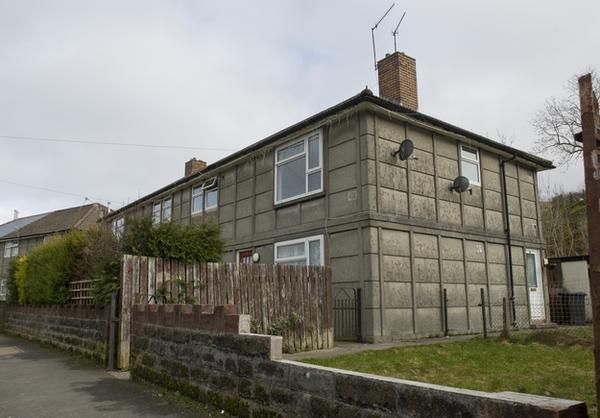
One look at Craig ab Iago’s house reveals his passion for his homeland. Underneath the distinctive Welsh flag is a sign commemorating his as one of the first affordable homes in Llanllyfni, north-west Wales, that reads ‘Cymdeithas Tai Gwynedd. Thanks for 45 years of voluntary service’ and the names of two of the organisation’s founders. The home was built in 1971 by a small local charity, Tai Gwynedd, to provide affordable housing to local people in this predominantly Welsh-speaking rural community.
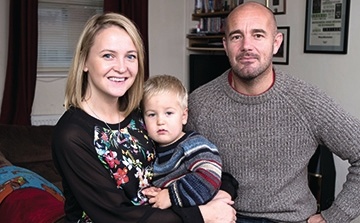
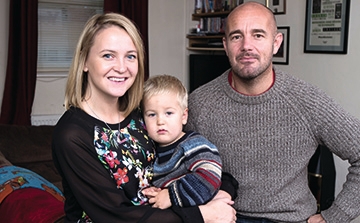
But the Plaid Cymru councillor (pictured with partner Llio Wyn and son Ynyr) for the Llanllyfni ward of Gwynedd fears that a joint plan by the Isle of Anglesey and Gwynedd county councils to build 7,665 homes throughout the two North Wales counties by 2026 – without a clear commitment to creating more affordable housing – would be a disastrous blow for the Welsh language heartlands.
‘Welsh is a marker for our community. We have a way of life that people have lived for hundreds of years. But the community is being ripped apart,’ he says.
Up in arms
Llanllyfni sits between the Snowdonia National Park and the beautiful North Wales coastline, at the heart of a region that attracts millions of tourists every year. It als sits at the heart of a debate over the future of the Welsh language, which is intimately tied up with prosperity, government house-building targets, second homes and the allocation policies of local councils. Inside Housing has travelled to visit the community to find out if plans to alleviate a housing problem could be about to start a new identity crisis in rural Wales.
This is certainly a major debate in the country at the moment. The Welsh Language Society, for example, says the Welsh Assembly’s newly published draft Planning Bill needs to give authorities the power to refuse developments on the grounds of language concerns. The society adds that the government-issued language technical guidance for councils should be made mandatory.
It has taken direct action on the issue. In February 2014, six protestors from the society were arrested after chaining themselves to the gates of the Welsh Government offices in Llandudno. In March, supporters chained themselves to regional government office gates in Aberystwyth. In April, they staged sit-ins and spray-painted Welsh government offices in Cardiff. The society has also run poster campaigns on road signs and in parliamentary offices. Protests have been held nationally as well as in Gwynedd, with the biggest turn out around 500 people in Caernarfon in March.
To understand Gwynedd’s place in this unusually linguistic housing crisis, it’s important to know some facts about the region. The local economy is dominated by tourism and agriculture, but seems to have failed to deliver prosperity: rural parts of Gwynedd are amongst the 20% most deprived in Wales. As a lack of work forces young people to emigrate, retirees and holidaymakers continue to move in; in 2010, there were over 8,000 registered second homes in Gwynedd. Affordable housing is at a premium for local Welsh speakers.
“Current planning law does not recognise that we have a language which is having to fight for its survival.”
According to the Land Registry, house prices in Gwynedd more than doubled from £56,413 in April 2001 to £138,944 in January 2014, a much steeper rise than the 85% seen across England and Wales in that time period. There are 2,361 people waiting for social housing in Gwynedd – over 90% of whom have a local connection.
Campaigners say this mix of factors is putting the Welsh language under huge pressure. According to census data, the number of Welsh speakers in Gwynedd, despite being the highest in the country, dropped from 69% in 2001 to 65.4% in 2011. Nationally, 23.3% of the Welsh population aged three or over were able to speak Welsh to some degree.
Local connection
‘The houses here are so expensive. I couldn’t afford to live here without social housing,’ says Sioned Fflur, 29, a support worker and tenant with 29-home landlord Tai Gwynedd. ‘There was a house for sale locally for £400,000. Nobody round here could afford to buy it.
‘It’s ridiculous to build 8,000 new private homes that are definitely not affordable for people who live around here. I am worried about the language. You’ve got more and more people moving into the area, but they move here to retire or to buy second homes.’
Source: Colin McPherson
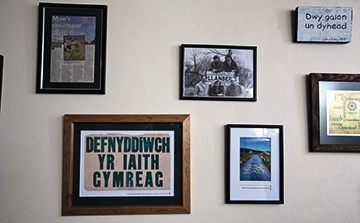
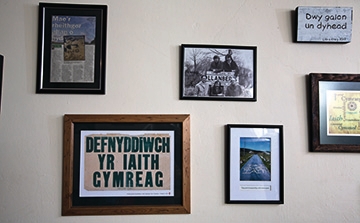
Welsh memorabilia in the home of Craig ab Iago at Llanllyfni, Gwynedd, north Wales
Neighbour Julie Jones, 38, a school cook and tenant of 6,300-home housing association Cartrefi Cymunedol Gwynedd (CCG), agrees. ‘It’s weird. It’s like living in England,’ she says. ‘A lot of people I know would like to buy houses, but they just can’t afford it.’
The issues become even more concentrated as you travel down the beautiful Llyn peninsula to the coastal village of Abersoch. An area of outstanding natural beauty, around 45% of all properties in Abersoch are second homes.
In 2006 the average price of houses sold in Abersoch was £380,000 – 15 times the average income. And as locals struggle, in October a house with a helipad and heated outdoor swimming pools was put on the market for £1.5m.
Gwynedd Council does have tools to tackle the problem. The new Welsh Housing Bill gives local authorities powers to double council tax on second homes. Gwynedd has demanded that 30% of recent developments are made affordable, which it has defined as around 45% below market price.
But taxi firm owner and CCG tenant Paul Harding, 33, says this rarely works in practice.
‘There were some flats built recently, and the cheapest was £595,000. That’s like London prices. So even the so-called affordable houses are priced at around £200,000, which is still out of reach for local people.’
Although originally from Chichester, he says he ‘totally respects’ the Welsh language.
“If you look after the community, the community will take care of the language.”
‘The Welsh language is really important to my partner and two sons. But as more people move into the area, they just don’t learn the language. And it is dying out because of it.’
Cymdeithas yr Iaith Gymraeg, the Welsh Language Society, is firmly opposed to Gwynedd Council’s housing target, which aims to see 7,665 homes built by 2026.
‘If you allow housing to be built by private developers and bought by the highest bidder, they will not be owned by Welsh speakers,’ explains Toni Schiavone, the society’s sustainable communities spokesperson.
‘There is insufficient economic development to ensure that Welsh speakers can remain in the area. But housing needs to be built to meet that need.’
The Welsh Language Society’s direct action approach has certainly been gathering momentum. In early November, Welsh council leaders wrote to the Welsh minister for natural resources, Carl Sargeant, demanding that councils have the power to decide housing targets independent of central government, and block developments on the grounds of language concerns.
‘I definitely feel that we have changed opinion,’ explains Mr Schiavone. ‘We accept the need to have a more sophisticated planning system. But current planning law does not recognise that we have a language which is having to fight for its survival.’
Mr Sargeant insists that the current guidance, together with the new bill, provides the ‘right tools for the job of delivering the Welsh language.’
‘Growth for the future and looking at what the opportunities are for communities is a very important part of the Welsh language. We have to be very careful. If you don’t have development, then you put communities at risk,’ he adds.
Housing associations are caught in the middle. Both CCG and the 4,500-home Grŵp Cynefin are undeniably committed to the language. The vast majority of their staff are bilingual, and they operate in Welsh.
Yet they face criticism that they aren’t innovative enough. Mr Schiavone also questions the April merger between Cymdeithas Tai Clwyd and Cymdeithas Tai Eryri that created Grŵp Cynefin. He would prefer a system of smaller, locally based organisations, like Tai Gwynedd.
But Walis George, chief executive of Grŵp Cynefin, says his organisation is still driven by a strong commitment to protect local communities.
‘Back when we were set up in the 1970s, it was very much about reducing the number of people moving out of these areas. And I am very aware of that legacy.’
He says the merger was about building capacity to ‘do more’; Grŵp Cynefin plans to spend £21m on 200 new homes by 2017. The Welsh Assembly has committed £120.6 million to housing associations over the next two years, and social landlords will build 1,100 homes across North Wales by 2020.
‘Because of the social and economic changes in the area we have a long-term commitment to making communities more sustainable in the future. And that means doing much more than building bricks and mortar.’
Grŵp Cynefin has part-funded an enterprise centre in the tourism-dominated Llyn Peninsula to boost the local economy. And its rural housing enabler, part of a network of independent experts working in rural communities across Wales supporting the delivery of homes for local people, helps villages find solutions to their housing needs.
Language of love
Back in 2004, the community council in the 80% Welsh-speaking Bala village of Llanuwchllyn, sick of the lack of affordable housing, worked with the housing enabler to take matters into their own hands.
They set up an informal society, Sylfeini (or, in English, Foundations), and teamed up with Tai Clwyd (now Grŵp Cynefin), which bought land from Gwynedd Council at less than market value in order to build four eco-homes.
‘It was about looking after the local community and people,’ explains Huw Antur, a member of the community council for 25 years. ‘And if you look after the community, the community will take care of the language.’
Despite the successful partnership, there is a feeling that some local social housing has been allocated without proper thought. A block of flats built in the 1970s has attracted anti-social behavior and become hard to let.
‘Problems like this are exaggerated in a small community like ours,’ Mr Antur explains. ‘The social housing system hasn’t always worked for the benefit of the community.”
Mr George says such issues are being tackled. In Gwynedd, maximum social housing priority is given to those with a five-year county and community connection, while in Snowdonia National Park, ‘local’ is defined as those with a 10-year connection.
“We are not diluting the language. We are adding to it.”
Anne Foote, CCG tenant
‘We would prefer to look at the strategic disposal of individual properties rather than house people who don’t have a local connection,’ he says. ‘The strength of the Welsh language is a litmus test of the health of these communities.’
But, Mr Sargeant says, healthy Welsh communities don’t have to be Welsh speakers, and housing and planning needs to be designed so that newcomers feel welcome.
‘We have very diverse communities right across Wales, where they aren’t first language Welsh communities, but where Welsh is doing really well.
‘Wales shouldn’t be anti-English or anti-anywhere.’
CCG tenant Anne Foote, 59, is originally from Zambia. She has lived near Bethesda for 35 years, and describes her son as a ‘proud Welshman’.
‘We don’t want to marginalise or isolate the people who live here and contribute to the economy and raise their children as Welsh speakers. We are not diluting the language. We are adding to it. We need to focus on getting people to speak the language, and not worry so much about newcomers flooding in,’ Ms Foote adds.
‘The same low-paid jobs are available to newcomers as to locals - so they will have the same problems.’
But campaigners insist that defending the Welsh language is not about being anti-English. Their priority is to protect the natural beauty of North Wales from over-development, while giving Welsh speakers the opportunity to stay where the language still thrives.
‘Welsh is part of the heritage of the whole of Britain,’ Mr Schiavone says. ‘It is the world’s oldest living language. We should all be working to protect it. It is not my culture. It is our culture.’

Related stories