Model city
It’s had its detractors over the years, but research shows that Milton Keynes has one of the strongest economies in the UK. Here, Kate Youde finds out how its pro-development approach to housing has played a key role in the city’s success


With its concrete cows and numerous roundabouts, Milton Keynes has been the butt of a fair few jokes over the years. But now, thanks to the city’s economic success, it looks like its residents are having the last laugh.
Think tank Centre for Cities’ latest Cities Outlook - a ‘health check’ of the UK’s 64 largest towns and cities - reveals Milton Keynes has one of the country’s strongest economies. Employment and business start-up rates are high and house price rises are low.
But what role has housing development played in the borough’s success, and are there lessons to be learned from its approach?
Milton Keynes was designated as a ‘new city’, designed to disperse population following World War II, in 1967. Situated in Buckinghamshire, it enjoys good transport links: the west coast mainline provides rail access to Birmingham in 55 minutes, London in 35 minutes and Manchester in an hour and 35 minutes, while the M1 motorway is also on its doorstep. As resident Paul Hollingsworth puts it: ‘It’s bang smack in the middle of
everywhere you need to get to.’
With a 17 per cent population increase from 212,700 in 2001 to 248,800 in 2011, it is also the UK’s fastest-growing city according to Centre for Cities, although it is technically a town with ambitions. Last week it was confirmed as on of 20 areas invited to bring forward proposals as part of the government’s city deals programme. Yet its house prices remain below the English average of £249,000: they were £219,000 in the third quarter of 2011.
This is partly explained, according to Centre for Cities, by the town’s ‘pro-development stance’ and the fact supply has moved broadly in line with demand. Milton Keynes’ housing stock grew by 18 per cent between 2001 and 2011 from 86,480 in 2001 to 101,650 in 2011 - the largest expansion in any English city. The fact house prices are lower than many other cities in the south east, the report adds, makes it easier for people to access job opportunities in Milton Keynes’ economy.
Diverse economy
It is a broad economy that does not rely on one particular industry. Nearly 86 per cent of employees work in the private sector. Retail is the biggest industry, accounting for 10.1 per cent of employment. But over the years, the city has attracted a diverse range of employers, from Formula One team Red Bull Racing to the bank Santander. The soft drinks manufacturer A.G. Barr is creating 100 jobs at its new 265,000 square feet manufacturing and logistics facility at Magna Park, a logistics and warehousing development on the edge of the town.
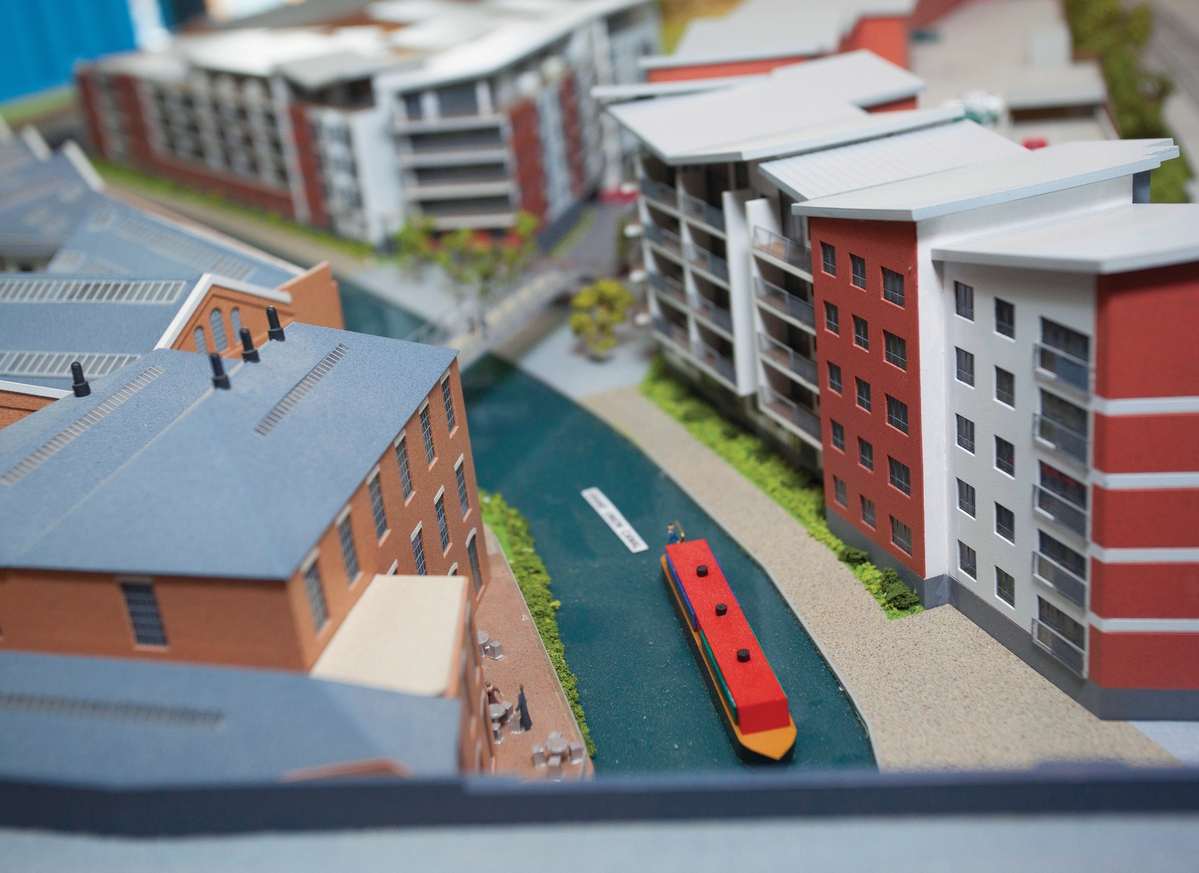
A model of the completed site
Last summer, Network Rail opened a new 400,000 square feet national centre in the middle of the town, employing 3,000 staff from across the country, on the site of the former national hockey stadium. Russell Spink, Network Rail’s media relations manager, says location was the company’s prime concern, but the availability of housing nearby was ‘one of the key considerations’.
Some employees have moved into 62,000-home housing association Places for People’s Wolverton Park scheme, a 300-home mixed tenure development in a historic former railway works three miles to the north-west of Milton Keynes. Pete Treadwell, PfP’s site services officer, estimates about 7 per cent of residents work for Network Rail - the scheme’s proximity to their workplace a key selling point.
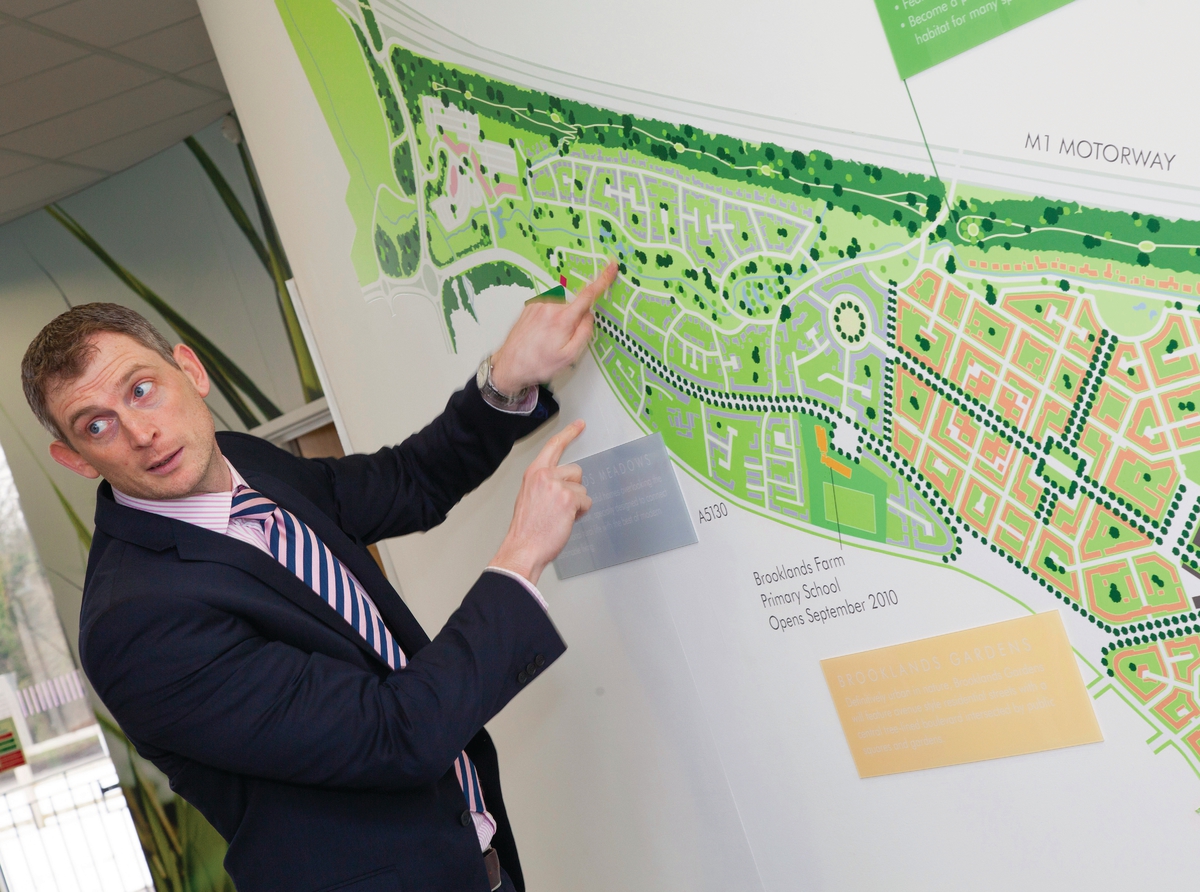
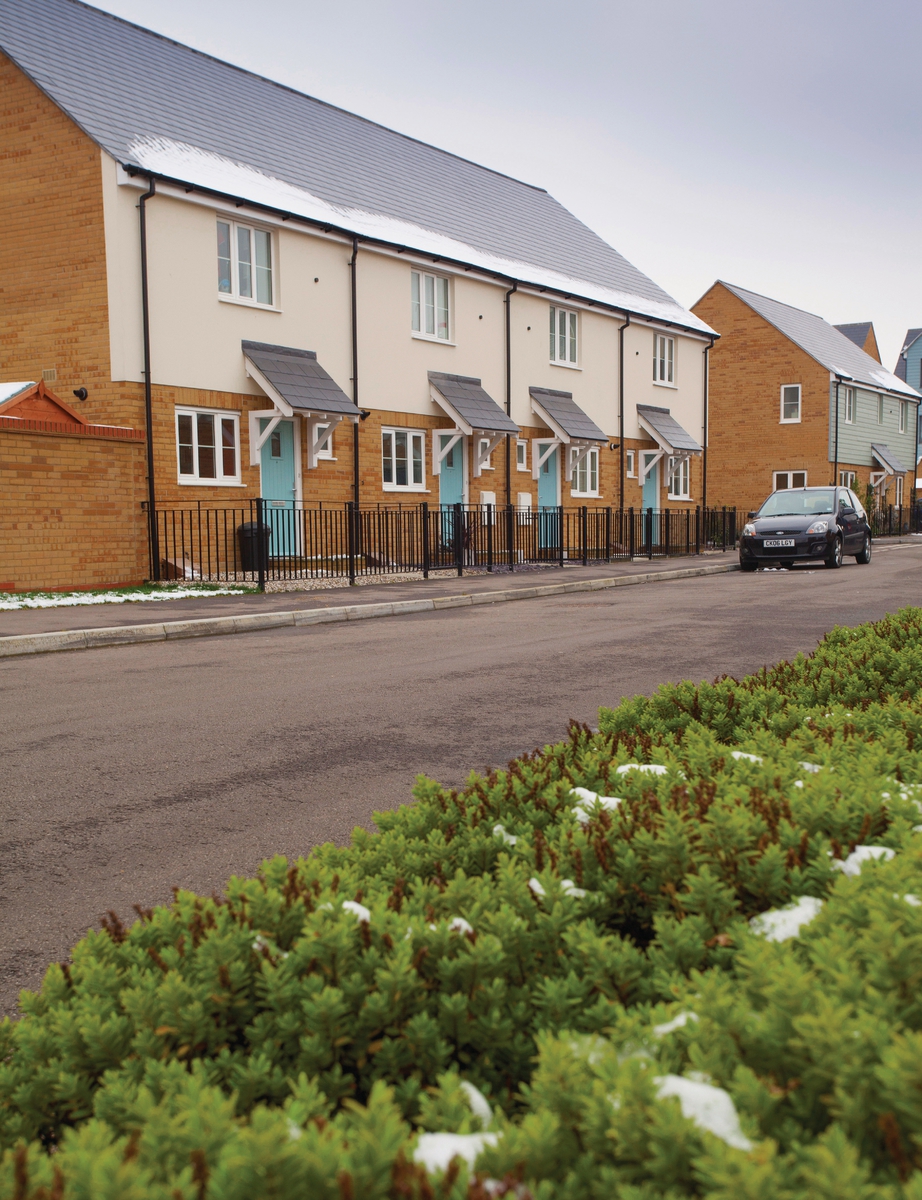
PfP is also developing Brooklands, a £500 million scheme east of Milton Keynes, where 2,500 homes - 25 per cent for shared ownership and 5 per cent for affordable rent - will be built over the next 10 years as well as new schools and commercial spaces. Two hundred homes are already occupied following completion of the first stage.
The company has worked with the Homes and Communities Agency to offer a ‘flexible tenure’ model, which allows individuals to choose from a range of options to suit their needs, including buying outright, shared ownership and rental. Simon Elcock, project director for Brooklands, says this gave the company a greater degree of confidence to come forward with a development at a time when the ‘degree of market take-up was something that was a little unknown’.
He adds the fact Milton Keynes is a new town means there is an ‘expectation of growth’.
‘There are places where some developers had planning applications refused or met difficulties, but that’s more around the structure of the development rather than the argument of whether or not there should be development,’ he adds.
There is no shortage of demand for property at Brooklands, despite prices being about 8 per cent higher than the local market at £122,500 for a one-bed flat to £420,000 for a five-bed detached house. One reason for this is that, according to PfP, infrastructure such as roads, children’s play areas and 30,000 trees are already in place so customers do not have to buy on a promise. When PfP released properties for the first phase, people queued overnight in the sales office car park.
Building communities
Douglas McCall, leader of the Liberal Democrat group at Conservative-run Milton Keynes Council, says the reason the city has grown so successfully is because it does not just build houses. ‘We build houses and parks and schools and all the other social infrastructure that goes with it,’ he says. ‘It’s about building communities.’ He supports the approach of ‘pepper potting’ (where affordable, shared ownership and outright sale homes are mixed together) to build a ‘real community’.
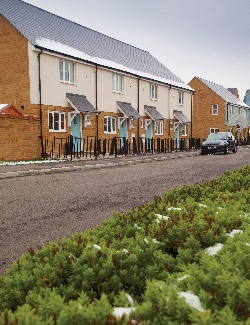
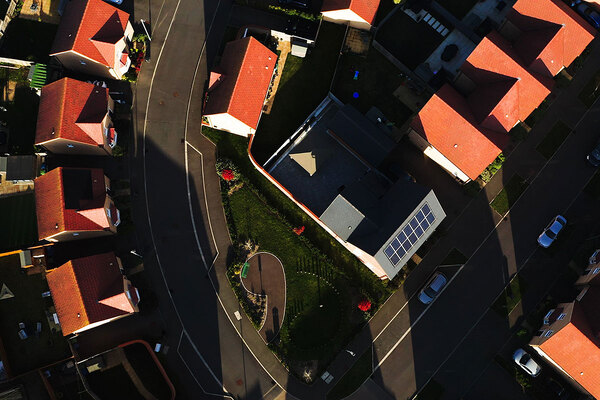
Places for People’s £500 million Brooklands development. Over the next 10 years, 2,500 homes will be built on the 360-acre site
While house building in Milton Keynes has slowed during the economic downturn, as it has nationally, the town has still had the highest housing stock growth in the UK. It increased 1.3 per cent between 2010 and 2011, from 100,360 to 101,650.
During 2011/12, the number of completed homes rose to 1,580, of which 467 were affordable housing - 0.5 per cent below the 30 per cent policy the council adopted in its 2005 local plan under the former Lib Dem administration.
And the development is set to keep on coming. The council has a core strategy target of building 1,750 homes per year up to 2026 - 28,000 in total. It has commitments to accommodate 25,531 homes and forecasts 10,664 will be built over the next five years. The HCA is doing its bit to help. In January it transferred £32 million of land and property assets - including sites for new homes - to Milton Keynes Council.
To ensure housing growth balances with employment growth, the local authority has a target of creating 1.5 new jobs per new dwelling - although there are no specific incentives to ensure this. Iain Stewart, the Conservative MP for Milton Keynes South, believes what has made the town a success is that housing development and economic development has gone hand-in-hand.
‘Sometimes our national image belies what we’ve got,’ he adds. ‘Some people say Milton Keynes is just roundabouts and concrete cows; the reality is far, far different.’
With so much development, you might expect some objection from residents. Yet, far from being nimbys, all the locals Inside Housing meets on a cold, grey day in the town centre are supportive of development. From teenage students to pensioners, they are united by a love for their home town. But then, as many remind me, they are used to constant development.
Strain on healthcare
Can the city’s infrastructure cope with the rate of expansion, however? Retired Marks & Spencer employee Lynne Balchin, 67, who has lived in Milton Keynes for 30 years, says a new hospital is needed. ‘[The current] one can’t keep up with the amount of people we have in Milton Keynes now and there isn’t anywhere else they can expand down at the [existing] hospital,’ she says.
Conservative MP Mr Stewart, who campaigned in the 2010 general election on a platform of ‘I before e: infrastructure before expansion’, agrees the hospital is ‘absolutely an issue’.
‘The accident and emergency department was built to cater for the region of something like 20,000 patients a year,’ he says. ‘It’s now almost four times that.’ He met the health secretary Jeremy Hunt last month to press the case for an expanded A&E.
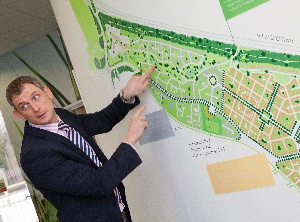
Tom Mahood, national sales and marketing manager at Places for People, points out the Brooklands plans
David Hopkins, deputy leader of the council, says Milton Keynes has ‘built in a degree of future-proofing’ into its infrastructure thanks to its grid road system. Many roads are already dual carriageways, or there is land available to make them so. He says the capacity is there if the city wanted to move towards a rapid transit public transport system in the future - although there are no current plans to do this - and adds it is already improving transport links.
There is a downside to the fact Milton Keynes was built for cars, however: its carbon dioxide emissions are 7.4 tonnes per person. This is the 11th highest level of the places analysed by Centre for Cities.
While there is the land allocation to develop at sustainable density levels outside the centre, Mr Hopkins says the local authority faces a challenge in central Milton Keynes, which was designed around a city with a population of 250,000. It is projected to have 305,000 residents by 2033.
But, for now, he says there is ‘room for another two or three Network Rails’ to move their businesses into the town. The council is also looking at some buildings developed 30 years ago, which may not be fit for purpose now but could be redesigned to meet employers’ needs.
When it comes to lessons other cities could learn, Mr Hopkins believes much is down to ‘the intangibles’.
‘A lot of the success of Milton Keynes is based around its people, because at the end of the day you are only building bricks and mortar… but it’s actually the enthusiasm of this “can do” feel about Milton Keynes that makes it quite unique,’ he explains.
‘It works in Milton Keynes; it may not work in the north east, the north west or in the south east of England. It is a unique combination of people, of location, of transport links, of education and skills and, I would
say this, a local authority in particular which is very positive moving forward.
‘We have a model here in Milton Keynes that works for Milton Keynes, and we ain’t going to break it.’

Saaira Gill, 26, who is training to be a trademark attorney at Urquhart-Dykes & Lord, commutes from Birmingham, but is moving to Milton Keynes: ‘I like the fact everything is so close and so accessible but the only downside to Milton Keynes is that, for me, it’s lacking in character.’

Michael Athanasiou, 22, who works for Santander, bought a home in the central Vizion development, built by Abbeygate Developments and Helical Bar: ‘It’s exciting to be part of Milton Keynes’ future. I have got a flat and it was easy for a first-time buyer my age to do it. I did shared ownership.’

Sheila Goldsmith, 63, an administration team manager at Milton Keynes Council, worked previously in the planning department for 20 years: ‘I think the infrastructure is very good. It’s usually put in before the housing gets there; it’s carefully thought out. Personally speaking, I like the growth.’

Project co-ordinator Ruwaida Denn, 29, who is married with two children, moved from London four years ago: ‘I love Milton Keynes because it’s spacious and because I have a family: it’s family-friendly. It’s not as hyped as London, the pace is slower and you have everything really.’

Hubert Mandiangu, 31, who is looking for a job in security, moved to the UK from Congo three years ago: ‘I think this is a good place for me because I lived in Swansea before and didn’t find a lot of jobs. Here, I [have found] two or three times [the jobs].’

Paul Hollingsworth, 28, who works at Santander, bought a home with his girlfriend in the Downs Barn area of the city: ‘If Milton Keynes is expanding I don’t need to move elsewhere to work. I can stay here and match my ambitions.’





Related stories