You are viewing 1 of your 1 free articles
Sir James Cleverly interview: regulation is ‘always the wrong answer’
Shadow housing secretary Sir James Cleverly shares his views on Grenfell, the Renters’ Rights Act and the Conservative Party’s pledge to end stamp duty. James Riding reports


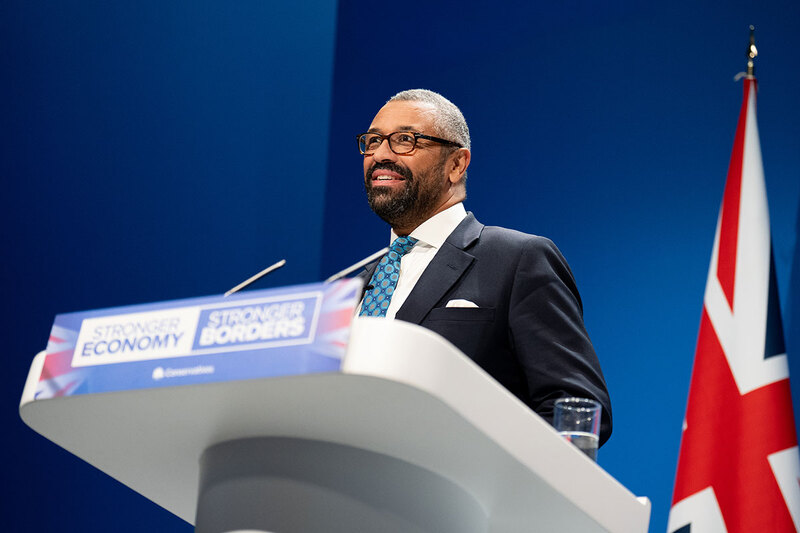 Shadow housing secretary Sir James Cleverly shares his views on Grenfell, the Renters’ Rights Act and the party’s pledge to end stamp duty. James Riding reports #UKhousing
It has been a difficult 18 months in opposition for the Conservatives. Kemi Badenoch’s party is once again in second place in the polls, but most of the movement has come from a collapse in support for the Labour government and the rise of Nigel Farage’s Reform UK. More in Common currently puts the Tories on 23% – more popular than Labour (19%), but behind Reform (31%).
The Conservatives need policy announcements that will turn heads and generate headlines. And strikingly, they have turned to housing. In her first conference speech as party leader in October, Ms Badenoch pledged to abolish stamp duty on primary residences, saying it would help first-time buyers and pensioners looking to downsize. Her shadow housing secretary, Sir James Cleverly, was delighted.
“This was part of my sales pitch when I was running for leadership,” he tells Inside Housing during a half-hour interview in his Portcullis House office, opposite the Palace of Westminster.
After Sir James stood unsuccessfully to replace Rishi Sunak as Tory leader, Ms Badenoch, who won the contest, brought him back into the shadow cabinet in July 2025.
Read more



“At the moment, we have real stagnation in the residential property market,” he says. “We don’t have churn. We have older people who are disincentivised from downsizing. And because of that, what we’re not getting is that natural step-up-the-ladder process.”
Indeed, many academic economists have long argued that stamp duty is flawed.
If stamp duty is “a bad tax”, as Ms Badenoch puts it, why not go further and scrap it on homes bought by companies? Until 2024, institutional investors used to get a stamp duty discount on bulk purchases of flats.
“We are not seeking to help businesses get property portfolios,” Sir James rejoins. “That’s not what we’re focusing on. We’re focusing on people.”
Sir James is one of the last remaining Conservative big beasts in the shadow cabinet. He gained wide public recognition serving as education secretary under Boris Johnson, foreign secretary under Liz Truss and Mr Sunak, and home secretary under Mr Sunak.
In person he is sharply dressed, with an Apple Watch on his right wrist and a gold analogue watch on his left. He is warm and affable and remains focused on our conversation as bells ring around us, indicating the votes going on in parliament.
The Conservatives say their stamp duty cut would cost £9bn a year, which would come out of £47bn of savings identified by shadow chancellor Mel Stride. Sir James also hopes the cut would generate tax revenue as more people move house and renovate their new properties.
As the Labour government pursues higher taxes and higher spending, the Conservatives argue that they are the only party prioritising spending restraint. Which prompts the question: what would the Tories cut from the housing budget?
The party’s proposed £47bn savings figure includes £4bn worth of housing cuts from 2029-30, supposedly from ensuring benefits and social housing are reserved for UK nationals. I push Sir James for more specifics.
“We’re looking to reduce the headcount of the Civil Service, quangos, the wider pool of people who are basically paid directly by the state,” he says. “Exactly how much of that will come within the housing department, that’s hard to say.” It is not one of the highest-spending departments in government, he notes.
But he does single out the planning system as a target for cuts. “The planning process is complicated,” he says. “It’s driving a lot of bureaucracy within not just central government, but local government as well.
“One of the things I will definitely be looking at is how we alleviate that cost and bureaucracy and, by extension, reduce the necessary head count of people on the public sector payroll that is dealing with this.”
What is missing from his analysis is that the planning industry has already been hit by council budget cuts over the past 15 years. Planning departments are spending a fifth less in real terms than they were in 2009, according to the Royal Town Planning Institute. In fact, many developers are calling for more funding for planning departments, rather than less.
“We are not seeking to help businesses get property portfolios. That’s not what we’re focusing on. We’re focusing on people”
There is a deeper question behind the Conservatives’ promises to rein in spending. Are they simply eyeing up waste, or are they willing to make more difficult choices about what to cut?
“We should always look to push down on waste,” Sir James says. “But ultimately, one of the things that we have to be realistic about [is]… we need to do less stuff.
“We need to make sure the stuff we do, we do well, but we shouldn’t have this octopus-like desire to have our tentacles in every element.”
He cites the Renters’ Rights Act 2025 as an example of “more and more intrusive activity in government”. The legislation “won’t deter bad actors”, who already ignore the rules, but will pile more pressure on landlords who play by the rules.
“You’re not solving the problem,” he says. “You’re just creating more friction, more inertia.”
So, would the Conservatives reverse the Renters’ Rights Act? “Well, we’re on record as saying this is the wrong direction of travel,” he says. “Renters need protecting, no two ways about that”, but he would take a “much more targeted approach”.
How can the government turbocharge housebuilding when the public finances are stretched? Housing association L&Q, economist Dame Kate Barker and property agency Savills are among those calling for US-style tax credits to raise the funds to build 90,000 social rent homes a year. Are the Conservatives interested in this policy?

Sir James won’t be drawn on the details. “There’s a long way to go between now and the next general election,” he says. “We want to use the time that’s been forced upon us by the electorate to actually get policies right, rather than just announce stuff quickly.”
But he is speaking to international counterparts about their efforts to grow housing supply.
“The bottom line is greater involvement of the private sector, I think, is essential.” He wants to get more players in the market and support small house builders. Would he, therefore, encourage the growth of the for-profits – registered providers backed by private capital?
“I’ve not spoken to anyone in the social housing world that thinks the quantum of money in that system is enough,” he says. “Everyone agrees you want more money in the system. So then the question is, where’s that money going to come from? Is it going to come from central government? Well, I think the Treasury is sending some pretty strong signals that that ain’t going to happen.
“So then the obvious question is, what is more important to you: an ideological position, where you’re wedded to ‘there must not be private sector money coming into this system’? Or are you more focused on outputs? I’m a Conservative. We are an outputs-focused party.”
“We need to make sure the stuff we do, we do well, but we shouldn’t have this octopus-like desire to have our tentacles in every element”
Sounds like good news for Blackstone and L&G, then. But does he specifically want to see more homes for social rent, as his predecessor Michael Gove did?
“We don’t have enough of any tenure type at the moment,” he says. “I’m a Conservative. Ultimately, I want to see as many people as possible have the opportunity to own their own home. If people don’t want to, for whatever reason… fine. It’s entirely up to them. I want to maximise the opportunity for people to do so. If I get that right, then actually this whole balanced-tenure thing diminishes as a debate.”
This brings him on to housebuilding in London. Mayor of London Sadiq Khan is “massively off the pace on everything”, he says. “He can row about affordable housing, he can row about social rent, he can row about all these things. The bottom line is, under his tenure, so little is being built [that] it’s a totally moot point.”
One of the things Mr Khan has blamed for sluggish housebuilding in the capital is the Building Safety Regulator, which was set up and resourced under the Conservatives. Why weren’t some of those delays and challenges foreseen? “It’s absolutely right that we look at that,” Sir James says.
“These policies that are limiting building, they’re all well-intentioned… but we have to ask ourselves, if stuff isn’t being built, why is it not being built? And what do we need to do about that? So it is one of the things that we’ll be looking at.”
What would the Conservatives do to speed up cladding remediation? Of the 5,613 high and mid-rise buildings identified with unsafe cladding, just 35% have completed remediation works.
“Well, there are a huge amount of buildings that were there,” Sir James says. “When you’ve got an economy that’s contracting or stagnating, as we now see under Labour, all these things are made more difficult. So the first thing we’ve got to do is get the economy going again. And taxing it until the pips squeak, regulating it so no one can do anything, tying everyone up in red tape – it’s always, always the wrong answer.”
Grenfell Inquiry
Always? The final Grenfell Tower Inquiry report set out a raft of failures behind the devastating 2017 fire, but it also contained criticism of the government’s “deregulatory agenda” from 2009 onwards, which “dominated” the housing department’s thinking to such an extent that “even matters affecting the safety of life were ignored, delayed or disregarded”.
“I read that report because I’ve had a very close interest in this,” says Sir James, who was formerly head of the London Fire Authority. “And while those quotes were absolutely in the report, when you look at it, actually the failure was enforcement rather than a failure of regulation. There was a load of bad practice.”
He continues: “[When] you look at the detail of the report, I’m not sure that the report proved that actually a deregulatory attitude was what the problem was here.”
Instead, he argues, the fire that killed 72 people was “definitely a failure of enforcement, and the products [that] didn’t meet the specs that they claimed to meet”.
Sir James is correct that the report criticised failures of enforcement, but it absolutely found failures of regulation, too. The inquiry panel found a critical gap in official government guidance: the “wholly inappropriate” Class 0 standard for external wall cladding. The retention of this defective standard over many decades, despite clear warnings and evidence of its danger, came down to the “deregulatory agenda” criticised in the report, hard as that may be now for some politicians to accept.
“What I’m not going to do is go, ‘I know how to solve homelessness – here’s my magic wand solution.’ Because that does no one any favours”
Homelessness in England spiralled under the Conservatives: the number of households living in temporary accommodation rose 120% between 2010 and 2024. How would Sir James tackle this?
A “much closer” working relationship between the government departments that deal with the drivers of homelessness, such as the Home Office and the Department of Health and Social Care, is key, he says.
“By the time someone’s in temporary accommodation, the problem is already crystallised. Preventing people becoming homeless [has] got to be the right answer.” Of course, some of it is about “the provision of housing at a price point that people can afford”, he adds.
The Labour government’s homelessness strategy was “a real damp squib”, he says. “Loads of fanfare. And you get it, and you’re like, ‘Is that it?’ It wasn’t catastrophic, but it wasn’t a game-changer.”
He points out that the Conservative Party has people like Bob Blackman and Nickie Aiken, former leader of Westminster City Council, who have done “a huge amount of work” on homelessness. “But what I’m not going to do is go, ‘I know how to solve homelessness – here’s my magic wand solution.’ Because that does no one any favours,” he adds.
Sir James Cleverly’s political CV
2025-present: Shadow housing secretary
2024: Shadow home secretary
2023-24: Home secretary
2022-23: Foreign secretary
2022: Education secretary
2022: Minister of state for Europe and North America
2020-22: Minister of state for Middle East, North Africa and North America
2019-20: Minister without portfolio and chair of the Conservative Party
2019: Parliamentary under-secretary of state for exiting the European Union
2015-present: MP for Braintree
Sign up to Inside Housing’s Daily News bulletin
Sign up to Inside Housing’s Daily News bulletin, featuring the latest social housing news delivered to your inbox.
Already have an account? Click here to manage your newsletters.
Related stories