You are viewing 1 of your 1 free articles
Southwark’s new council leader on regeneration, the C3 grading and making housing an ‘absolute priority’
Years after she worked to evacuate the Ledbury Estate for safety reasons, Southwark council leader Sarah King visits the near-finished homes on the regenerated estate. As part of Inside Housing’s Spotlight on Regeneration, Eliza Parr joins her to speak about the journey to this point, and how council homes are the ‘fabric’ of the borough


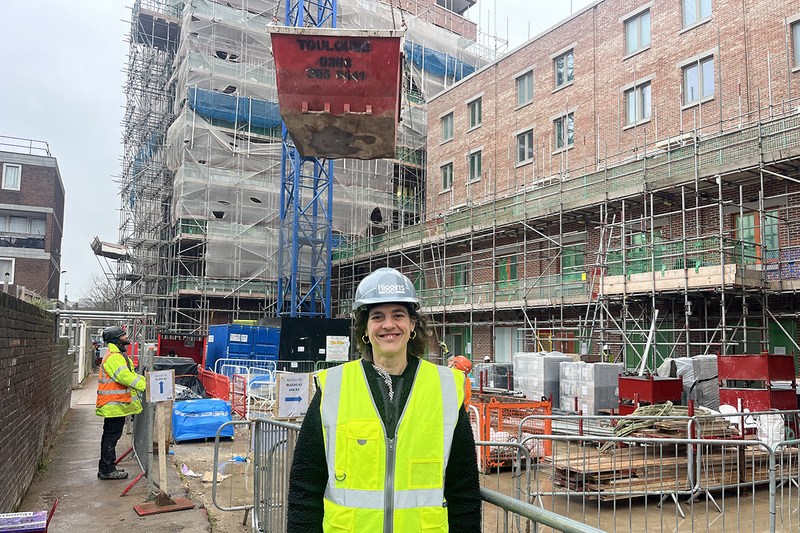 Years after she worked to evacuate the Ledbury Estate for safety reasons, Southwark council leader Sarah King visits the near-finished homes on the regenerated estate. Eliza Parr joins her #UKhousing
On the short walk from the Old Kent Road to the Ledbury Estate, it is hard to hear yourself think for the sound of construction. It is an oppressively grey February day in London – the Shard has disappeared behind fog – but here in Peckham, a number of cranes are still visible.
It has been nine months since Sarah King, leader of Southwark Council, last visited the Ledbury Estate regeneration scheme, and her excitement to see the site’s progress is obvious, despite the persistent drizzle. Ms King is particularly keen to check on the difference between the council homes and the homes for private sale. Both have large windows, spacious balconies and plenty of storage space.
“I wanted to see the difference between the council and private flats – it’s that reassurance piece, that there’s hardly any difference between the two,” Ms King says. And for an estate regeneration like Ledbury, she adds, this is “even more important, because the estate has such a strong sense of identity”.
“For estate regeneration, getting that relationship with residents right is the key thing. But I don’t think any of us underestimate how difficult it is to actually ask someone to move from their home,” says Ms King.
Ms King is no stranger to these difficult conversations, having previously led on engagement with residents for the Ledbury Estate regeneration scheme when she was cabinet member for council homes.
Read more
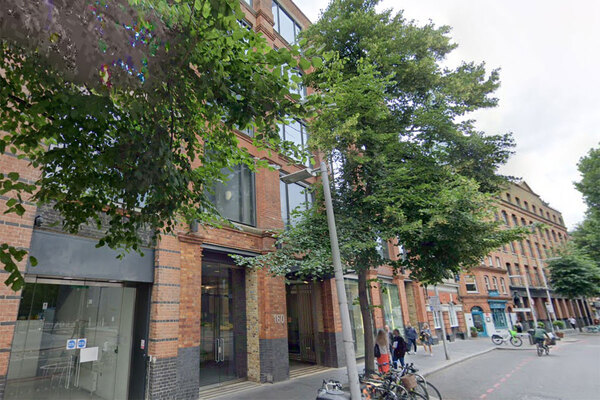
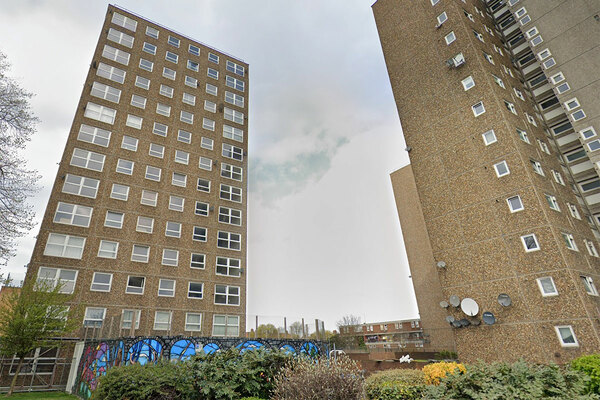
Engineering consultancy Arup discovered safety issues with the blocks in 2017 after residents had been reporting cracks in the walls of their flats, as well as leaks. Arup found that the safety of the blocks could not be guaranteed with a gas supply fitted. The council urgently switched off the gas supply, and later in 2019, another investigation by Arup found that structural defects on the estate were worse than previously thought. In 2021, residents voted in favour of demolishing the blocks.
Three years later, the council told remaining residents on the estate that they needed to move out earlier than expected since the safety issues had worsened. The council had also identified a new issue with the storage of lithium batteries needed for mobility scooters, which increased the risk of fire.
In autumn this year, almost a decade later, the estate will start welcoming them back.
The ‘fabric’ of Southwark
Ms King and Inside Housing are being shown around the regeneration scheme’s first phase, where two new blocks have been built on the site of one of the old towers. Together they will provide up to 60 new council homes and 20 homes for private sale. When complete, the council expects the regeneration of Ledbury to cost £212m.
After our tour, while warming up in the construction site office, Inside Housing sits down with Ms King as part of our Spotlight on Regeneration to talk about why she thinks social housing is the “fabric” of Southwark, the difficulties of getting regeneration projects done these days and why she is a housing-focused leader.
Having grown up in neighbouring Lewisham in the 1980s, Ms King studied philosophy, politics and economics at Oxford, followed by a master’s at Edinburgh, and later lived in Reading. But she always felt the call back to the capital.
“I was desperate to move back, and I suppose I’m a very committed south Londoner, so I settled back in Southwark,” she says.
And once she had cut out the commuting time from Reading to her public affairs job in London, Ms King found time in her schedule to get into politics as a Labour councillor in Southwark’s Champion Hill ward.
“I wasn’t spending copious amounts of time commuting, so I filled it with becoming a councillor,” she says of her election to the council in 2010.
Ms King spent over 20 years at Connect, a public affairs consultancy, where she became an owner in 2016 following a management buyout. The firm works with housing associations, local authorities and private developers, which she says gave her a “solid grounding” in a lot of the policy areas she would go on to cover as a politician.
She also believes her lobbying work, which came to an end when she became council leader in July 2025, sharpened her understanding of the housing sector’s priorities.
It makes sense, then, that Ms King took up a role as cabinet member for council homes in 2024. Hardly an easy job – a few months after she was appointed, Southwark Council was handed a C3 rating by the Regulator of Social Housing due to “serious failings”, including a failure to self-refer over the lack of smoke alarms in over 50% of its homes.
This was a “really, really difficult time for us as a landlord”, Ms King says. It led to the development of the council’s ‘Good Landlord Plan’, which includes an investment of £250m in its existing homes over three years.
Ms King’s experience in this role was a driving force behind her decision to run for council leader in 2025, she tells Inside Housing.
“When I was thinking of standing for the leadership, people often talk to you about why you want to do it, and housing was overwhelmingly part of my own pitch,” she says.
Ms King wanted to ensure that housing remained the council’s “absolute top priority” and believed that “being council leader was the way to do that”.
“For estate regeneration, getting that relationship with residents right is the key thing. But I don’t think any of us underestimate how difficult it is to actually ask someone to move from their home”
Does she prefer politics to lobbying? Definitely, Ms King says, asking permission to recount a “tiny story”.
When she chaired one of her first cabinet meetings as leader, a resident showed up at the council’s offices near London Bridge. The security team thought there might be a protest, but the resident simply wanted to give the new council leader a bouquet of flowers to say thank you for her help. She had been living in temporary accommodation and Ms King had helped her case get reassessed, which led to the resident being offered a council home.
“I cannot compare that feeling to anything else,” Ms King says.
But her election to leader in July last year was not entirely smooth sailing. She was only narrowly elected in a second vote, after the London Labour Party overturned the initial election of another candidate due to concerns about the use of proxy voting.
Then, three months into her tenure as leader, the council hit national headlines again. Southwark came under scrutiny after it was revealed that chancellor Rachel Reeves owned an unlicensed property in the borough. To make matters worse, the council’s own cabinet member for council homes, Michael Situ, was later forced to resign after it was found he had made the same mistake.
When I ask Ms King about this, she finishes eating a biscuit before responding. This gives her time to think, she says. The council leader puts the blame firmly at the door of letting agents that fail to comply with licensing rules, and she says the council’s enforcement team is doing “a huge amount of work” to stop similar cases.
“I’m fundamentally shocked by letting agents... it’s your day job to get it right. You are going into a commercial relationship with the landlord and, as I understand, saying, ‘We will make sure your property is appropriately licensed.’ And if you’re not doing that, then that’s a fundamental failing of what that business is there for,” she says.
Unsurprisingly, Ms King seems far keener to talk about how the council is providing new homes for those in need. And it would be hard to argue with Southwark’s success in this arena: the council topped Inside Housing’s list of the Biggest Council House Builders last year.
It completed 689 homes in 2024-25, almost 30% more than Lewisham Council, which came in second place. This is not an accident, Ms King says, pointing to the fact that Southwark made housebuilding one of its biggest political priorities, as well as the availability of land in the borough.
At 39,000 homes, Southwark is also one of the biggest council landlords in England, having retained much of its stock. A total of 40% of households in the borough live in social housing, and just over a quarter in council homes. It makes Southwark somewhat unique, Ms King says, as council estates are part of residents’ everyday life, whether they are a social housing resident or not.
“If you are a resident in my ward, and you’re walking from Sainsbury’s to Peckham Rye station, you walk through a huge council estate, and at no point is a resident looking at that thinking, ‘Oh, that’s council land and that’s other public space.’”
Council estates are “very much the fabric of Southwark”, the council leader adds.
It is no surprise, then, that regeneration is high on her agenda. Southwark has a number of large and high-profile schemes, including the 4,200-home regeneration of the Aylesbury Estate.
These developments are long, complex and often beset by a number of delays. In March, a month after we spoke, the council announced plans to change its decades-long partnership with Notting Hill Genesis based on residents’ concerns that progress on the Aylesbury Estate has been too slow. Southwark will now seek out new development partners to complete remaining phases in the scheme.
Providing more homes
The Ledbury Estate renewal, the site of our visit today, will replace the four original tower blocks, which were originally built in the 1960s using large panel system methods, with 340 new homes.
Ms King says she doesn’t regret how the 2024 evacuation was handled. But she recognises the personal toll it took on residents.
“I think it is a difficult thing when you go and meet with residents and say, ‘We have been part of the long-term regeneration plan, but actually the situation has changed, and we need to move you more quickly,’” she says.
Most residents had moved off the estate in the three years after safety issues were identified in 2017, which means when they start to move into the new homes in the autumn, they will have waited at least five years to come back. Many have settled in surrounding neighbourhoods and have decided not to return.
Alex Talbot, project manager for the scheme, says all residents have been contacted and the response has been “50/50” in terms of interest in returning.
“We were confident that we would be able to house everyone, and it’s proved that way because, as we know from experience, people don’t always come back. But even if every single person had chosen to return, we would have been able to [house them],” Mr Talbot adds.
There were originally 224 homes across the four tower blocks on the estate, of which 190 were council homes and 34 were leaseholder homes. The regeneration – which is due to be finished by spring 2030 – will provide a total of 340 new homes, of which 266 will be council homes, nine will be leaseholder replacement homes, and 65 will be for market sale.

During our tour we see several Ledbury Estate homes that are approaching completion.
“My brain was focused on the existing towers and the people who lived in them,” Ms King reflects. “And actually, coming here today, it’s rebalanced the other way. We’re talking about the people who are moving in and actually benefitting from those brand new homes.”
Despite this optimism, the council leader is realistic about viability challenges across the capital for both new development and regeneration. One striking example of these challenges is British Land’s application to cut the affordable housing offer for its 3,700-home Canada Water masterplan to just 3%.
This scheme was called in by the mayor of London at the end of last year and an outcome is still yet to be announced. Ms King says Southwark Council was “extraordinarily concerned about the affordable offer being in that very, very low percentage”. But she also recognises that developers, housing associations and local authorities are all facing the same challenges.
For councils, this is most acutely felt in pressure on the Housing Revenue Account (HRA). Ms King says that a new 10-year Social and Affordable Homes Programme and rent settlement have provided support for council finances, but do not go far enough.
“All of those decisions have really, really helped us in terms of financial planning for the HRA, but fundamentally, what we need is a conversation about the debt that currently exists in it, and the fact that the ringfenced account when it was set up did not allow for rent freezes and rent increases,” she says.
In 2012, the government introduced a new ‘self-financing’ settlement for the HRA in England, which was based on assumptions that over 10 years councils’ rental incomes would increase, while maintenance costs would be affordable. Instead, councils faced four years of rent cuts as a result of government rent policy, as well as a new regulatory environment with increased costs.
“If you are a resident in my ward, and you’re walking from Sainsbury’s to Peckham Rye station, you walk through a huge council estate, and at no point is a resident looking at that thinking, ‘Oh, that’s council land and that’s other public space’”
Southwark Council has led the charge for HRA reform through its Securing the Future of Council Housing campaign, which launched in 2024 and has more than 100 council signatories. It calls for a “fair and sustainable” HRA system, with recommendations for the government to reopen the 2012 debt settlement as a priority.
Without this, Ms King suggests, regeneration in the capital will not be viable: “It’s that sort of conversation which would put the potential for council-led estate regeneration back on the table as an option, which it isn’t at the moment.”
The council’s delivery programme is focused on regeneration, Ms King says, but the HRA “is now in a place where we can’t borrow to build the council homes that we want, that in some places we have planning permission for”. HRA reform would therefore be a “game-changer” for Southwark in terms of unlocking those stalled sites, she adds.
But how likely is government action on HRA reform? Ms King is diplomatic in her response, stating that there is an “acceptance of the issue” from the government.
“There’s more to do in terms of the government actually taking action, and I think there is good understanding, which is important. And at the start of the campaign, I would have argued that a previous government did not understand the challenges.”
In the meantime, Southwark Council has taken action to help tackle viability issues. Earlier this year, the council signed development agreements with Wates Residential and Mount Anvil to deliver 1,100 homes on eight sites across the borough. This partnership will mean the council can provide new council homes without having to borrow from the HRA.
The agreements are keeping the show on the road, Ms King suggests. “It’s a new way of working for us, but it makes sure that we can continue to deliver new homes for the next few years.”
Sign up to Inside Housing’s Council Focus newsletter
Sign up to Inside Housing’s weekly Council Focus newsletter, featuring the latest affordable housing news focused on local authorities delivered to your inbox.
Already have an account? Click here to manage your newsletters.
Related stories