You are viewing 1 of your 1 free articles
The best housing research of 2025
Thinkhouse curated almost 100 reports in 2025, covering everything from homelessness to housing supply and net zero. Chair Richard Hyde runs through the Editorial Panel’s top five


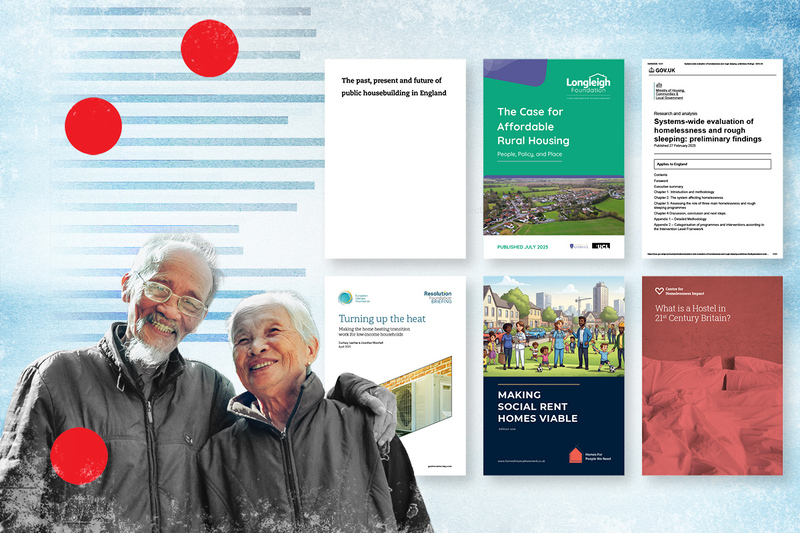 Thinkhouse curated almost 100 reports in 2025, covering everything from homelessness to housing supply. Chair Richard Hyde runs through the Editorial Panel’s top five #UKhousing
During 2025, the Thinkhouse Editorial Panel, made up of members drawn from a cross-section of the housing world, assessed almost 100 new reports – all of which were uploaded and classified in our web library. Panel members looked at the quality of the research, the breadth of analysis and whether the recommendations can be translated easily into policy or influence decision-makers.
Here are the top five reports of 2025 and why we selected them. They include regular subject matters such as homelessness, net zero, rural homes and social housing supply, while our most highly scored report covers a form of housing that is rarely reported on.
Read more



In fifth place is The case for affordable rural housing: people, policy and place by the Longleigh Foundation. Authors Tom Moore, Nick Gallent, Andrew Purves and Richard Dunning highlight how government housing programmes and aspirations rarely make an explicit commitment to increasing rural housing provision. With the research based on 21 qualitative interviews, the authors set out to give an overview of the issues and challenges associated with the development of social and affordable housing outside of towns and cities.
The Editorial Panel said they feel this report provides a comprehensive analysis of this subject matter and a set of clear and achievable policy recommendations that could make a tangible difference.
In fourth place is a report written by the Centre for Homelessness Impact for the Ministry of Housing, Communities and Local Government (MHCLG) titled Systems-wide evaluation of homelessness and rough sleeping: preliminary findings. There is a shortage of robust evidence on the effective structural and systemic actions that may be needed to tackle the drivers of homelessness and rough sleeping in the UK. This report fills this evidence gap.
“Too many developers will reduce their delivery of social housing to ensure a scheme is financially worthwhile. The solution is a substantial public subsidy to bridge this gap”
It is perhaps the first time that a government, either in the UK or internationally, has set out to understand the systemic impact of its policies and interventions in relation to homelessness and rough sleeping. The Editorial Panel felt that this report, given the rise in homelessness and rough sleeping, was timely and set out clearly what is driving this growth and how policy could make a greater impact. It was my personal favourite report of 2025.
In third place is Turning up the heat by the Resolution Foundation and European Climate Foundation. It was written by Zachary Leather and Jonathan Marshall. There were a number of reports published last year that focused on reducing home carbon emissions (now the second-largest contributor to the UK’s carbon footprint), but the Editorial Panel felt this one stood out as it focused on how behaviours need to change.
The report recommends a proactive approach that ensures costs are fair and solutions work for lower-income households, as well as those that are wealthier. It proposes that a new means-tested grant is introduced on top of current programmes, set at a level such that the cost of a heat pump is comparable to a gas boiler (that would suggest around £3,000 on top of £7,500 from the existing Boiler Upgrade Scheme). Targeting households based on income will ensure those least able to afford the outlay will benefit.
In second place is the report Making social rent homes viable. This was produced by Homes for People We Need, which is an informal collective of organisations, experts and practitioners from across the housing and real estate sector that share a common goal of helping to solve the housing crisis in the UK.
The report makes clear that the fundamental challenge confronting affordable housing delivery is stark. Affordable homes, specifically social rent homes, simply do not pay their way. Their capital value is significantly less than the total development costs, creating a large viability gap. Too many developers will reduce their delivery of social housing to ensure a scheme is financially worthwhile. The solution is a substantial public subsidy to bridge this gap and enable delivery at the scale needed.
The report suggests that ‘social housing tax credits’ could enable private capital deployment now in exchange for future tax relief. Section 106 agreements should fix affordable housing values at the planning stage to improve market efficiency. Right to Buy should be further reformed to preserve the affordable housing stock. A ‘flex rent’ approach that links rents to household income should be considered to optimise revenue generation while maintaining affordability. Finally, the housing association sector desperately needs recapitalising in addition to the recent 10-year rent settlement.
“Hostels could be typified as primarily generalist accommodation with fairly open acceptance criteria that provide a ‘core service’ of move-on support”
In first place and the Thinkhouse Editorial Panel’s most highly ranked report of 2025 is the Centre for Homelessness Impact’s What is a hostel in 21st century Britain? The report was written by Guillermo Rodríguez-Guzmán, Michelle Binfield and Rob Anderson in 2024, but released in early 2025. It proposes a set of hostel provisions’ typical characteristics, constituting a ‘base type’ upon which a more sophisticated typology might be built through future research. This can be used to systematically compare different models of provision to allow better evaluation and learning.
The report is dedicated to the late Jeremy Swain, an inspiring leader in this area at both Thames Reach and MHCLG. The Editorial Panel recognised that the report is probably not only the largest study of its kind, as it draws data from 104 local authorities and 317 hostel projects, but that it also provides a clear and detailed appraisal of this vital segment of homelessness support.
Hostels could be typified as primarily generalist accommodation with fairly open acceptance criteria that provide a ‘core service’ of move-on support, welfare and budgeting advice, and emotional support. In terms of physical characteristics, hostels could be typified as generally encompassing fairly small sites, providing self-contained accommodation of 10 to 20 bedspaces, often with private access to facilities.
Hostels are typically staffed 24 hours a day, and could be defined using target outcome and typical duration of stay, with most hostels aiming to provide temporary housing for six months to two years, with the goal of moving on to settled housing. Finally, in terms of cost and funding structure, hostels cost around £27,000 per bed space per year, primarily funded by housing benefit.
The breadth and depth of this report, in such an under-researched area, means that it will be used for many years to come by policymakers and practitioners in the sector. They will find that it gives them an informed understanding of the value for money of different types of provision for people who need homelessness support. The Editorial Panel felt that this report will make a fundamental difference to people who need to use these services.
We run a competition for papers written by early career researchers. Awarding this prize is always one of the highlights of our year. The 2025 winner was Maurice Lange with his paper The past, present and future of public housebuilding in England. Once again, the competition attracted some great talent who will, undoubtedly, go on to do amazing things in the housing world.
Richard Hyde, chair, Thinkhouse Editorial Panel, with contributions from other members of the panel
Sign up to Inside Housing’s Daily News bulletin
Sign up to Inside Housing’s Daily News bulletin, featuring the latest social housing news delivered to your inbox.
Already have an account? Click here to manage your newsletters.
Related stories