You are viewing 1 of your 1 free articles
New UK Housing Review tracks for-profit rise, Right to Buy impact and LHA freeze
The latest UK Housing Review has tracked the consolidation of for-profits across the sector, the impact of the Right to Buy (RTB) and the government’s Local Housing Allowance (LHA) freeze.


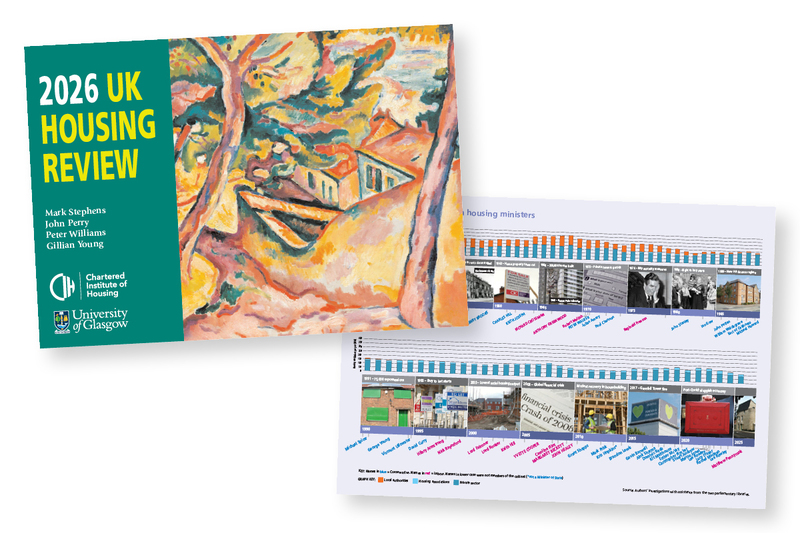 The latest UK Housing Review has tracked the consolidation of for-profits, the impact of the Right to Buy and the government’s Local Housing Allowance freeze #UKhousing
Published by the Chartered Institute of Housing (CIH), the membership body’s annual research shows 2.8 million homes sold under the RTB had generated £62bn by March 2025.
This led to a sharp decline in social housing availability and growing pressure on renters and public finances.
The analysis highlights how the long-term loss of social housing has pushed many lower-income households into the private rented sector, where rents are at their highest-ever level as a share of earnings (36.1%).
Around 40% of homes sold through the RTB are now privately rented, often at significantly higher rents than social housing.

This shift has contributed to increased government spending on housing benefit and left many households in less secure and, on average, poorer-quality accommodation.
It builds on last year’s report, which found the government was likely to fall short of its target to build 1.5 million homes by around 25%.
Rachael Williamson, director of policy, communications and external affairs at the CIH, said: “Right to Buy transformed homeownership opportunities for millions, but this new analysis shows the lasting consequences for the availability of social housing today.”
Looking at for-profit providers, disregarding subsidiaries, the report tracks 64 firms who owned 46,555 homes in 2025. However, ownership is highly concentrated among the seven largest landlords, which own 80% of this part of the market.
The latest analysis comes after a major piece of research by Inside Housing Living revealed the scale of global investment in UK rental living.
For those in receipt of LHA, the CIH review highlights “the government’s failure to maintain its real value”.
By the start of the first year of the current freeze, the proportion of the market covered by the frozen LHA rate had shrunk to around 20% across all LHA categories. This severely restricts access to an affordable letting and creates a shortfall between rents and benefits of around £100 per month for an average property.
The report argues that the “government should break its addiction to freezing LHA rates and return to a policy of maintaining the real value of LHA rates, as it does with other pensions and benefits through annual upratings”.
It highlights how the current system of housing support is “simultaneously expensive and inadequate”, with some low-income households in England unable to access social housing because they cannot meet affordability requirements.
RTB ended in Scotland in 2016 and in Wales in 2019, while sales continue in England (with reduced discounts), and through the House Sales Scheme in Northern Ireland.
The authors find that Scotland’s earlier policy change and comparatively strong social housing completions have helped to preserve stock levels, with lettings to new social tenants falling by only 3% since 2014-15.
By contrast, there have been a quarter fewer lettings over the same period in England, Wales and Northern Ireland – a decline linked to reduced turnover, stock losses and insufficient new supply.
The slowdown in social lettings is identified as one of the factors behind rising homelessness, as fewer homes are available for people in housing need.
Ms Williamson added: “With demand rising and homelessness pressures growing, rebuilding social housing supply must remain a priority for housing policy across the UK.
“Ensuring councils and housing associations can replace and expand affordable homes is critical to restoring a housing system that works for everyone.”
The review notes that recent UK government restrictions on the RTB may reduce further losses of social rented homes and protect rental income streams. While this could eventually mean fewer sales receipts, the changes should encourage councils to build new homes, particularly now that receipts can be combined with grant funding.
Lord Richard Best, former chair of poverty charity the Joseph Rowntree Foundation, said: “Since the Joseph Rowntree Foundation published this brilliant annual review in 1993, it has been an essential companion for housing policymakers and practitioners.
“Not only does it set out the evidence on which policies can be made, but it contributes new thinking each year through its authoritative commentaries on contemporary issues.”
Stephen Aldridge, director for analysis and data at the Ministry of Housing, Communities and Local Government, said: “I look forward to the publication of the UK Housing Review every year.
“Comprehensive, rigorous, insightful and with a unique UK-wide focus, there is no better guide to what is happening in housing markets and housing policy, and the challenges and opportunities ahead. It is a must-read for every housing policymaker, analyst and practitioner across the public, private and voluntary sectors.”
Sign up to Inside Housing’s Daily News bulletin
Sign up to Inside Housing’s Daily News bulletin, featuring the latest social housing news delivered to your inbox.
Already have an account? Click here to manage your newsletters.
Related stories