How social landlords can embrace innovation – even if it doesn’t come naturally
Inside Housing Innovation Week took place in November. It was an opportunity for social landlords to showcase alternative approaches to improving day-to-day operations


 Following a public vote and a judging session, Chris Jones, CEO HomeLINK @Aico_Limited announces that @RavenHT has beaten 5 other finalists to win @insidehousing #innovatehousingUK £10k (sponsored)“@insidehousing #innovatehousingUK prize will allow us to build the customer information aspect of our asset management plans,” says Julia Mixter, director of transformation @RavenHT (sponsored) @Aico_LimitedFor HAs to get innovation right, they may need to take the pressure off: “It doesn't have to be completely innovative. It has to come at the right time, at the right cost and with the right people,” says Lucy Fraser, head of innovation @albynhousing #innovatehousingUK (sponsored)
In association with:

In the decade since Bromford innovation coach Paul Taylor set up what is thought to be housing’s first innovation lab, he has encountered a common refrain about the ability of social landlords to innovate.
“A lot of organisations start by saying, ‘We’re really bad at innovation,’” says Mr Taylor. It is a line to which he offers a simple and reassuring response: “That’s because you’re designed to be bad at innovation.”
“A housing association is about delivering repeatable business and doing a very small, finite number of things very well,” he explains. “So, structurally, when we try to introduce new ideas, often the organisation will reject those ideas. That’s perfectly normal.”
Many across the sector are trying hard to change this attitude. The second annual Inside Housing Innovation Week is designed to recognise, celebrate and amplify those efforts. Supported by fire safety manufacturer Aico, it involves virtual sessions across five days in which the challenges and opportunities of innovating in social housing are explored.
Learning from Spielberg and the shark
Mr Taylor understands that implementing new ways of doing things can be difficult, but he also says there is no better time to do so. Why? Call it the Jaws moral.
“The shark that Steven Spielberg had purchased for the movie, and spent most of his budget on, broke straight away and he didn’t have the money to get a new one. So he used the music, or showed surface-level objects like dinghies and buoys, to create tension. It was a great movie that broke the mould because of the lack of resources,” he says.
David Done, chief executive of housing association RHP, explains in a subsequent session that the social housing rent cuts of 2015 in England proved an impetus for the creation of his organisation’s online services.
“There are moments in any organisation which do act as burning platforms, and those rent cuts were one of those. Our sector needs innovation more than at any other time because we’re facing some huge challenges.”
At RHP, there has even been innovation on innovation itself. “At first, it was a bit of a mad scientist approach – we were just trying to pick up any good idea and run with it, but it didn’t always produce the best outcomes for customers,” explains Mr Done, in a session entitled What does innovation mean anyway? That is why RHP has shifted to “a much more structured and comprehensive approach to innovation, called service design”.
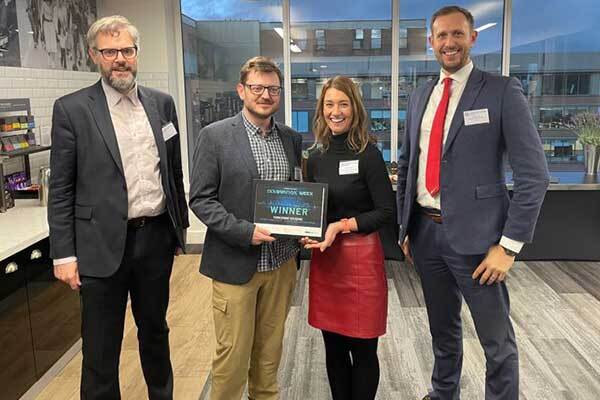
Raven Housing Trust wins the Inside Housing Innovation Week Award 2022
This second annual celebration of innovation in the sector draws to a close with an important announcement: the winner of the 2022 Inside Housing Innovation Week Award.
Following a public vote and a judging session with an expert panel, Chris Jones, chief executive of Aico HomeLINK, announces that Raven Housing Trust has beaten five other finalists to take the prize.
“We are delighted to have been awarded the Inside Housing Innovation Award 2022 for our iProperty Cloud project,” says Julia Mixter, director of transformation at Raven Housing Trust. “The prize money will allow us to build the customer information aspect of our asset management plans, meaning we can share up-to-date information with customers about planned works, and will enable customers to feed back on work after completion.”
As the winner, the association will receive £10,000 and a full day of consultancy with Aico’s product development team to help develop the online portal.
“Essentially it involves breaking services down into their component parts and fine-tuning to meet the needs of users in a very personalised way,” he explains.
The importance of co-design is a theme that runs throughout this year’s Innovation Week. Sarah Mitton, age-friendly communities manager at Clarion, explains how it is involving residents much more broadly: “We wanted to think more innovatively about how we co-create with our residents, not just on hyper-local issues but on wider strategies and programmes.”
To that end, Clarion now has two key resident ambassador networks: one for younger people and one for older. Among the projects is the introduction of Homeshare to social housing, through which older people with a spare room are matched with younger people seeking affordable accommodation. It was suggested by a resident ambassador.
“One of the things that is key when talking about innovation is that very rarely is anything brand new,” says Ms Mitton. “Often, it can be just looking at something that has had an impact and tweaking it, or bringing it in house to achieve the impact.”
In numbers
£10k
Prize for winning this year’s competition, awarded to Raven Housing Trust
The value of incremental improvement
Put another way: for housing associations to get innovation right, there may be a need to take the pressure off and think of it as small improvements.
“You just have to have a good idea,” says Lucy Fraser, head of innovation at Albyn Housing Society, during her session. “It doesn’t have to be completely innovative. It has to come at the right time, at the right cost, and it has to have the right people behind it.”
She has been working on a technology-enabled housing scheme, where ambient sensors are installed into the homes of vulnerable residents. By monitoring movement and activity, it is possible to help identify downturns in someone’s well-being and independence, and act as needed. The technology is not compulsory. Ms Fraser says: “What we find is that those who do need the technology want it because it makes them feel safe.”
This point – that any innovation is only helpful if it is what is wanted and needed by residents – is one that comes through clearly in the final session of the week. Paul Nettleton, customer engagement lead at Catalyst Housing, details how the association has greatly increased digital engagement. The many possible applications of digital technology have become increasingly evident since the pandemic began. But Mr Nettleton argues there should be no assumption that all residents want to move to such interactions.
“If you’re on a digital journey, you need to make sure you have that mandate from your customers,” he says. “We surveyed all of our customers, and a huge proportion told us they do want these services; that’s their preference for the way they interact with us.
“But a key takeaway is digital engagement shouldn’t be the only way that we engage with people. It works for most people. But it needs to be a tool in the toolbox.”
Innovation may mean many things to many people, but in social housing it always comes back to the same central idea – meeting the needs of residents.
“If we think about housing associations, we are long-term custodians,” says Mr Taylor. “We are in the community, our homes are going to be there in 30, 40, 50 years’ time and society will change during that time. Even if we don’t use the word innovation, we’ve got to make sure we’re constantly thinking about the future, what it might hold and how it might affect our customers.”
Related stories