How to use tenant satisfaction measures to strengthen your financial viability
Tenant satisfaction measures aren’t just a regulatory tool, but a way to strengthen financial resilience. Inside Housing, in association with consultancy Newton, convened a roundtable to explore best practice. Photography by Dan Joseph



In association with:

The tenant satisfaction measures (TSMs) have now been up and running for more than two years. According to the Regulator of Social Housing (RSH), the TSMs serve three purposes.
They provide data that allows the regulator to see how providers are measuring up against the consumer standards; they are a tool with which tenants can hold their landlords accountable; and they provide insights for landlords on where they should focus their efforts to improve their services.
The strategic opportunity for housing providers lies in that third purpose. Used well, supporters say, the TSMs can strengthen organisations’ financial viability and boost their bottom lines. In October, Inside Housing, in association with strategy consultancy Newton, brought together a panel of experts from across the sector to consider a range of possibilities.
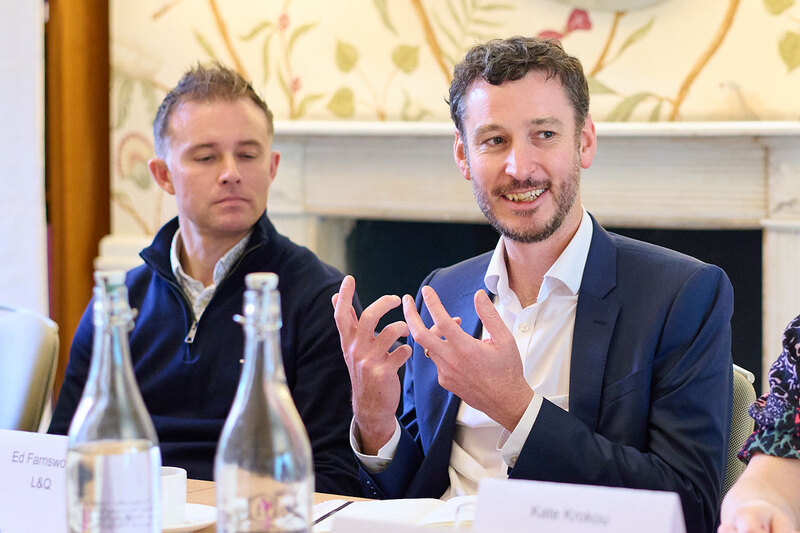
“I have long held the belief that there is a symbiotic relationship between resident satisfaction and financial resilience,” says Ed Farnsworth, executive group director for finance at L&Q.
“The myth that those two pull against each other is frankly frustrating, because if you get the service right for the customer, you deliver it at a lower cost.”


The notion that achieving better TSM results must entail higher costs is flawed, agrees Shyam Radia, a director at Newton. Clients have told him they need more housing officers, more repairs operatives or more staff in their call centres, he says, but the reality is often simpler than that.
“When we talk to residents, there are four key focus areas people are worried about,” Mr Radia says.
“They want to be able to get in touch with you easily, they want things resolved more quickly, they want to be kept up to date with what’s going on with their issues – and then they want their issues resolved.”
Once an issue is resolved, he adds, people are generally happy with the fix. “So it’s really the first three areas that are driving tenant satisfaction scores.”
Achieving high scores depends on a well-functioning organisation, from frontline to back office. “Are [your back office staff] enabling your [customer-facing] teams to do the right things? And do you have the right operator model and business foundations?
“Because where we’re seeing that not in place, that’s impacting your customer service, that’s impacting your ability to pick the phone up quickly or do a repair within 28 days.”
At 35,000-home landlord Onward Homes, TSM data has driven a hefty – and business-positive – change, says Sandy Livingstone, the association’s executive director of growth. The TSM results revealed that tenants weren’t happy with Onward’s outsourced repairs service, Mr Livingstone says. “We fundamentally changed it and brought it in house, and already through the investment we’ve made, customer satisfaction is up, performance is a lot stronger, and actually it’s less expensive because we’re controlling [the service], and the culture is a lot better.”
As a reflection of an organisation’s overall performance, the TSMs are becoming the “frontline of financial resilience”, says David Ripley, chief operating officer at 40,000-home Stonewater.

These days, he explains, conversations with lenders are about the health of the organisation as a whole: “Are we a safe pair of hands, not just financially, but also operationally? Are we doing the right things to keep the business going in the way that it needs to go?”
Many of the outcomes measured by the TSMs are a reflection of how well a provider functions as a whole.
“A lot of it leads back to culture,” Mr Ripley says, “and whether we are reacting or being proactive [in how] we deliver our services. So a lot of the data that we’re using from the TSMs, we’re matching together with other data within the organisation to make sure that we’re getting that balance right.”
For this reason, TSM results are becoming of essential importance to investors and lenders, says Mr Farnsworth from L&Q.
“They recognise that TSMs are a fundamental indication of how well run a business is. And if you’re a lender or an investor in a business, you want to get your loan repaid at some point in the future. You want to make sure you get your interest payment. But fundamentally, you want to know that that business is sound and is well run.”
It is a similar story where housebuilding is concerned, says Caroline Moore, chief financial officer at 55,000-home Abri, as TSMs are becoming an increasingly valued source of information for external stakeholders.
“What we see with development is that developers, joint venture partners, local authorities and Homes England all absolutely want to see our TSM results,” Ms Moore says.
“It puts us in a better place for development opportunities and we can be more competitive with a better TSM score.”

Several panellists mentioned the value of TSM data in helping them to target their resources more efficiently to those who need them most – particularly with regard to geography. Jahedur Rahman is director of housing at Haringey Council, which manages around 20,000 homes in north London. He describes Haringey as a borough of two halves: “You’ve got the really affluent area, and then you’ve got east of the borough, where you’ve got high levels of deprivation, low education attainment levels and a higher level of anti-social behaviour.”
The TSM data shows decisively that tenant satisfaction is not purely based on the quality of service. Geography plays a big role, and the council has begun to use that insight to inform its interventions.
“The wider approach for housing, certainly in the east of the borough, is what more can we do beyond housing,” he says. “Are there spaces where we can go in and work with communities to improve employment and education levels? Because that’s clearly impacting how they view the council as a landlord.”
This type of insight, derived from an analysis of TSM results, has been of use to housing association Abri, too. Its properties are in “distinct concentrations” around the South of England, and the housing association collates its TSM data on a regional basis.
“We know in London that people are, in general, less satisfied than [other residents] the further you get away from London,” Ms Moore says. “But is it the way we’re structuring our service? Is it our colleagues? Is it the legacy investment in stock that has or hasn’t taken place? Having that body of evidence is proving really good in terms of how we determine our regional investment strategy.
“We are launching a new corporate strategy in a couple of months’ time, and it’s based on really solid regional investment plans that are genuinely different for each region.”
From the point of view of the regulator – represented at this roundtable by Andy Singleton, assistant director of regulatory engagement at the RSH – this deployment of TSM data by landlords is a fundamental feature of the new regulatory regime.
“We get to see the big picture, how organisations compare to each other,” Mr Singleton says.
“But what we’re really interested in as a regulator is how organisations are using the TSMs to inform service delivery, particularly where there’s a regional model, or within neighbourhoods… how you’re using that intelligence, but also taking a step further back from that, how it’s helping to inform how you are meeting your strategic purpose as an organisation.”
For 120,000-home landlord Hyde Group, the TSMs have revealed patterns of tenant satisfaction based not so much on tenants’ location, but rather on the type of properties in which they live.
“Even when you look within a region in London, we can see that people in houses in London are much happier than people in flats,” says Kate Krokou, chief strategy and transformation officer at Hyde.
“[This insight] has helped us to have conversations around our service model.”
Last year’s TSM results contained a surprise, Ms Krokou adds. Hyde expected its lowest satisfaction scores to come from residents in its high-rise blocks, where there had been some fire safety concerns. “Actually they had much higher satisfaction than our mid-rise blocks who don’t see us that often. Our tall towers, where we’ve had long engagement with our customers and where we’ve spent money on improving them, got much higher satisfaction levels.”
It is the kind of insight that a standard tenant satisfaction survey wouldn’t necessarily reveal.
“Transactional satisfaction surveys tell us what it was like the last time you contacted us, whereas the TSMs tell us how our customers feel about us, and there’s quite a big gap sometimes,” Ms Krokou says.
The panel does sound one or two notes of caution, however, particularly around organisations using data from satisfaction measures alone to inform their strategic direction.

“You can end up playing whack-a-mole with your board,” says Mr Ripley. “They want you to go here and fix this issue, then to go there and fix that issue.
“That’s why organisations have got to take a step back and think about what really, truly matters. And I don’t know that enough of those conversations happen.”
Ms Krokou points out that the TSMs are a lagging indicator. The changes a landlord might make in response to what the data is telling them can take a while to be implemented and to make a tangible difference to tenants’ lives, and it can in turn take a year or two for there to be a noticeable difference reflected in their TSM scores.
Two years into a large-scale transformation programme at Hyde, Ms Krokou says, the board was concerned that the changes had not yet moved the dial on the landlord’s TSM scores.
“The board was saying, ‘This has been your action plan for quite a long time, but the scores aren’t moving,’” Ms Krokou explains.
“But we said, ‘Stick with it. Let’s leverage the benefit of this investment.’ And now our results have improved. When using TSMs for action planning, bear in mind that it can take a long time for [tenant] perceptions to move.”
It’s crucial to not allow the TSM tail to wag the dog, Mr Farnsworth says. “We risk building our services around meeting a TSM or satisfying some other regulatory requirement, and then you end up with this complete hodgepodge of a service.
“So we’ve got to be careful not to be [overly] reactive to the regulatory environment and reactive to TSMs. It’s far better having a clear strategy for the resident in the centre of that.”
Participants
Martin Hilditch (chair)
Editor, Inside Housing
Ed Farnsworth
Executive group director of finance, L&Q
Kate Krokou
Chief strategy and transformation officer, Hyde Group
Sandy Livingstone
Executive director of growth, Onward Homes
Caroline Moore
Chief financial officer, Abri
Shyam Radia
Director, Newton
Jahedur Rahman
Director of housing, Haringey Council
David Ripley
Chief transformation officer, Stonewater
Andy Singleton
Assistant director of regulatory engagement, Regulator of Social Housing
Sign up to Inside Housing’s Daily News bulletin
Sign up to Inside Housing’s Daily News bulletin, featuring the latest social housing news delivered to your inbox.
Click here to register and receive the Daily News bulletin straight to your inbox.
And subscribe to Inside Housing by clicking here.
Already have an account? Click here to manage your newsletters.
Related stories