Leeds: What a drive to become the UK’s first net zero, climate-positive city means for housing
Leeds wants to go down in history as the UK’s first climate-positive city – and the council wants to act as a pathfinder for other urban areas. Martin Hilditch investigates what it is doing, and what it might mean for how cities approach housing in the future


 Leeds wants to be the UK’s first climate-positive city. Martin Hilditch investigates what it might mean for how cities approach housing in the future. #UKhousing
Go back to the Cities Encyclopaedia
Leeds City Council talks big when it comes to climate change. Its sights are set on nothing less than becoming the “UK’s first net zero and nature-positive city”.
That desire is born out of a collective fear about what the future holds. In 2019, councillors across the political spectrum voted to declare a climate emergency in the city and pledged to speed up action to deliver on net zero.
Since then, the weather has backed them up. First, the city posted its highest-ever recorded temperature, 39.8°C, in 2022’s heatwave. Then, it was battered by flash flooding in May last year. During one storm, the expected rainfall for the whole of May fell in a single hour. Last year, the city’s climate emergency annual report predicted worse to come. It stated that the climate-related hazards Leeds is “increasingly likely to experience” are heat, flooding and drought (at the time of writing, Leeds is in a drought, with Yorkshire Water’s reservoir levels at 57.1%, “well below the 74.2% average for this time of year”).
If those are the reasons Leeds thinks it should act quickly, how, in practice, does one of the UK’s biggest cities plan such a rapid shift, and what has it achieved so far?
Read more

Green credentials
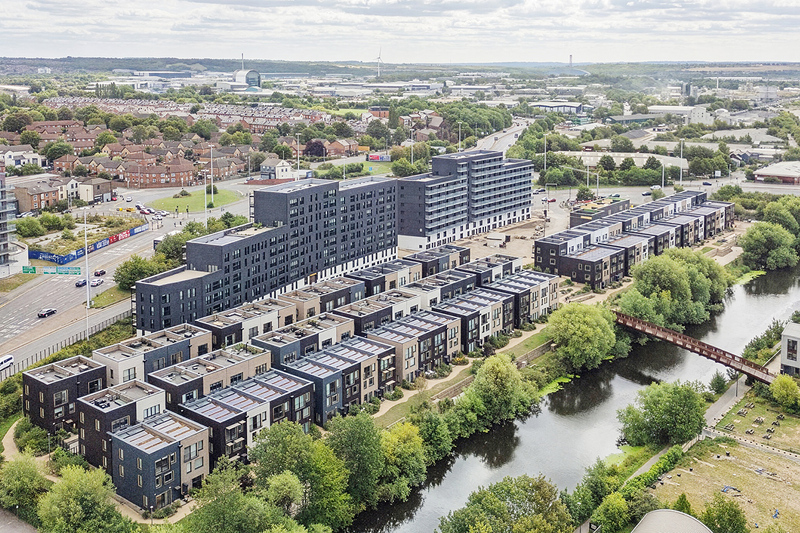
We will start with a development that is at the spearhead of Leeds’ bold ambitions, and that the council sees as a “global exemplar”. The Leeds Climate Innovation District is a short and stunning walk along the River Aire from Leeds City Centre – forget the 15-minute neighbourhood, this is the 15-minute city.
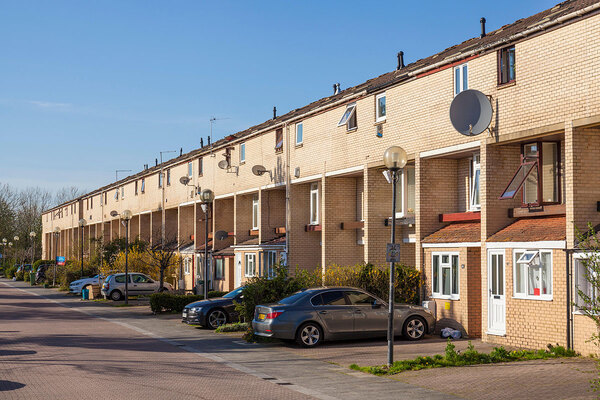
Built offsite by sustainable property developer Citu, the first thing you notice about the £800m, 955-home development is the absence of cars. An underground car park (with one space for each resident) sits beneath the terrace of houses, meaning the outside environment is populated by plants, green space and attractive walkways.
Jonathan Wilson, managing director of Citu (who backs the scheme so much he lives there), says this is more than a cosmetic touch.
“If you look at the standard model for housing nowadays it is heavily dominated by having a car outside the front of your house,” he says. “What does that mean? It means if you can remove the car, you’re removing the road, you’re removing that car parking space. It changes the feel and it changes behaviours.”
The connectivity of the site, including that river setting, is also important, says Phoebe Nicol, development manager and partnership lead at the Climate Innovation District.
“We always think about how are you going to walk [to facilities], how are you going to cycle, how are you going to take the bus? If the answer is that you can’t, and it’s private vehicles only, it is not [the site] for us,” she says.
There is a huge emphasis on the properties’ green credentials in the marketing, too. Signs are dotted throughout the site’s show home, pointing out cooling vents that promote air circulation, or ‘home and away’ switches by the front door so occupants can turn off all lights and unnecessary appliances at the push of a single button as they go out. All homes have air source heat pumps and are designed in line with Passivhaus principles.
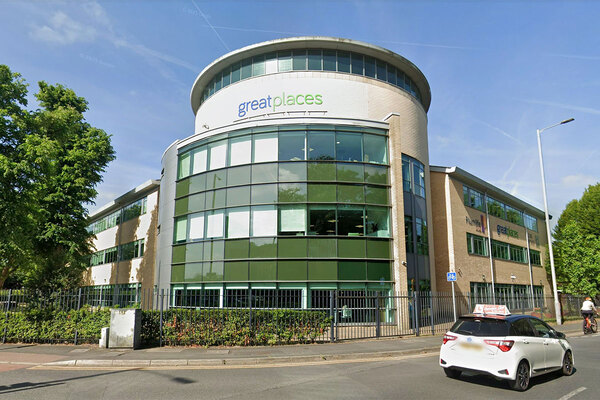
Yorkshire Housing, whose head office, The Place, lies next to Citu’s timber-frame factory and at the heart of the innovation district, has taken ownership of the site’s social homes.
Nick Atkin, chief executive of the housing association, says he thinks the homes are “a great example of what happens when you put sustainability first and take a whole-place approach” to development. “They’re exactly the kind of high-quality, affordable and energy-efficient homes we need to be building,” he says.
The innovation district should be the shape of things to come in Leeds. The city has just been consulting on its planning framework for development through to 2042, the Leeds Local Plan. The consultation sets out the city’s zero-carbon ambitions, including reducing energy demand and meeting heat and power needs from low-carbon sources and making space for renewables in new developments across the city.
Polly Cook, chief officer for climate, energy and green spaces at Leeds City Council, is part of the team charged with working to create a “resilient, sustainable city”. The local plan will consider everything from making sure new development is resilient in terms of heat and cold, but also “think about green spaces, because it is not just about the building, it’s about the context it is sat in and people having access to space”.
Given the huge number of moving parts in the system, the city realised it needed a convener to help pull partners together. The Leeds Climate Commission, a partnership between the University of Leeds, the council and representatives from the public, private and third sectors, under director Rosa Foster, has taken on that convening role.
“If you have a target that is ambitious, people realise there is an urgency to it. I think that’s really important with climate change”
“Part of that is a recognition that the council cannot do it on its own,” Ms Cook says. “It has got to reach out to everyone. This [appointing Ms Foster] is another statement about the importance of partnership.”
All of which means that the council’s role is both delivery and cheerleading at the same time. One example of this is its partnership with both the public and private sectors as part of the Leeds Low Carbon Accelerator, to explore how to speed up the integration of low-carbon technologies and insulation in homes. Yorkshire Housing is looking to make a big contribution to Team Leeds, too – it has developed a net zero roadmap that focuses on eliminating gas use, improving insulation and using renewable technologies to build new homes.
Elsewhere, one of the city’s most ambitious schemes affects both its housing and businesses. Leeds PIPES describes itself as “one of the UK’s fastest-growing” major heat networks, which uses heat created as a by-product from burning Leeds’ non-recyclable waste.
The network, delivered by Vital Energi, in partnership with Leeds City Council and Ener-Vate, is now connected to more than 2,300 homes, and a diverse range of businesses including Leeds Town Hall and St James’s Hospital. In 2023-24, the network supplied 29,000 megawatt hours of heating and helped to slash the city’s carbon footprint by 5,945 tonnes of carbon.
The council also has ambitions to act as a “pathfinder” when it comes to proving that modern district heating systems can be a “viable alternative” to more traditional approaches.
“We’re just procuring at the moment a partner to develop a secondary network,” Ms Cook adds. “The timing is very good because the government has just recommended the South Bank as one of their preferred areas for a new town. That is where we are procuring the new heat network, so that would allow, as that new development happens, for it to be connected to a new district heating network.”
The planned new network would use surplus energy from industry, rather than energy from the waste plant, so there will be less reliance on one source, she says.
The ultimate aim is for all the networks to connect together “so there’s resilience” in the energy, Ms Cook adds. “About 7% of our current heat on the district heating system is still gas and, ultimately, we want to move away from gas completely. If we had resilience linked to the other network, we would be able to do that.”
A third proposed heat network, powered from energy waste operator Enfinium’s Skelton Grange facility in Leeds, is also part of the future plans.
Championing biodiversity
Leeds is also increasingly looking to drive improvements via other developments. Planning regulations that came into effect in 2024 mean that all developments must leave biodiversity better off than before – a process referred to as biodiversity net gain (BNG).
Leeds City Council’s planning team is encouraging developers to deliver this locally. Developers are now being offered the “opportunity to have a positive impact on local biodiversity and wildlife by buying biodiversity net gain units on council land”.
Over the past year, the first BNG schemes funded by developers, and focused on grassland and woodland, were delivered on sites across the city, following consultation with residents.
We’ve set up our own habitat banking vehicle,” Ms Cook says. “That means developers can buy credits from us and we can deliver it across some of our public spaces.”
Private sector housing has come under the LED-powered spotlight, too. A £4.4m scheme, funded by the West Yorkshire Combined Authority, Housing Leeds and central government grant, has been working to bring energy efficiency improvements to hundreds of back-to-back homes in the Cedars area of Armley. That includes the installation of external wall and attic room insulation to council and private sector homes.
As mentioned, the council has also been scrutinising its own departments, leading to a variety of activity. For starters, it currently has a 336-strong fleet of electric vehicles. Its 2024 climate emergency annual report says the council currently believes that is “the largest zero-emission fleet of any local authority in the country”. Longer term, the council says its aim is to identify dates when vehicles will be available in “alternative fuel models, but also when there will be better price parity”. More widely, there has been a rapid growth in public charge points in the city, from 129 in October 2021 to 548 in October 2023.
When the council declared its climate emergency, it targeted 2030 as the year to reach zero carbon. The city is estimated to have produced 5.8kt of CO2 in 2023, down from 10.5kt in 2005 and 7kt in 2019, according to emissions statistics published by the Department for Energy Security and Net Zero.
As well as being proactive, Leeds City Council thinks that successful cities in the future will need to defend against the impact of climate change.
Earlier this year, Victoria Eaton, director of public health at the council, published her annual report, which focused entirely on the impact of rising temperatures on Leeds. It highlights the need for mitigation and adaptation strategies, including developing heat action plans, improving housing standards and expanding green spaces.
“Having someone like the director of public health recognise that helps to get wider buy-in, because it’s no longer [just] a certain team’s responsibility, because it impacts on everything in the system,” Ms Cook adds.
Local planning policies will look to increase tree canopy cover and expand green and blue corridors. The dual goal is to help shade and cool the city and restore wildlife habitats.
The council also acknowledges that “flooding remains a threat”. It has encouraged residents and business owners to create a flood plan for their home or business using the Environment Agency’s template, and to sign up to flood alerts in their area at gov.uk.
While there is little doubt that Leeds is making huge strides, the pressure is constantly on to up the pace. This is perhaps the final piece of learning for other cities: be ambitious. Leeds has set out to be no less than the first net zero and nature-positive city. Ms Cook rejects any suggestion that having such a public commitment could be a millstone around the neck of the council.
“The thing about having something that is very ambitious is that it drives the pace,” she says. “If you just said, ‘We’ll get there eventually,’ you don’t have the urgency, you don’t have the speed, you don’t have it integrated into every decision you’re making. If you have a target that is ambitious, people realise there is an urgency to it. I think that’s really important with climate change.”
Sign up to Inside Housing’s Sustainability newsletter
Sign up to Inside Housing’s weekly Sustainability newsletter, featuring our in-depth coverage of the sector’s journey to delivering net zero.
Click here to register and receive the Sustainability newsletter straight to your inbox.
And subscribe to Inside Housing by clicking here.
Already have an account? Click here to manage your newsletters.
Related stories