You are viewing 1 of your 1 free articles
Can the Warm Homes Plan help retrofit truly adopt long-termism?
Labour’s flagship energy efficiency strategy could see the realisation of long-termism and area-based delivery, writes Derek Horrocks, owner of Sustainable Building Services and chair of the National Home Decarbonisation Group



Derek Horrocks is the owner of Sustainable Building Services (UK) Ltd
 Labour’s flagship energy efficiency strategy could see the realisation of long-termism and area-based delivery, writes Derek Horrocks, owner of Sustainable Building Services #UKhousing
The planned investment and scale of impact proposed by the Warm Homes Plan (WHP) is unprecedented. The plan aspires to establish a shift in how retrofit is approached across the UK by moving away from a patchwork of short-term initiatives and towards a multi-year framework – working street-by-street, not house-by-house.
Combining sustained public investment for low-income households with new finance options for able-to-pay households, the WHP creates a more predictable and investable market for delivery partners. This long-term view is critical, with the able-to-pay market able to access low or no-interest green loans from the £2bn allocated from 2027-28.
Stability also enables delivery partners to plan strategically and scale responsibly, while keeping quality central – rather than responding reactively to short funding cycles.
Read more


It’s helpful to see metro mayors and local authorities placed in the driving seat, reflecting the importance of regional leadership and knowledge. They will be vital in co-ordinating retrofit at scale through the management of Regional Energy Spatial Plans, Local Area Energy Plans, targeted low-income support and mapping of future energy demand to identify grid upgrade requirements.
This will all be especially important in bringing area-based delivery to fruition, which combines social housing with the able-to-pay sector – unlocking various efficiencies while reducing disruption for communities.
“I welcome the government’s commitment to consolidate both Warm Homes schemes into a single scheme for low-income households”
Currently, the WHP reflects the way only a small number of contractors and clients are working. This involves delivering Warm Homes: Social Housing Fund and Warm Homes: Local Grant programmes, and managing the end-to-end retrofit journey.
An area-based, whole-house retrofit approach ensures the right measures are delivered in the right order, fully aligned with PAS 2035, while improving comfort, health and energy affordability for residents. It’s possible and it’s happening, but not nearly enough at the moment.
This is precisely why I welcome the government’s commitment to consolidate both Warm Homes schemes into a single scheme for low-income households from 2028.
This will facilitate a joined-up, cross-tenure approach tackling fuel poverty, delivering meaningful benefits to whole communities, while creating an estimated 180,000 new jobs and economies of scale for the retrofit supply chain. It also aligns with the government’s plans to devolve retrofit funding to five new regions by 2028 and reduce bureaucracy.
The WHP also proposes the creation of a new Warm Homes Agency within the next couple of years, bringing together existing functions across government and Ofgem, with the aim of simplifying oversight and strengthening delivery at scale. Clear governance and effective co-ordination will be essential as programmes accelerate.
A streamlined approach to oversight also reflects a wider focus on improving consumer protection and embedding a culture of right-first-time delivery. In due course, this should rapidly improve confidence in green finance pathways and enable multi-tenure, area-based retrofit delivery.
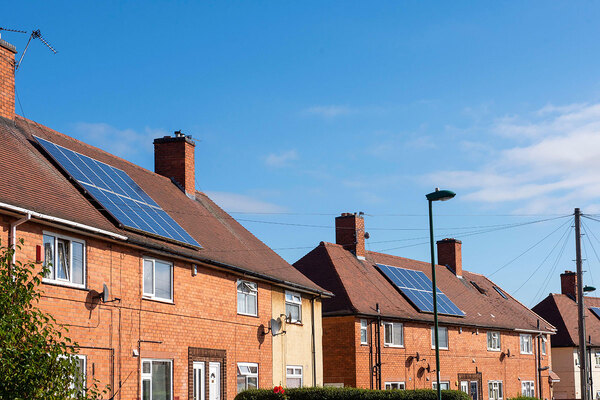
In moving away from a siloed focus on insulation measures, unless they’re cost-effective and impactful, the WHP presents clarity on the importance of clean heat and microgeneration. Several ambitious targets have been set, such as tripling the number of homes with solar panels and delivering around 450,000 heat pump installations per year by 2030.
“A fabric-first approach remains essential, with insulation and ventilation forming the foundation for effective low-carbon heating and energy generation”
The WHP establishes an ambition to more than double the share of UK heat demand met via heat networks by 2035, alongside progress in the transition towards these becoming strategic infrastructure. By creating a route to resident-led flexibility – enabling households to increase generation and shift demand to cheaper periods – this should improve consumer buy-in, confidence and comfort.
While technology will play a central role, the WHP reaffirms that only the right measures should be applied to each home. A fabric-first approach remains essential, with insulation and ventilation forming the foundation for effective low-carbon heating and energy generation. In many cases, these improvements deliver immediate benefits and reduce risk, particularly in harder-to-treat homes.
The WHP references positive sentiment around the Boiler Upgrade Scheme, driven by reported energy bill reductions. However, this positivity must extend to retrofit as a whole, with the right measures selected for each home and clear accountability maintained as delivery scales up.
This is an opportunity to improve the lives of millions across the country, making homes warmer, drier and healthier. At the heart of the WHP is vital recognition that decent living conditions should not be a privilege but a basic standard that improves quality of life.
Building on decades of progress, it’s time to support local authorities, housing providers and combined authorities in taking full responsibility for delivering outcomes that transform homes and communities.
Derek Horrocks, owner, Sustainable Building Services and chair, National Home Decarbonisation Group
Sign up to Inside Housing’s Sustainability newsletter
Sign up to Inside Housing’s weekly Sustainability newsletter, featuring our in-depth coverage of the sector’s journey to delivering net zero.
Already have an account? Click here to manage your newsletters.
Related stories