You are viewing 1 of your 1 free articles
Looking back at 40 years of the BME social housing sector
Back in the year 2000, Sheron Carter wrote about her hopes for the future of Black and minority ethnic people in housing. We republish her thoughts from back then, and she revisits the topic in a comment today. So did her hopes fade?



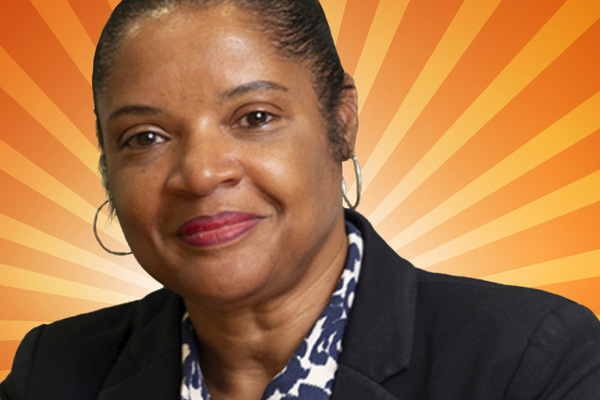
Sheron Carter is chief executive of Hexagon Housing Association
 In the year 2000, @CarterSheron wrote for @insidehousing with a call to even the playing field for BME staff and housing associations. Today, she looks back at whether that happened
14 January 2000 – don’t look back in anger
Now that we have entered the 21st century, I am not quite sure what to make of the experience. As a child I had envisioned apocalypse. More recently the Y2K doomsayers had me looking out for planes falling from the sky or a new skyline created by the odd stray nuclear missile. On the great day itself, Japan gave me a bit of a stir but that was about it. I now find myself living in what used to be the future and reflecting a little on what is past.
One of the things I was most proud of in the last century was the development of the Black and minority ethnic housing sector. Black housing associations have grown significantly on a less than even playing field. Many developed after the Housing Act 1988 so did not have the benefit of fully subsidised assets against which monies could be borrowed and rents pooled. Even so, according to Housing Corporation figures, Black associations raised £101m in private finance between 1988 and 1997. In London alone, the number of properties owned by these associations grew from just 68 to 9,666 over the period.
Read more


The Positive Action Training in Housing schemes have not done too badly either. Having trained around 1,200 people since Merseyside Skills Training launched the first scheme in 1984, all can boast of phenomenal success rates ahead of any other single training initiative in the UK. For example, PATH local authorities have seen more than 90 per cent of its trainees secure employment, including over 80 per cent who have gone on to middle and senior management positions. Even my humble venture has seen modest success by being the first BME not-for-profit organisation to receive a Legal Aid Board contract, forming part of the lord chancellor’s new ‘community legal services’.
There remains much to be done and the playing field is still uneven. But the Black housing sector has demonstrated two things: taking a chance can pay off, and much can be achieved with dedication and commitment. However, sustainable change is not cheap or short term.
The challenge for the future lies in the mainstream. In 1998, the Housing Corporation launched the third BME housing policy and published regional strategies the following year. As well as consolidating the Black housing sector, this strategy seeks to ensure that all associations’ strategies “take full account of the interests of Black and minority ethnic communities, based on realistic assessments of need and backed by meaningful consultation”.
Central to this policy is the empowerment of BME communities. This includes the make-up of governing bodies, recruitment and staff development, tenant participation and the employment of Black contractors.
Whether associations have the commitment and drive to make this strategy a success is yet to be seen. With few exceptions, the track record of many has not been impressive. Real empowerment comes not from the number of ethnic minorities involved in an association, but where they are placed and the influence they have over decisions.
The policy is not clear on performance expectations. What tangible outcomes should be expected from the successful development of BME staff? It will be interesting to see if any of the associations will be able to say that more than 80% of their BME staff went on to middle and senior management.
Hopefully, I will be around at the end of this decade. I wonder whether I will like the future. You never know, maybe I will look back at this decade and find the outcome of the third BME housing strategy will also make me proud.
Sheron Carter, director, Frontline Housing Advice
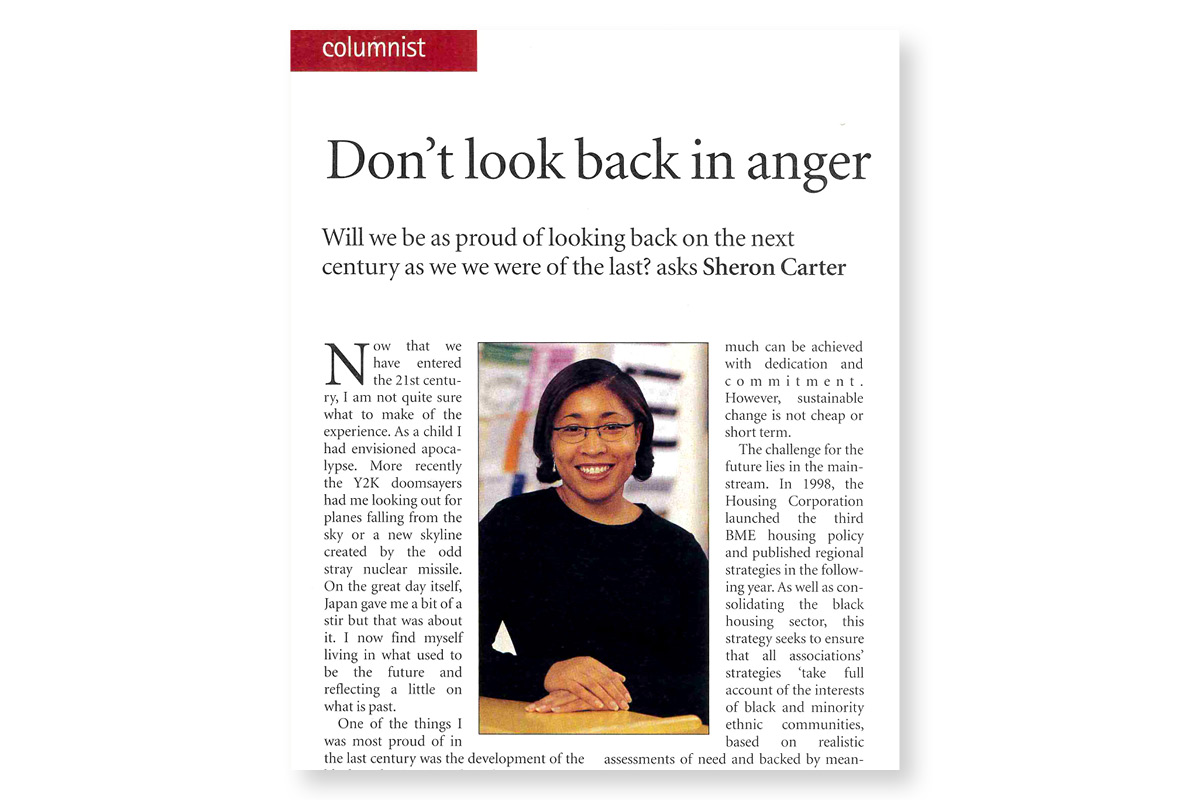
26 March 2024 – my view two decades later: definitely, maybe
The sector has been through some changes since I wrote this article (left) in January 2000. I was leading a charity at the time, working to support homeless people from Black and minority ethnic communities. The 1990s was a time when the sector actively addressed disparities in ethnically diverse communities, albeit with varying degrees of failure and success. I was proud to be part of it.
Mainstreaming the “empowerment of BME communities” was the novel idea of the early noughties, but it did not have the enabling impact of past BME housing policies. BME associations continued to thrive, but the big players were eventually absorbed into ‘mainstream’ housing associations with some anguish. Inviting BME-owned businesses onto contractor lists came and went. And we are still talking about under-representation on association boards and in senior teams.
It was a period of rapid expansion and innovation. ‘Community development’ became the buzzword. Associations expanded supported housing operations and developed all manner of initiatives to help local communities to prosper. Estate regeneration was done on a massive scale. I remember sitting around a table talking about Wembley becoming the new Covent Garden. It isn’t quite that, but certainly a vast transformation.
There was a cooling towards associations in the next decade with the ‘bonfire of the quangos’ and rent cuts in fast pursuit. We voiced concerns that the latter would weaken the sector’s capacity to invest in new and existing homes. We know how that went.
New regulations, macroeconomics, geopolitics and a pandemic have all added to making the 2020s the most challenging operating environment I have seen in the past 40 years. In London, it has reduced capacity to deliver new homes faster than anticipated, increasing overcrowding and homelessness. Many of us have had to reduce development programmes to focus on core service delivery and prioritise investment in existing stock.
There are powerful ethnically diverse voices causing a seismic shift to the narrative across the sector. And there are pockets where mainstreaming diversity is working. At Hexagon, everyone from the boardroom to the reception desk are a microcosm of the communities we serve. This is not because of a diversity initiative, but from seeing the value that each person in each role brings.
Among the L12 group of London medium-sized associations, half have a Black or brown chair or chief executive, three-quarters are led by a female chief executive, and half of the board members are women.
I think it’s a shame that some of these associations are disappearing, too. I remain optimistic knowing we could and must do better. And in the knowledge that we have made a phenomenal contribution to the delivery of sustainable homes and community services, we stay in the game when others pull out and we keep trying no matter how hard it gets. All the best for the next 40 years.
Sheron Carter is chief executive of Hexagon, a board member at NLM, and a senior independent director at Local Space
Sign up to our Best of In-Depth newsletter

We have recently relaunched our weekly Long Read newsletter as Best of In-Depth. The idea is to bring you a shorter selection of the very best analysis and comment we are publishing each week.
Already have an account? Click here to manage your newsletters.
Related stories