You are viewing 1 of your 1 free articles
Building safety thresholds are reshaping mid-rise delivery of affordable housing
Developers are increasingly redesigning affordable housing to sit below 11 metres, writes Diane Ellis, regional director at Lanpro


 Developers are increasingly redesigning affordable housing to sit below 11 metres, writes Diane Ellis, regional director at Lanpro #UKhousing
Eighteen metres (or seven storeys) is the best-known tipping point in the Building Safety Act (BSA). Above it, a residential-led scheme can fall into the higher-risk building category, with a step-change in scrutiny and responsibility.
Yet it is 11 metres that is now steering many schemes. A separate set of rules and operational expectations applies to “relevant buildings” in the middle ground between low-rise and high-rise, and developers are increasingly redesigning their projects to sit below the threshold of 11 metres.
For multi-occupied residential buildings over 11 metres, the Fire Safety (England) Regulations 2022 impose additional ongoing duties, including fire door checks. Approved Document B also lowers key safety triggers to this height: sprinklers are required in new blocks of flats from 11 metres rather than 30, restrictions on combustible materials apply in external walls and wayfinding signage expectations begin above 11 metres.
More change is coming through the Fire Safety (Residential Evacuation Plans) (England) Regulations 2025, which will impose tighter requirements for buildings over 11 metres.
Read more
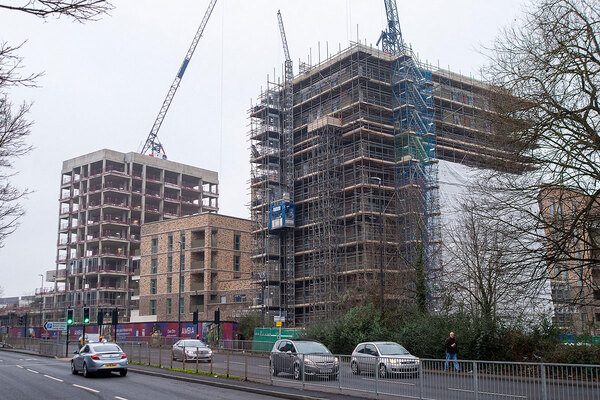

Conversations about the 11-metre line often refer to a fire engine’s ladder length. The reality is more nuanced, but the underlying point holds: operational assumptions begin to change at 11 metres, and the compliance burden shifts with them. Many developers are also wary that requirements now associated with 18 metres could, over time, be applied lower down.
“In the north-west, skylines are changing quickly, but there are signs of a widening gap between schemes that sit comfortably below key thresholds and schemes that go high enough to carry the regulatory overhead”
Below 18 metres, housing schemes typically retain flexibility in design development and programme through conventional building control routes. Above 18 metres, the gateway process applies at planning, pre-construction and pre-occupation.
Gateway 2 is the pressure point: Building Safety Regulator approval is required before construction begins, and design change must then be managed through a more formal route.
Delays, and the need to front-load design work, affect lead-in time and cashflow. For buildings over 18 metres, the requirement for a second staircase and lift adds further cost. Developers respond by building just under 18 metres, or by going high enough for the extra overhead to be justified. The middle is squeezed.
The data behind Gateway 2 shows how quickly confidence was tested. In July 2025, the Building Safety Regulator’s first management information release showed that just 15 of 193 new build submissions had been approved at Gateway 2 (around 8%). Despite a statutory 12-week determination period, average times were widely reported to be closer to nine months.
Since then, official updates show stronger throughput: in the 12 weeks to 22 December 2025, the BSR issued 94 new build determinations and 347 Gateway 2 decisions overall, with ‘good-quality’ applications in the Innovation Unit being turned around in roughly 12 to 13 weeks. Progress is visible, but the experience remains uneven and is still heavily influenced by application quality, capacity and scheme complexity.
The commercial impact has been immediate. National House Building Council registrations in London fell sharply in Q2 of 2025, with developers citing Gateway 2 delays as a significant factor.
In the north-west, skylines are changing quickly, but there are signs of a widening gap between schemes that sit comfortably below key thresholds and schemes that go high enough to carry the regulatory overhead. I have heard of a scheme consulted on at 19 storeys that is now being revised to six storeys, with uncertainty around Gateway 2 delays cited as the reason.
“If uncertainty pushes schemes to flatten and spread, pressure does not disappear. It relocates onto land take, infrastructure and the politics of the green belt”
Masterplans assume a distribution of heights: taller markers at transport hubs and on corners, mid-rise blocks along key routes and density stepping down towards existing neighbourhoods. If mid-rise is squeezed out, we lose the geometry that makes many urban extensions, regeneration areas and transport-led schemes work.
The National Planning Policy Framework supports efficient use of land and higher densities in well-connected locations. Centre for Cities argues that matching comparable French or Japanese densities could allow at least 2.3 million additional homes in urban cores, and that if central London were as dense as Paris, the capital could accommodate around 500,000 more homes.
It also suggests the largest shortfall sits in major regional cities outside London, with 12 big cities outside London accounting for over half of the total gap.
If uncertainty pushes schemes to flatten and spread, pressure does not disappear. It relocates onto land take, infrastructure and the politics of the green belt.
Land values do not usually fall simply because a scheme is lower-rise. If output is reduced, savings are often sought in specification, layout and public realm, affecting streetscape and amenity.
What needs to change? I do not think anyone in the sector begrudges the principle of building safety, but delays and viability pressures need to be addressed.
At present, building below 11 metres can feel like the simplest route to certainty. Building above it adds uncertainty and cost, and that burden ultimately falls on the residents who need these homes.
Diane Ellis, regional director, Lanpro
Sign up to Inside Housing’s Building and Fire Safety newsletter
Sign up to Inside Housing’s fortnightly Building and Fire Safety newsletter, now including a monthly update on building safety from Inside Housing’s contributing editor Peter Apps.
Click here to register and receive the Building and Fire Safety newsletter straight to your inbox.
And subscribe to Inside Housing by clicking here.
Already have an account? Click here to manage your newsletters.
Related stories