



You are viewing 1 of your 1 free articles
Falling over the threshold
Inside Housing reveals for the first time how many council homes are at risk of a sell-off under the extension of the Right to Buy to housing associations. Alex Turner reports


Video:
features code

Council housing was just starting to get a new lease of life. Set relatively free by financing reforms, local authorities across England were just started to build homes again, many for the first time in a generation.
But now, a shadow has fallen over the future of council housing.
“What we’d be seeing is a continuing geographical segregation of the country by wealth.”
James Tickell, partner, Campbell Tickell
That shadow is the government’s plan to extend the Right to Buy to housing association tenants. Many details remain unclear, but we know the government plans to fund the Right to Buy for housing association tenants by forcing local authorities to sell their ‘high-value’ properties once they become void. The sales will fund other Tory priorities too, such as the detoxification of brownfield land.
Now, Inside Housing can exclusively reveal the potential scale of the sell-off. We sent Freedom of Information requests to more than 100 stock-owning councils. We asked how many homes of different types and sizes worth above the ‘high-value’ thresholds they own, when they were valued and whether they had changed tenancies over the previous decade.
Postcode lottery
What we found were massive differences from one local authority in the same region to another, with some facing the prospect of losing vast proportions of stock – and others reporting they will be totally unaffected, with none of their homes falling into the Conservatives’ definition of high-value.
Video:
Ad slot
Some inner London boroughs – Islington, for example – have warned the policy may see them forced to sell new council homes they’re building to meet local identified need.
A total of 30 authorities provided detailed information as to their probable high-value stock: more than 17,000 homes in total, all valued in the last 18 months and mostly within the last six. A further 29 councils told us they have no high-value homes.
No government definition of a ‘high-value’ home has been released. But before the election, the Conservatives defined ‘high-value’ as meaning “in the top one-third of property values of their type”. They proposed setting high-value thresholds at a regional level, subject to consultation. For example, a two-bedroom home in the North East would be deemed high-value if worth more than £125,000 on the open market, while in the South East it would need to be worth £250,000 to hit the sale threshold.
Because the thresholds don’t account for intra-regional peaks and troughs, we found localised property hotspots are far more likely to lose their council housing.
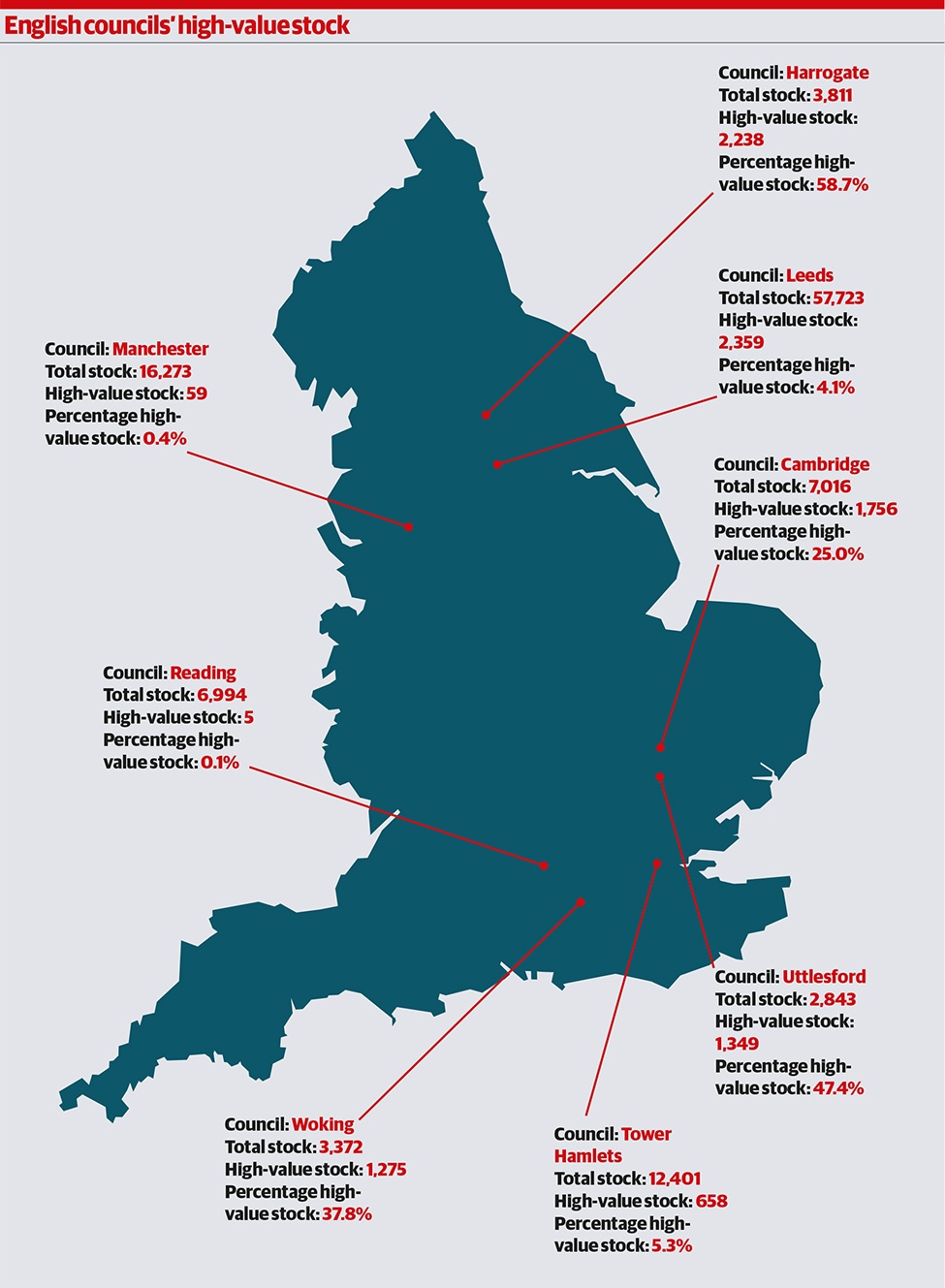
As things stand, in London, the thresholds result in Camden Council predicting around 34% of its housing will be classified as high-value, while Tower Hamlets reports 5% and Croydon zero. But such disparities aren’t confined to the capital.
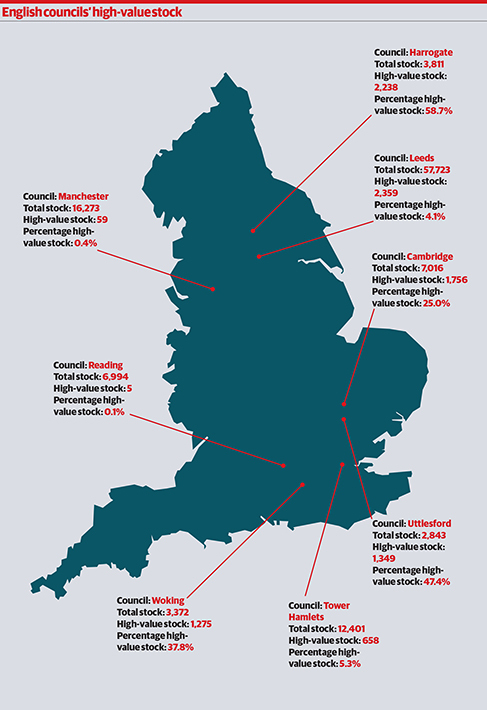
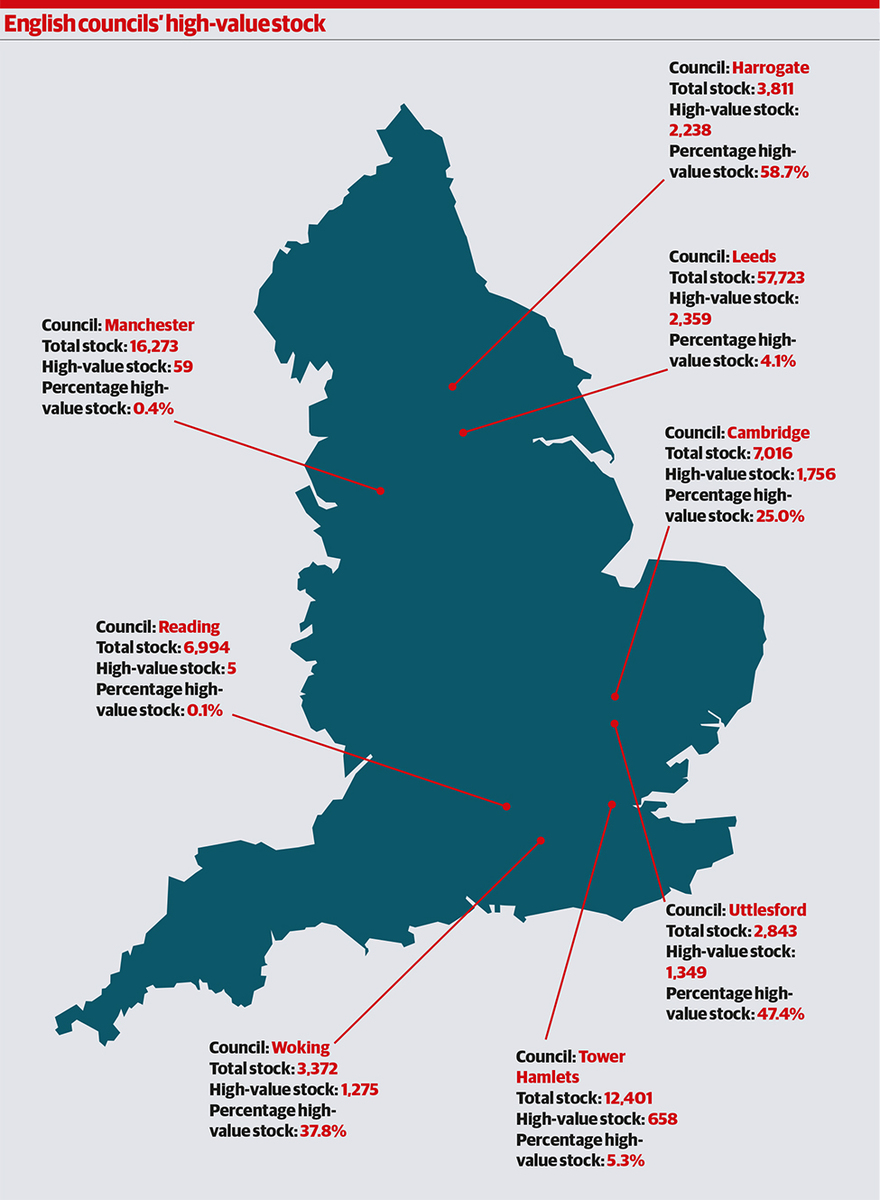
Head into the South East commuter belt and in Slough, for instance, just 0.3% of the authority’s 6,540 homes are estimated to be high-value. Less than 20 miles away, in Woking (with 3,372 council homes, out of a 4,500-strong social stock – and a waiting list of 1,500), that percentage shoots up to 38%.
If the government’s thresholds continue to treat the whole South East region as one entity, Neil Coles, Woking Council’s housing standards manager, reckons the local effects could be “catastrophic”. He predicts properties will quickly end up in the hands of private sector landlords; according to Rightmove, rents for two-bedroom flats in Woking start at about £900 a month.
Shared concerns
In the East of England, Kevin Price voices similar fears. He’s cabinet member for housing at Cambridge Council, where 25% of the authority’s 7,016 homes are thought to be high-value.
Cambridge is one of a dozen authorities that shared information about which of their high-value properties have been vacant in the last decade. Of the 12 councils’ 5,201 high-value homes, 46% have new tenants since 2005 (45% in Cambridge), demonstrating that stock could be lost rapidly.
“We own about 19% of homes in the city; the entire social sector makes up about 25%,” says Mr Price. “We’ve already been losing considerably to the reinvigoration of the original Right to Buy – about 60 homes a year [up from fewer than 10 before discounts were increased].”
Mr Coles and Mr Price explain that local planning constraints and lack of available land mean replacing lost homes within their authority boundaries is difficult. Both face the conundrum that new homes planned by their councils could be sold after just one tenancy.
While Woking and Cambridge are within the capital’s gravitational pull, their woes are mirrored elsewhere. Two hundred miles north of London, the Yorkshire spa town of Harrogate reports that a stunning 59% of its 3,811 homes are estimated to be high-value, the highest proportion of any local authority that supplied data.
“[It affects] most of our area, including the towns of Harrogate and Knaresborough and the city of Ripon,” says Madeleine Bell, Harrogate Council’s head of housing. “It’s also associated rural areas and the villages between the A1 and York – here almost all stock will be sold as it becomes vacant.”
James Tickell, partner at consultancy Campbell Tickell, says rural exemptions from sell-offs are essential. Areas such as Cornwall and Cumbria, where prices are high, local wages often low and housebuilding a fiendishly tricky business, will face similar challenges to North Yorkshire.
“The hard work of pulling together complicated rural schemes that allow people to live in villages they were born in, would be swept away over time,” he says.
In general, provincial cities don’t face such severe scenarios. Newcastle estimates it has 265 high-value homes (1% of stock); Nottingham and Leicester 47 (both 0.2%) apiece; Portsmouth and Southampton zero.
Interestingly, Manchester – which has experienced some of the UK’s strongest house price growth – reports just 59 high-value homes (0.4% of stock). Most of the council’s historic stock has been transferred to housing associations; its 16,273 retained homes are largely in low-priced postcodes.
But Leeds (57,723 homes) and Sheffield (40,383) face selling 2,359 and 1,637 properties (both 4%) respectively. Most affected are estates in Sheffield’s leafier southern suburbs, and homes in the market towns ringing Leeds’ northern edge.
Spokespeople from both councils express fears over potential long-term effects on the social mix of the cities’ communities, with any replacement homes likely to be built in less affluent neighbourhoods. For both though, it’s as much the type of stock vulnerable to loss as its location that gives cause for concern – and it’s here that the national picture begins to line up.
Across all 30 councils, 80% of all high-value homes are either one or two bedrooms, while 38% are bungalows.
The 29 English councils with no high-value stock
- Blackpool
- Central Bedfordshire
- Hull
- Luton
- Northumberland
- Portsmouth
- Southampton
- Stoke
- Barking and Dagenham
- Croydon
- Hillingdon
- Oldham
- Barnsley
- Doncaster
- Wolverhampton
- Chesterfield
- South Derbyshire
- Colchester
- West Lancashire
- Charnwood
- North West Leicestershire
- South Holland
- Great Yarmouth
- Corby
- Ashfield
- Mansfield
- Tamworth
- Ipswich
- North Warwickshire
bedroom tax dilemma
For areas heavily affected by the bedroom tax, this stock distribution is especially problematic.
But smaller properties are in greatest demand in most authorities we speak to. “Although we have a huge overcrowding issue, there are very significant numbers waiting for one and two-bedroom homes,” says Rachel Blake, cabinet member for strategic development at Tower Hamlets Council.
The presence of so many bungalows (in some areas destined never to be property hotspots, such as Barrow-in-Furness, they’re the only high-value homes) adds an extra level of complexity. While some two-bedroom bungalows house small families, many, especially one-beds, are used primarily as age-banded homes or accessible accommodation for people with disabilities.
Selling such homes would remove a valuable, potentially irreplaceable social housing resource. “Opportunities for downsizing and more effectively using stock will be lost,” says Mr Coles – though he points out that in areas such as his, encouraging an elderly resident to move out of a family home would be just as likely to see it sold off anyway.
So what happens next?
“The value threshold could instead be set at a local authority level, which would reduce the effect on high-priced markets,” argues Richard Donnell, research and insight director at valuations agency Hometrack.
Hometrack modelling suggests social homes are worth just 63% of their private counterparts on the open market. This means, by setting thresholds at a local authority level, it’s unlikely that extra swathes of council housing would suddenly become vulnerable to sell-off.
When we ask the Department for Communities and Local Government if the thresholds were likely to be implemented as set out by the Conservatives, a spokesperson will only say that detail will be “set out in due course”.
More than one interviewee describes the looming scenario, combined with the impact of the recently announced cuts to social rent levels, as a “perfect storm”, which puts at risk maintaining and expanding their number of homes.
In Cambridge, Mr Price predicts his authority will still build where possible. But most councils say they’re waiting for the detail in the Housing Bill later this year before they decide what to do about their development programmes.
If that detail doesn’t contain significant refinements, warns Mr Tickell, the effects could be grave.
“What we’d be seeing is a continuing geographical segregation of the country by wealth – most of us live in economically mixed neighbourhoods, even in prosperous areas,” he says.
“You’d end up with poorer people unable to live in quite large parts of the country. We’re looking at a massive programme of social engineering.”
Good values?
While we were conducting our research via Freedom of Information requests, consultancy Hometrack has been modelling the impact high-value council housing disposal, based on valuations for the whole of the UK’s residential stock – not just addresses that have sold. It has shared some of its data with Inside Housing; while there are local divergences, the broad trends identified are the same.
Councils usually take one property archetype and use it as a “beacon” to value other similar nearby homes explains Hometrack’s Richard Donnell. The accuracy of this process, he says, “depends on how much of a beacon it is”; in other words, how many attributes are included and how similar a selection of properties it represents.
From this year, the Local Government Transparency Code requires authorities to publish stock valuations, including market values. Clearly, consistency among these will be crucial when determining which homes are and aren’t high-value.
Mr Donnell is less gloomy (or more, depending on whether you are a council facing the sell-off of your properties or George Osborne), predicting that high-value sales could generate not £4.5bn, but £3bn a year.
“If government got properly organised and there were processes to organise distribution of this cash, you could probably get more than a one-for-one replacement,” he says.
But “inefficiencies”, he adds, make it much less likely this will transpire – and he concurs that a “hollowing out” of affordable housing in inner London and other expensive locations is inevitable.




Related stories







