First to go: how the Social Housing Decarbonisation Fund is working for one winner
The Midlands Energy Hub and a group of housing associations have won a piece of the first tranche of government money meant for decarbonising social homes. Gavriel Hollander looks at how the money is being spent, and how it is helping landlords get to grips with the bigger project of retrofitting homes


 The Midlands Energy Hub and a group of housing associations have won a piece of the first tranche of government money meant for decarbonising social homes. @Gavhollander looks at how the money is being spent #UKhousing.@beisgovuk has started allocating the Social Housing Decarbonisation Fund. @Gavhollander talks to some of the first recipients @MyNottingham, @Futures_hg, @MetTVH #UKhousing
No one really knows what the final bill for decarbonising the UK’s five million social homes will come to. Research by Inside Housing in 2020 put the total just north of £100bn, but the long shadow of inflation, coupled with an ongoing materials and labour shortage, may well make that figure appear optimistic.
Whatever the ultimate number, £179m would seem to be quite a small proportion of it at first glance. Yet that is the total package of funding awarded by the Department for Business, Energy & Industrial Strategy (BEIS) in the first wave of its £800m Social Housing Decarbonisation Fund (SHDF).
“Ultimately it’s all about the people who live in those properties and about making sure that it’s the right solution for them and the homes that they’re in”
That £179m will be split between 69 projects and will cover upgrade work on around 20,000 social homes. That kind of investment is certainly not to be sniffed at, and indeed it will make a positive difference to the people living in those homes. But what will this pot of funding actually achieve? And what role could it play in housing associations’ wider decarbonisation plans as they move towards the 2050 net zero target?
In truth, the SHDF, which is available only to English bidders, is part of an alphabet soup of funding streams that social landlords are using to push forward their energy efficiency and decarbonisation programmes and which – taken together – begin to add up to a more impactful sum of money.
Read more


 Net zero costs would ‘bust’ most housing associations without extra funds, claims PlaceShapers chair
There is the Local Authority Delivery Scheme, a £500m funding stream that forms part of the wider £2bn Green Homes Grant. The phase-two allocation last year saw £300m spread between five local energy hubs. Similarly, the Sustainable Warmth funding competition saw around £500m invested in 79 local authority projects to upgrade energy efficiency measures. And then there is the Energy Company Obligation (ECO), which has been running since 2013 and is designed to bring as many homes as possible up to Energy Performance Certificate (EPC) Band C by 2030, with an interim target of Band D by 2025. The fourth iteration of the ECO will run from this year until 2026, funded from a charge on electricity bills, with £1bn allocated each year to improve energy efficiency.
In this wider context, the SHDF no longer looks like tinkering around the margins. That is even more the case given that winning bidders are expected to contribute up to a third of the cost of projects they bid for in matched funding, taking the overall investment across all waves of the programme to £1.2bn.
The biggest beneficiary from the first wave is a consortium of nine housing associations and local authorities led by Nottingham City Council and its partner, the Midlands Energy Hub. The group was awarded £14.9m, which will fund retrofit work on more than 1,500 homes. That works out as funding of around £9,000 per home, with the total spend per home pushed up to £13,500 when taking into account the landlords’ contribution.
“Our approach to net zero, which seems to be reasonably consistent with everyone else, is fabric first, worst first”
Michael Gallagher, head of the Midlands Energy Hub, says that the relatively low level of funding available should be viewed in a wider context: “The SHDF is part of a bigger picture. We had the confidence to bid into this because of the work we’ve done previously under different schemes.
“It’s about building that bigger picture: to see how we can enable the maximum amount of work to be delivered at scale across the region, but still enabling that local place-based approach that’s so important, because ultimately it’s all about the people who live in those properties and about making sure that it’s the right solution for them and the homes that they’re in.”
‘Fabric first, worst first’
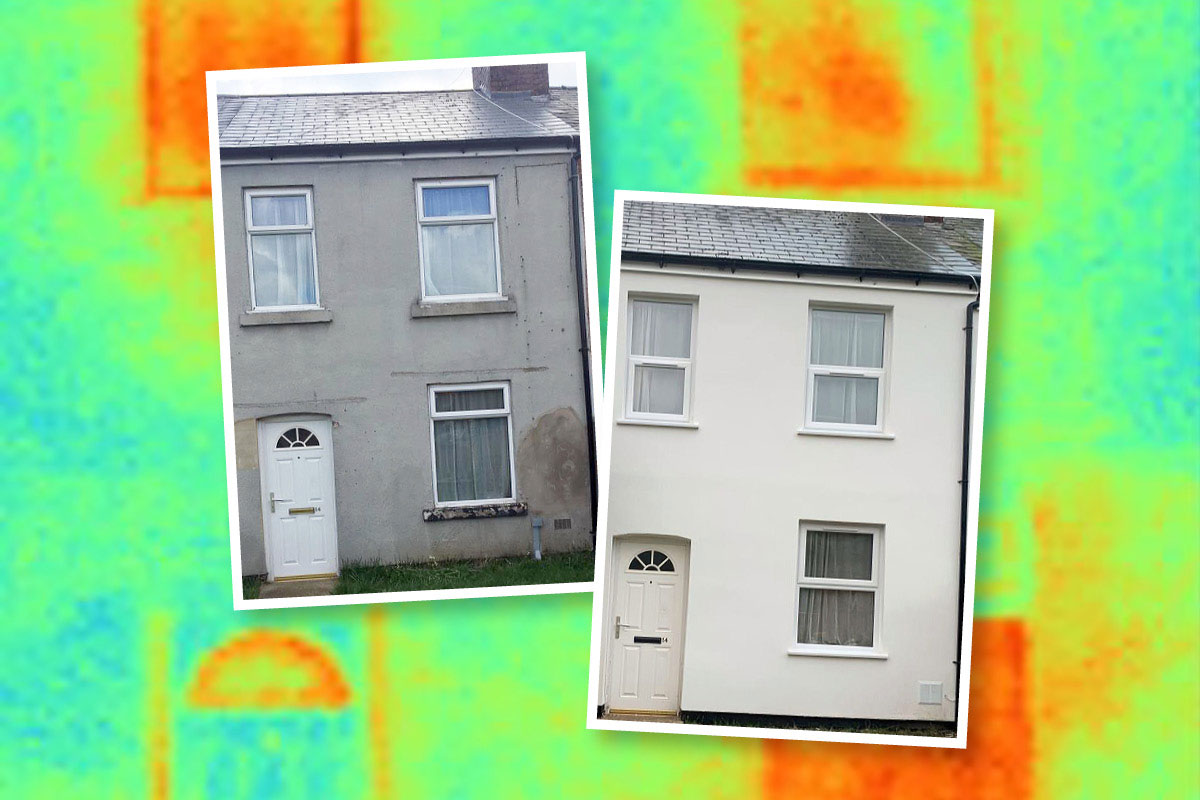
The majority of the projects that will see money funnelled to them in the first instance will involve external wall or cavity wall insulation work, with heat decarbonisation (such as the installation of air source heat pumps) taking a back seat.
As James Dial, programme manager at consortium member Futures Housing Group, tells Inside Housing, the decision to tackle those homes that require a ‘fabric-first’ approach with the SHDF money is in line with the association’s wider strategy.
“Heat pumps are pretty expensive at this point in time. There’s a lack of supply chain out there, so we know from other housing associations that what they’ve assumed in their bids or their project budgets [is different from] what they’re going out to tender for”
“Our approach to net zero, which seems to be reasonably consistent with everyone else, is fabric first, worst first,” he explains, meaning that the 10,000-home landlord will use funding to deal initially with its worst-performing homes in terms of energy efficiency. It has set a target of getting all homes to EPC Band C by 2030, with a ‘stretch target’ of achieving that by 2028. The SHDF funding will be used to invest in homes currently in bands D and E.
“Our view of transitioning to heat pumps is ‘not yet’. Our core strategy essentially says it’s fabric first, probably up to 2030 and then we start to transition towards clean heat,” Mr Dial adds. “There’s a couple of things that are in our mind with that approach. Heat pumps are pretty expensive at this point in time. There’s a lack of supply chain out there, so we know from other housing associations that what they’ve assumed in their bids or their project budgets [is different from] what they’re going out to tender for. So they end up paying more than they’ve anticipated. We anticipate the cost of heat pumps will come down as we get towards 2030 and beyond.”
The Midlands Energy Hub’s biggest housing association member is Metropolitan Thames Valley Housing (MTVH), which will receive just over £2m for 500 homes. The 58,000-home landlord also won a further £2m of funding alongside Lambeth Council. Adding in MTVH’s co-funding contribution, it means it will invest £6m in total across the Midlands and Lambeth schemes.
“It gets us started and, crucially, it helps to develop a supply chain that’s otherwise not there”
For a landlord with a turnover of £465m in 2020-21, this does not seem like a transformative amount. But Jules Bickers, director of property at MTVH, explains that part of the reason this kind of funding stream is important is that it helps to create a marketplace for the sort of work that will have to be scaled up significantly if the sector is to meet its decarbonisation ambitions.
“It gets us started and, crucially, it helps to develop a supply chain that’s otherwise not there,” Mr Bickers says. “It also develops those internal skills, like the retrofit co-ordinator and retrofit assessor that we need.”
MTVH’s initial target is to get 75% of its homes to EPC Band C by 2026. Mr Bickers estimates that equates to upgrading between 10,000 and 15,000 properties over five years. He accepts that government funding streams are only ever part of the solution. “We’re clear that we’re going to need to be largely self-sufficient and find the space in our business plan [for our retrofit programme] over the next 20 to 25 years to fund all of this,” he says.
That said, MTVH expects to take part in the next round of SHDF funding and will likely bid for the fourth round of ECO money in May. “All those opportunities to keep taking advantage of those funds will remain,” Mr Bickers says.
Although government funding is a boon to many associations trying to work out how to pay for net zero, there are risks involved, too. The SHDF money comes with a ‘use it or lose it’ clause that says work must be completed within 12 months. Futures’ Mr Dial says: “The grant award doesn’t change so we’re exposed to the risk of price changes, positively and negatively. But that’s a risk we are willing to accept.”
Mr Gallagher at the Midlands Energy Hub believes that some of the risk is mitigated by the advantages of working as a consortium. The hub, for example, offers two dynamic purchasing systems, designed to respond to increased demand from consortium members.
“Whenever you look at a programme, there are always going to be challenges and there always has to be a date by which it needs to be delivered,” he explains. “So it ultimately comes back to good planning. I think one of the advantages we’ve got is we’ve done some of that hard work around getting these mechanisms in place. We know there are challenges with the supply chain, but we think the work that the hub has done will alleviate some of those.”
And in a sense, it is that urgency to deliver that will – it is hoped – drive innovation among landlords and the supply chains that will carry out this work.
Sign up to our Best of In-Depth newsletter

We have recently relaunched our weekly Long Read newsletter as Best of In-Depth. The idea is to bring you a shorter selection of the very best analysis and comment we are publishing each week.
Already have an account? Click here to manage your newsletters.
Related stories