You are viewing 1 of your 1 free articles
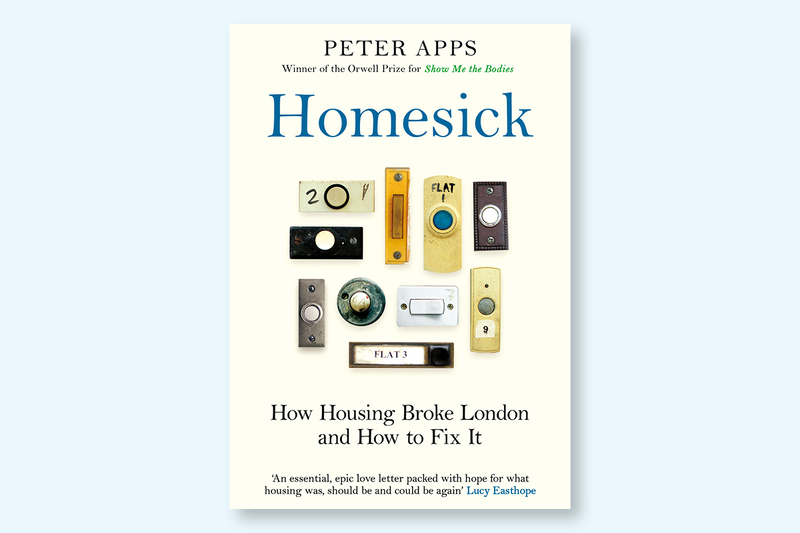
‘Homesick: how housing broke London and how to fix it’ – an extract from Peter Apps’ latest book
London’s housing crisis has become unbearable, but the city was not always like this. In Peter Apps’ new book, he traces the city’s journey from the relative security of the 1980s to the chaos of the present day. In this extract, we visit London in the 1980s and meet some of the characters the book will follow as the decades pass


 ‘Homesick: how housing broke London and how to fix it’ – an extract from Peter Apps’ latest book #UKhousing
1980s – The board swept clean
London in the 1980s was a city on the cusp of change. The bombardment by the German air force during World War II had left scars which took a long time to fix. An estimated 1.1 million houses had been destroyed or damaged during the war, with some poorer areas of the East End in particular so badly bombed they had to be almost entirely rebuilt. By the time the Blitz ended, roughly one in every six Londoners was homeless. The decades before the 1980s had seen the bomb-damaged city restored – craters filled in, new homes built, burned-out industrial facilities torn down and replaced. But if you looked closely, you could glimpse traces of the devastation. Wooden hoardings still ringed off old bombsites, yet to be remediated and redeveloped. Metal stubs were left where railings had been pulled out during the war’s ‘scrap for victory’ drive. Derelict Anderson shelters remained in many gardens – now repurposed as potting sheds, vines creeping across their corrugated iron roofs. Meanwhile, tens of thousands of Victorian-era houses had been branded slums and demolished, the residents moved out to vast new towns on the edge of the city or new social housing estates within it.
Rapid deindustrialisation was stripping London of its old jobs: the docks were closing and moving downriver to Essex, factories were shuttered and heavy industry jobs, the lifeblood of many working-class communities, were vanishing.
The wreckage remained: the dilapidated red brick and broken windows of now deserted warehouses and factories, overgrown canals, disused goods depots and empty, fenced-off power stations pockmarked the city. The capital was “suffering more severely than any other British city – even Liverpool” from the transformation away from an industrial economy, as Roy Porter argued in his history of the city.
Unions fought – and lost – battles outside London’s factories, just as they did on the picket lines in northern mining towns. Jobs still disappeared – overtaken by new technology, outsourced overseas or to other areas of the country. This translated directly into social deprivation: by the end of the decade, inner London topped national tables for poverty, family breakdown, school truancy and crime. It felt much more dangerous and rougher than it does today. Step into a phone box in Bayswater, Marylebone or Earl’s Court and it would be plastered with cards for call girls. Areas of east and south London like Hoxton or Peckham, now hotspots for young graduates, were unsafe, with regular street crime. It was also much dirtier. Landmarks like Westminster Abbey were coated in the soot and smoke of previous centuries. Rising traffic meant highly polluting cars and thick, dark air. Tube trains which had been in service since before World War II rattled and thundered under the city. Empty homes were left abandoned, no buyers willing to pay the money to fit them up to a liveable standard.
Amid this decline and deprivation, the population was falling, continuing a downward trend since the war. From a peak of 8.6 million just before the start of the war, the number of people living in the city fell to a low of just 6.8 million at the start of the 1980s, as people relocated to the new towns being built in a ring around the city, swapping London’s pollution and crime for a quiet life in the suburbs. It was a tough place to be an ethnic minority. A diverse city for centuries, London became even more multi-ethnic after World War II as the government encouraged immigration from British colonies to provide the workforce needed to rebuild the country. Housing was a major challenge for these new arrivals to the city – with discrimination rife in both private and social housing. As a result, they faced the worst of the private rented sector and were hammered by the unemployment of the late 1970s and early 1980s. There were riots in Brixton in 1981 and Tottenham in 1985 – a reaction to the openly racist policing of Black communities in these areas.
There were also large swathes of the city, like Silvertown in the east and Bermondsey in the south, which were unsafe for many minority ethnic communities, as a rising and powerful National Front capitalised on the dissatisfaction and anger in many of the traditional white working-class strongholds. The fascist group organised around pubs – such as the British Flag in Victoria Dock Road in Canning Town – set up advice centres focusing on white housing issues, which pinned the blame for the housing shortage on immigrants, and pressured councils not to allocate housing to Black and Asian families. Violent racist attacks were a fact of life for the city’s minority groups. In 1980, 29-year-old Akhtar Ali Baig was stopped by a skinhead gang on East Ham High Street, who spat at him, racially abused him and then stabbed him in the heart with a sheath knife. “I’ve just gutted a Paki,” one of the assailants shouted as he fled the scene.
This was London in the 1980s – a dangerous, dark, polluted, broken, depopulating city plagued by ethnic tension. But also very much alive. There were buzzy backstreet pubs, small live music venues, markets and high streets filled with local businesses – family-owned butchers, street traders, tailors, greengrocers.
Communities of Commonwealth immigrants, Irish, Jewish and Cockney residents gave areas of the city unique character. Developers saw an opportunity to remodel a new city from the debris of the old economy – empty warehouses, docks and markets. “I believe this is the decade in which London will become Europe’s capital,” says the gangster played by Bob Hoskins as he leads a boatload of American investors along the Thames in the film The Long Good Friday. “Having cleared away the outdated, we’ve got mile after mile and acre after acre of land for our future prosperity. No other city in the world has got, right at its centre, such an opportunity for profitable progress.”
This vision was not just fiction. The regeneration of east London’s docks, which closed for good in the early 1980s, was one of the biggest inner-city redevelopment projects in the world. Builders dug foundations for new glass and steel skyscrapers and office blocks for London’s burgeoning financial district – where the new trading freedoms which the government instituted in the 1980s would replace colonial trade, which the docks had been the centre of for two centuries, as the primary source of the country’s wealth. The London Docklands Development Corporation (LDDC), which was set up under Margaret Thatcher’s government and given control of the land in 1981, led the redevelopment. This was an ideologically driven project: chancellor Geoffrey Howe said the docklands were to be a “test area” for how “a return to free market principles could bring prosperity and jobs”. But in reality, it was not the free market in operation. Thatcher was suspicious that local authorities and unions were conspiring against the development potential of the former docklands. Labour-run Tower Hamlets Council, for example, wanted the area to be used to support more blue-collar employment. She saw the LDDC as a way to bypass this and create a base for her new, capitalist vision of Britain. Despite her apparent dislike of state intervention, the project was controlled and funded by central government, with billions in public money used to clear the site of its contamination and previous infrastructure, even filling in some of the former docks entirely. The private businesses that built offices and homes here in the years to come would be the beneficiaries of this spend.
In 1987, a modern, driverless light railway opened in the old docklands – snaking out from the new offices into the east of the city, where those who worked in the financial industries could now live. Development projects cropped up along these lines, catering for this wealthier Londoner. And an airport was opened in the former docklands in the same year – a base for international business people to fly directly between London and other financial centres around Europe. The new financial district came as Thatcher rebuilt the British economy into one which relied on wealth generated by traders. London’s time zone made it a convenient trading base between New York and Tokyo, and the London International Financial Futures Exchange (LIFFE) was opened in 1982 – a huge bear pit of city traders, right in the heart of London, where stockbrokers made and lost their fortunes in a buzz of capitalist energy, and then poured out into the surrounding pubs for boozy lunches and late-night drinks. There was suddenly a new way to get rich in the UK, a vision of wealth which was (theoretically) open to any kid with a school education, a decent head for numbers and the guts to try. Broadgate, near Liverpool Street station in the east of central London, was then largely derelict railway yards. It was promptly transformed into the base of this trading empire. “Here in a way we are drawing back the curtain of the future,” Thatcher declared at the launch of the development to build it.
Office blocks for the white-collar jobs popped up throughout the city, on top of old markets or bombsites. There was some local anger. “London needs a new office block like it needs a new plague” was graffitied on the hoardings of one development site in Swiss Cottage. The Victorian terraced homes in working-class areas were increasingly ceded to more middle-class families attracted by their affordability. People were coming to the city again. The falling population plateaued as people began to move to the city once more for work.
London was hurtling into the future, leaving its history behind. Its empty spaces and vacant buildings were becoming the currency of a modern city, untethered from its past. But who was it going to be for?
Andy
As a teenager, Andy Plant lived in a council house in Clapham Park. “Back then it was mostly working-class, rough pubs,” says Andy. “It wasn’t violent, but it was a working-class area.” He passed his 11+ exams and got a place at the nearest grammar school, which meant a daily mile-and-a-half walk to school in Battersea. He noticed the signs of gentrification as he walked. “There were rows of nice Edwardian-type housing,” he says. “On one side of the road you had the corner shop, the off licence, and on the other side you were starting to get delicatessens.” After he finished school, he joined the army. But during a drill, his foot went down a rabbit hole, his ankle twisted, his heavy pack fell and his shin bone snapped. “I’m told you could hear the scream from more than a mile away,” he says. His shin healed but his days in the army were over. He moved back to his aunt’s house in Clapham Park, which had started to turn into a tougher place to live. “It was rough. It was the sort of estate where everyone had an Alsatian or something so that they didn’t get attacked if they just went down the shop,” he says. At that time, punk music was a huge part of his life. He recalls seeing the Damned at a pub in Croydon. “For my generation punk set so many people free in terms of expressing ourselves,” he continues.
“This was another thing about all of London back then, most of the working-class areas had loads of record shops. We had Dub Vendor in Clapham Junction, which catered for the younger Black community. Walking past there as a teenager and getting almost bowled over by the bass coming out, that got me into reggae.”
The wobbly pillar – the dream of social housing
By 1980, London had achieved something remarkable, something which remains vanishingly rare both historically and globally: it had provided abundant municipal housing, giving its population secure, (largely) safe homes and breaking the grip of exploitative landlords. By 1981, 872,426 London households lived in social housing, 34.8 per cent of the city – more than double the 15.1 per cent who rented privately. To put it in context, New York City had 178,000 social housing households at the same time – and was still the biggest public housing authority in the US. Even more incredibly, this had been done without shipping people to the outskirts: unlike in Paris, where poorer residents live out in the banlieues, in London the social housing had been woven throughout the city, even in the centre.
This social miracle had been more than a century in the making. Social housing in London traced its roots back to piecemeal efforts of Victorian philanthropists, churches and almshouses to provide housing to the poor. In the aftermath of World War I, providing decent housing for those who couldn’t otherwise afford it became a priority for the state – the British troops were promised ‘Homes for Heroes’ on their return from France. The plan was simple: central government would borrow money cheaply and provide grants to local government bodies who would use it to build new social housing. Residents would then pay a reduced rent which, over a long period of time, would settle the initial debt. In this period, London built outwards, stretching into the marshes and farmlands to the east with the vast Becontree estate – a 27,000-home mini-city of smart, large, brick townhouses in long, spacious terraced streets, which accommodated many workers in the Ford car factory and remains the largest single municipal estate in Europe. In more central areas of the city, privately rented slum housing which dated back to the Victorian era was demolished and replaced. Many different visions of estates were built across the city, with the falling population meaning density was never a major concern and green areas and open spaces could be prioritised. Planners in Bermondsey attempted to rebuild the area as a ‘garden city’ – a development pioneered by Ada Salter, Labour’s first female mayor. The development delivered extraordinary cottage-style workers’ houses sitting in neat little rows in a vision of housing that seems a world apart from our idea of inner London estates today, although some were lost to the Luftwaffe’s bombs during the war and replaced with highrises in the decades that followed.
In the 1950s and 1960s, we built upwards. Futuristic dreams of streets in the sky abounded and brutalist concrete came into vogue as architects experimented with the potential of this modern form of construction. These estates were seen at the time as modern and exciting new ways to live – designed by an army of architects employed by the London County Council (LCC), which was the largest architectural practice in the country at the time. The homes were transformative for the working-class population, used to sharing between whole families and sweating to make rent for the private landlords who had ruled London since the nineteenth century. Pauline Hutchinson remembers growing up in Stepney, in the East End, in a house which had two rooms, a scullery and a minute back yard and was home to her mum, dad, grandmother and two siblings. The street was full of animal noises: dogs, cats, pigeons, rabbits and the chickens which Pauline’s family kept. Her parents were among the east Londoners who moved out of these conditions into council housing – getting a flat on a newly built council estate in 1950. Her parents were “over the moon” with the home, recalls Pauline. It was a three-bedroom flat with a tiny kitchen and living room together with an indoor bathroom, which felt like an unbelievable luxury in those days. “We knew everyone and there was a real sense of community. We had Jewish people, Africans, West Indians and Irish and lots of mixed-race families. We lived on the top floor and thought we were living in the clouds.” These new houses also gave Londoners stable and affordable rents and lifetime tenancies, which meant they had security and, in some circumstances, could pass it on to their children when they died. Oral histories of early social housing in London are scattered with new residents describing the social homes they moved into as “a palace”, “heaven with the gates off” or similar.
In essence, the provision of housing had become a direct role of the welfare state. It would be wrong to say there was ever complete consensus about this.
Throughout the twentieth century, governments also often looked for ways to sell off council homes, increase the rents and reduce the level of capital investment the state put up to build them. Even the ‘Homes for Heroes’ programme was subject to major cuts. Social housing became seen as the ‘wobbly pillar’ of the welfare state – never quite as secure in its place as health and education in the social contract between the government and its citizens.
But in London social housing thrived, particularly because of its staunch supporters in the LCC and its successor, the Greater London Council (GLC), controlled by Labour Party politicians who supported council housing for most of the twentieth century. By the 1980s, with London’s population having fallen, there was actually too much social housing: in 1981, Lambeth had 3,100 empty council properties, Islington had 2,800, Southwark had 2,700 and Hackney had 2,300. This created financial difficulties because there was stock standing vacant, and no one paying the rent. The GLC would occasionally run ‘first come, first served’ opportunities to become a tenant at estates where they had too much stock. Young people, some of them students, could simply join a queue at 9 a.m. and become council tenants by the afternoon.
For the most part, these estates were well looked after. Rents were paid to central government, which returned them as subsidy for maintenance, while councils also had business rates and council taxes to invest in housing. “In those days, Camden had money coming out of its ears,” says Derek Jarman, a long-time council tenant and former councillor, describing a programme of double glazing at one estate. “There was a resident caretaker. If there were any problems or if the kids were misbehaving he could go and tell them to either piss off or behave,” he adds. This was true of many estates around London. Resident caretakers, good maintenance, high standards of building overseen by the architects at the GLC and abundant supply. Council housing was thriving. But the aftershocks of Thatcher’s new economic model were sweeping through London and this would change everything.
Hannah, Andrew
Hannah Joshua grew up with her mum on the Samuel Lewis estate in Dalston. “When I looked out of my window there were lots of trees,” says Hannah. “I had all my friends on the estate or the estate across the road. Obviously, it wasn’t all perfect, but it was a good place to live. The idea that we were poor because we lived on an estate never really occurred to me.”
The estate was formed of three long, red-brick, four-storey finger blocks. One on the east was called ‘the electrics’ locally, because it was the only one with lifts. Hannah and her mum’s flat was small: the kitchen and bathroom were in the same room, separated by a shower curtain. Hannah spent a lot of her time outside. She can still name her friends and their flat numbers. “There were just loads of kids and we would all play out,” she says: tag, run outs, knock down ginger. “I feel like I had a lot of freedom,” says Hannah. “We had a club which was run by women on the estate. It was 20p to go and you’d have pool, table tennis, all sorts.” The estate had around six residential caretakers who lived there with their families. “They were quite grumpy, some of them, but they were always around,” she says. “If there were any problems, like a broken fuse, you would literally walk down to the estate office and someone would come up within half an hour.”
Andrew’s dad moved to London from Canvey Island in Essex after the devastating North Sea floods of 1953 submerged the small outcrop of land in the Thames estuary. The floods killed 307 people in the UK, 58 of them from Canvey Island. Andrew’s dad lost friends to the waves and watched their bodies floating along the street in the surging water. The family moved to east London not long after, to be further from the sea. It was here, on a small council estate in West Ham, that Andrew was born. “My dad was the postman for the area, and everyone knew him,” recalls Andrew. “People think now that the idea that everyone knew each other in the East End is a bit of a myth, but they really did. All the men would finish work and go down the pub: the postmen, the bus drivers, the plumbers. I’m just about old enough to remember the tail end of all that. When you watch old episodes of EastEnders, that’s what it was like at that point in time.” Andrew’s parents knew most of the other mums and dads in the area, so he had a lot of freedom as a child. He could go in and out of friends’ houses and play in the cul-de-sac. It wasn’t always an easy community, though. He recalls the story of a young man who lived locally who beat his wife and eventually killed her with a hammer. He was caught trying to dispose of the body with his father on a building site in Bow and both were prosecuted for murder. “It’s always been rough,” he adds. ”But you kind of learned to go with it and knew what you could and couldn’t do. And if you weren’t involved in any of the trouble, it was actually a really nice area to grow up in.”
Homesick: how housing broke London and how to fix it is published by OneWorld and is out now. You can purchase a copy here
Sign up to our Best of In-Depth newsletter

We have recently relaunched our weekly Long Read newsletter as Best of In-Depth. The idea is to bring you a shorter selection of the very best analysis and comment we are publishing each week.
Already have an account? Click here to manage your newsletters.
Related stories