You are viewing 1 of your 1 free articles
It is three months since Richard Meade became chief executive of the Scottish Federation of Housing Associations. As Scotland’s elections approach, how will he be advocating for the sector? Ellie Brown reports

Richard Meade moved around a lot as a child. He lived in army accommodation wherever his father was stationed, from Germany, to Norway, to Northern Ireland. He has fond memories of his travels. “I think sometimes as a kid, that was part of the adventure,” he says.
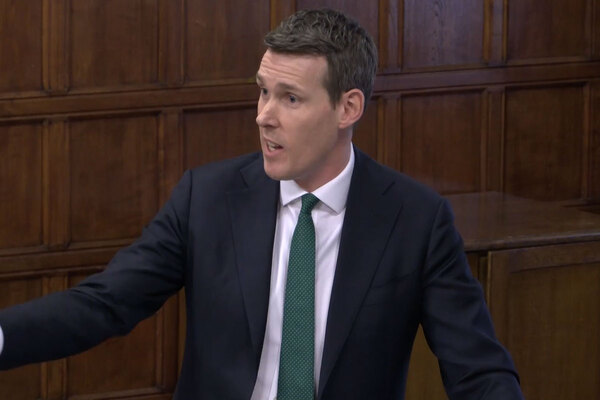
Mr Meade’s focus now, though, is on housing in just one country: Scotland. We are speaking in the plush bar of the Fairmont hotel in St Andrews, where the Scottish Federation of Housing Associations (SFHA) is holding its annual Finance Conference.
In September he became chief executive of the SFHA, the trade body that represents 97% of Scotland’s housing associations. His appointment followed successful efforts by his predecessor Sally Thomas to boost the association’s membership numbers and influence.
How will Mr Meade steer the ship in the future? He tells me he wants to build on the organisation’s success – and go a step further. He wants to tell both MPs and the public the story of how housing associations contribute to the wider “social good”, in a bid to win support during a challenging time for the sector.
“I think that this sector knows really well what it does in terms of the impact it has on the individual. It’s more than bricks and mortar... it’s an opportunity to perhaps go into employment or education,” he says. But, he continues: “I think as a sector, actually, we’re not very good at telling that fuller story.
“I want SFHA to be at the forefront of [that]. I want to make sure that government sees that every priority it has is rooted in social housing.”
Unlike his predecessor, Mr Meade did not build his career in the housing sector. For the past two decades, he has worked in public affairs for charities throughout Scotland, including Barnardo’s and Marie Curie.
“I always had a sense of trying to do social good, [but] I knew I would never be a doctor or a nurse because I just didn’t have that sort of emotional resilience,” he says. At one point, after graduating, he entertained the idea of being a civil servant.
While working for charities related to health and social care, he noticed that “housing would crop up time and time again”.
At Barnardo’s, it was the impact of temporary accommodation on children. At Marie Curie, he was struck by stories of critically ill patients struggling to get suitable housing, from patients with chronic obstructive pulmonary disease being discharged to damp and mouldy homes, to a motor neurone disease patient unable to live with family as they could not get adaptations.
For this veteran of the third sector, then, applying for the SFHA job earlier this year was “almost a no-brainer”.
Given that these problems so often fall under the remit of housing associations, does Mr Meade see part of his role being to challenge the sector to do better?
He responds that the sector is doing “everything in its power” and highlights the constraints it faces from wider failures in the system. With adaptations, social landlords often face a “lack of resource to actually deliver those adaptations on time”, he says.
The SFHA is hearing now that “one of the biggest barriers is a lack of occupational therapists to do assessments, and that’s holding up the whole system”.
“I want to make sure that government sees that every priority it has is rooted in social housing”
On damp and mould, he highlights that this is a problem not just in social housing, but also often in the private rented sector and other tenures. “Also, equally, it might be bound to things like fuel poverty – if you haven’t got the money to heat your home, then that makes a huge difference,” he adds.
“Certainly, from what I understand, having come into this sector, housing associations do an awful lot to get that right, but it needs the rest of the system to be just as good.”
Before we met, I watched Mr Meade’s address to the conference, in which he name-checked just a few of the most pressing issues housing associations have at the forefront of their minds as Scotland prepares for its elections next May.
First up, there is the need for clarity from the government on which net zero standards landlords will have to meet, as the lack of information is delaying social landlords’ investment decisions. Second, housing associations are asking for public subsidy to help fund decarbonisation measures such as retrofit.
Housing associations also want an uplift in grant for new affordable homes. The SFHA is calling for £8.2bn over five years, which would help to deliver 15,500 homes a year, in line with research on housing need commissioned by the group and other housing organisations in Scotland.
Mairi McAllan, Scotland’s housing secretary, has so far committed to only £4.9bn of investment over the next four years, and in September she told Inside Housing that the 15,500 homes target is unrealistic given the squeeze on public finances.
Mr Meade admits that the government is facing huge challenges, but claims that those in Holyrood still have choices and could do more with what they have. He also argues that subsidy is needed since social landlords cannot look to cash-strapped tenants to pay for development and retrofit.
With Scotland heading to the polls on 7 May, Mr Meade sees a “huge opportunity” to bring in potentially dozens of new MSPs. Getting politicians to understand the importance of local housing associations and co-operatives in their communities will help the SFHA get its message across, he argues.
“When we go to government and say, ‘This is critical, this is a part of your priority’, we’ve got 120-odd MSPs behind us saying, ‘Yes, that’s true for my constituency too’,” he says.
It is an approach that worked for him during his eight-year stint at Marie Curie, where he worked as the charity’s head of public affairs and made it a priority to work with as many MSPs as he could, given the organisation had a presence in almost every constituency.
“I think [Mairi McAllan] has come to the sector with an open mind, and she’s been willing to learn”
When the charity was campaigning about support for palliative care, for example, Mr Meade could “rely on a huge, substantial number of MSPs to be picking the phone up and speaking to the minister or speaking to government to make change”.
“Making that issue relevant to every MSP was actually incredibly powerful,” he adds.
The SFHA is non-partisan, and in our conversation Mr Meade underlines that the organisation is speaking to every party ahead of the May election. This includes Reform, which is now second in the country’s polls and is represented in the Scottish parliament after long-standing Conservative MSP Graham Simpson defected in the summer.
Mr Simpson is well-known in Scotland’s housing sector, having led on this policy area for the Conservatives and served as cross-party housing convenor. Mr Meade acknowledges that the SFHA has worked with Mr Simpson for many years, and they have had chats about what housing might look like in Reform’s manifesto next year.
But it is the ruling Scottish National Party (SNP) that is in pole position six months out from the contest, having been in government since 2007. Housing has grown in prominence as a key issue for the party: the SNP declared a housing emergency last year, and in summer the portfolio was bumped up to cabinet, with Ms McAllan, former special advisor to the first minister, taking on the portfolio.

Mr Meade has met Ms McAllan two or three times now, and when we spoke the cabinet secretary was still due to address the second day of the conference. “I think she has come to the sector with an open mind, and she’s been willing to learn,” he says.
“I think the fact that we saw a housing emergency action plan is a testament to her early success in the role, and she clearly has some influence in cabinet to get that to that point.”
But he admits time is short for further progress, as from March the administration will likely switch focus from delivery to votes.
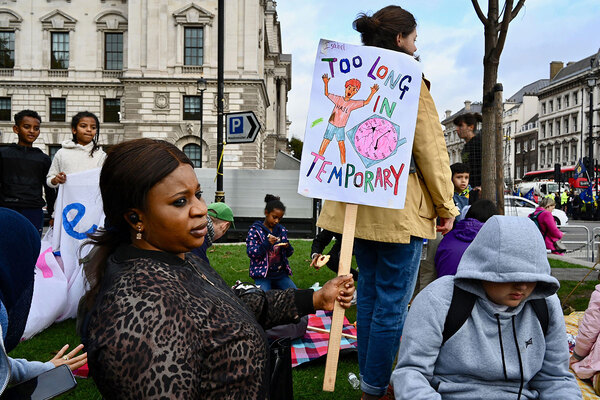
And the need for action to solve the housing emergency is pressing. In October, data showed social housing starts in Scotland had slumped to their lowest level since records began in the 1990s. Statistics in September revealed that the country has more than 10,000 children in temporary accommodation, while a quarter of a million people are languishing on council waiting lists.
David, my taxi driver on the way back to St Andrews town from the hotel, is one of the people looking for a home they can afford. A local who has family here, he tells me one-bed flats in the centre are going for as much as £2,000 per month. He is on the council housing waiting list for both the town and surrounding villages, but so far has found nothing.
Earlier that day, Mr Meade told the conference that the next parliament will define the future of social housing in the country. In fact, it could “fail social housing” altogether – which he clarifies now means it would not create the homes needed to solve the country’s shortage.
“If we don’t build those homes, and if we don’t maintain the ones that we’ve got to enable [residents] to continue to stay there, then we’ll still be talking about homelessness,” he says.
“We’ll still be talking about temporary accommodation and children living there, and that is just not acceptable in modern-day Scotland.”
Sign up to Inside Housing’s Scotland newsletter, a fortnightly round-up of all the key news and insight affecting the Scottish affordable housing sector.
Click here to register and receive the Scotland newsletter straight to your inbox.
And subscribe to Inside Housing by clicking here.
Already have an account? Click here to manage your newsletters.
Related stories