Latest housing research: can we support families moving out of area?
An evaluation of an out-of-area move support service did not have the expected outcome, but there were still useful learnings, writes Dr Michael Marshall, research associate in the School of Geography and Planning at the University of Sheffield


 An evaluation of an out-of-area move support service did not have the expected outcome, but there were still useful learnings, writes Dr Michael Marshall #UKhousing
Thinkhouse has recently curated reports on a diversity of topics – new towns, sustainable communities, co-living – but the report that stood out to me was Randomised Controlled Trial of the Homefinder UK Intervention: the impact of voluntary out-of-area moves on housing security by the Centre for Homelessness Impact (CHI). The report is an evaluation of Homefinder UK (HFUK), a service that supports out-of-area moves, and at first glance, it is not an obvious standout.
Spoiler alert: the evaluation found no evidence of significant impact from HFUK on six outcomes, including housing security. Despite this, the report produces useful insights and recommendations on an important topic, and illustrates the value of research even when it produces challenging findings.
HFUK is a voluntary service that helps households in high-demand areas at risk of housing insecurity to move to a lower-cost, lower-demand area. HFUK provides case management and support with identifying properties and submitting applications. HFUK is funded by local authority and housing association partners, whose applicants receive free access to the service.
HFUK has emerged in a landscape where certain local authorities are struggling to discharge their homelessness duties within their remit, especially in London. The report highlights that this has contributed to rising numbers of households placed in temporary accommodation or offered private rental housing outside the placing local authority. Out-of-area moves could result in a loss of social networks or difficulties in subsequently accessing jobs and schools. Therefore, understanding how moves to new areas affect people’s quality of life, and whether voluntary services such as HFUK can ensure best practice is followed, is an important matter for research.
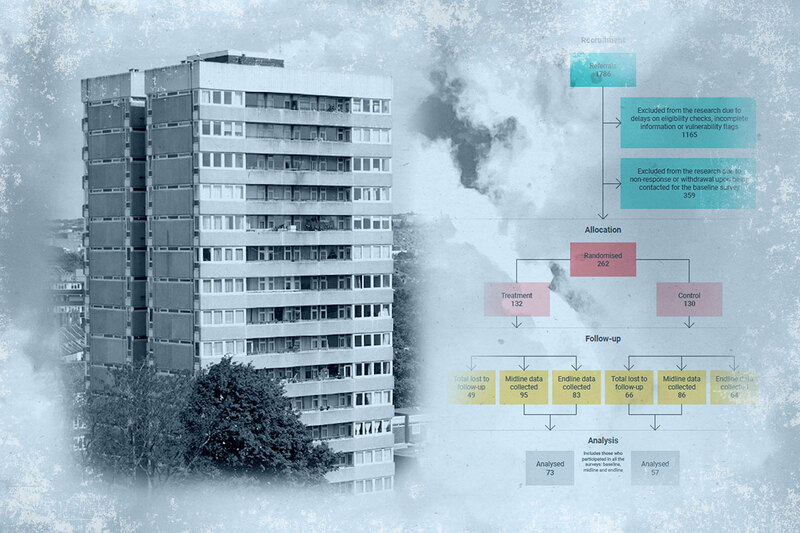
To understand the impact of HFUK, the CHI implemented a randomised controlled trial that involved 262 HFUK referrals, of which 132 were randomly assigned to receive the HFUK service and 130 were assigned to a control group (this involved being on a six-month waiting list for the service while being signposted to other support services). The CHI evaluated the impact of the service on housing security, social connectedness, mental health, physical health, employment and financial security. The randomised controlled trial was intended to be accompanied by a process evaluation – including interviews with service users, staff and stakeholders on how successfully HFUK was implemented – and an economic evaluation.
Read more

However, the report found no evidence of improved housing security through accessing the HFUK service, and this was primarily due to very few participants moving out of area. “Around 42% of the trial participants reported contact from HFUK staff to offer support for relocating to a new home. However, fewer than 5% of those contacted reported receiving support, and fewer than 2% relocated,” the report reads.
Insightful interviews
With so few out-of-area moves occurring, the CHI opted against conducting the economic evaluation and scaled back its process evaluation to 30 interviews. Yet it is these interviews that are the most insightful section of the report. They highlight several issues encountered by service users: the length of time from the initial application to receiving login details, infrequent contact from HFUK staff, confusion about how the service operates and a lack of suitable housing options available through HFUK’s website.
The interviews demonstrate the tension at the heart of out-of-area moves – service users often experienced substantial housing insecurity (eg overcrowding), which motivated them to apply to HFUK, but many were reluctant to leave their local area, or were only willing to move if their new area met certain conditions (eg public transport connections, being near relatives).
He added that Homefinder UK rehouses “approximately 225 to 250 households every year and hears back from many applicants regarding their gratitude in helping them turn their lives around”. He said that the success of the research was impacted by the time allocated to assessing outcomes during the trial, the size of the sample, and “the complex nature of rehousing vulnerable people”. He said: “I’m confident that should the analysis have taken place with those that successfully moved, the outcome would be very different.”
Ultimately, this study illustrates the value of rigorous evaluations that publish findings even without a concrete result. Without such research, we lack the tools to choose between competing solutions to societal problems such as homelessness. The CHI has produced a set of sensible recommendations for HFUK and its partners, including for HFUK to strengthen its communications and review its website, and for HFUK partners to review whether applicants are receiving the expected support.
But the study has a wider significance, in terms of how we design policies to reduce homelessness. The findings suggest that successful solutions need to be conscious of people’s strong connections to places, communities and support networks, and be embedded in a sense of ‘home’ that is more than just the dwelling.
Dr Michael Marshall, research associate, School of Geography and Planning, University of Sheffield, and member, Thinkhouse Editorial Panel. Thinkhouse is a website set up to be a repository of housing research. Its editorial panel critiques and collates the best of the most recent research in the sector
Correction 24/10/25: HFUK did not respond to Inside Housing’s initial request for comment. The article has been edited to add a response from Ninesh Muthiah, chief executive of Home Connections
Related stories