You are viewing 1 of your 1 free articles
Temporary accommodation is even worse for neurodivergent children, but councils can do better
No one knows how many children in temporary accommodation are neurodivergent and have additional needs, but it is likely to be tens of thousands. Katharine Swindells talks to families who are struggling to cope, and considers whether councils should be taking a different approach. Illustration by John Holcroft


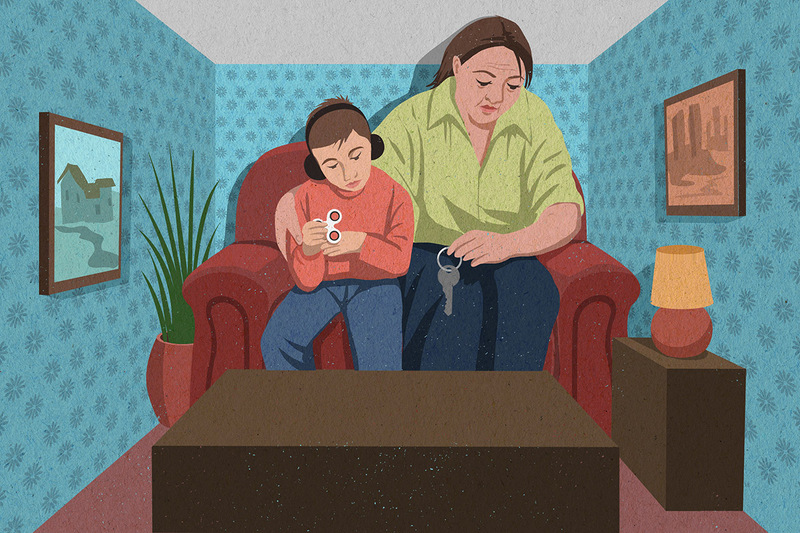 There may be tens of thousands of neurodivergent children in temporary accommodation. Katharine Swindells talks to families who are struggling to cope #UKhousing
Maryam Houssein* and her two sons have lived on the ground floor of a converted terraced house in Hackney, east London, for more than two years. This temporary accommodation is their third placement since fleeing domestic violence in 2021.
The boys are at school, so the flat is quiet now, but as you enter the narrow hallway, the first things you notice are the large scratches, dents and holes on the walls. These were made by Mahdi*, Ms Houssein’s 13-year-old son.
Ms Houssein picks at her fingernails and twists at the hairband around her wrist as she explains. Mahdi is autistic, and attends a specialist school. He is extremely sensitive to noise and other stimulation, but in the cramped property, giving him the calm environment he needs is difficult.
“He is a kind and sensitive boy, he enjoys football and computer games, however the ongoing instability and uncertainty have severely increased his anxiety,” Ms Houssein says. “There is no space for rest, study, therapy or even healthy family interaction.”
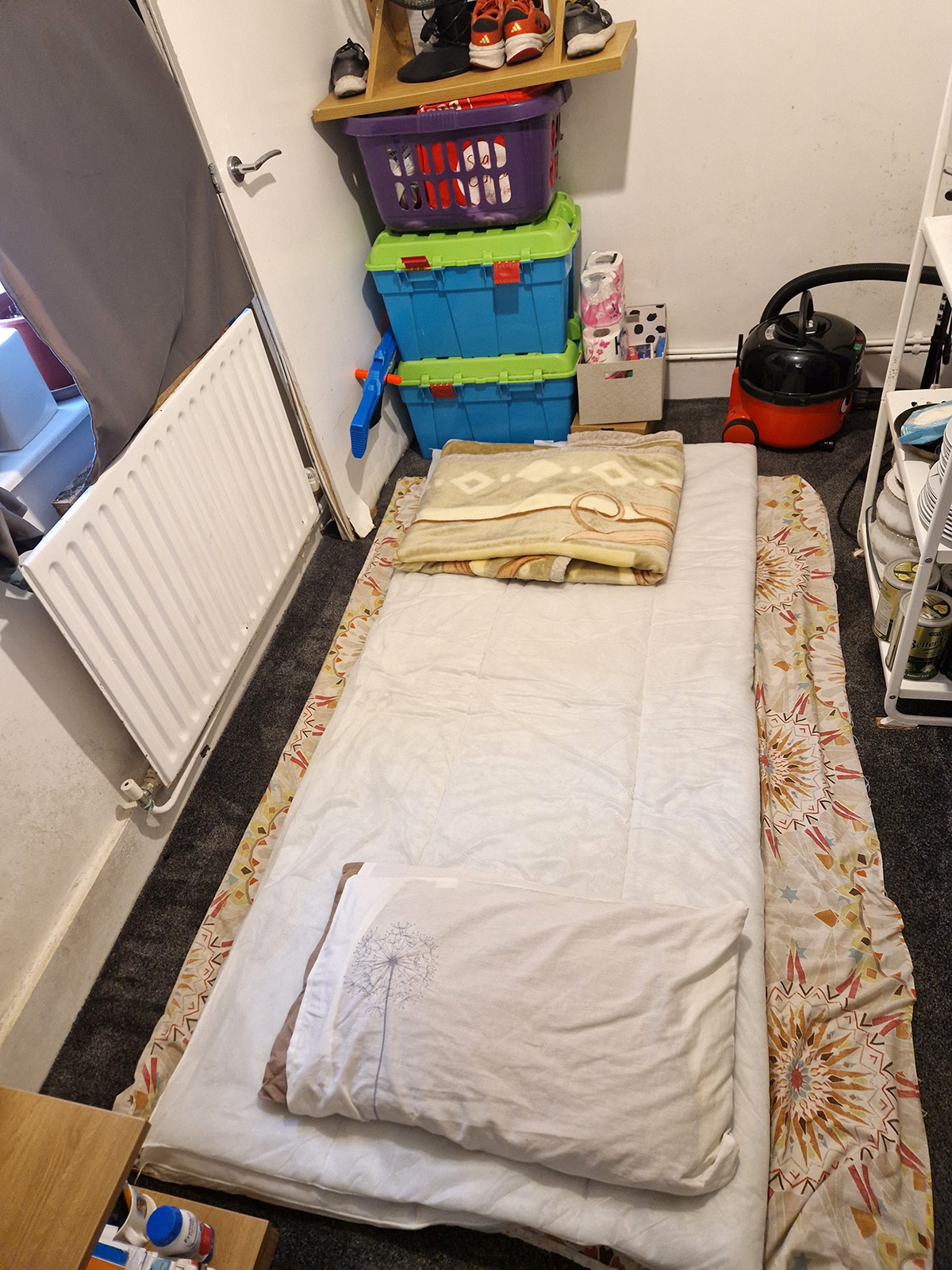
It is a two-bedroom flat – but only technically. Mahdi has the main bedroom, and Ms Houssein sleeps on the living room floor, pushing the dining table up against the wall to unfurl her mattress each night. When Mahdi is agitated in the night, he watches television in the living room, which means no sleep for Ms Houssein.
Amir*, her 10-year-old son, sleeps in the smaller bedroom, on a foldaway mattress on the floor. Barely larger than the mattress itself, the room is damp and mouldy. Ms Houssein shows me the black spores spreading across the wall, which she tells me she wipes every day, and she also has to pack away Amir’s bed every morning to stop the mould reaching it. One winter, mould got through Amir’s dresser and into all his clothes, so now all their clothes are stored in the main bedroom.
But the comings and goings of others into his room often trigger Mahdi, causing a meltdown. At 13, Mahdi’s already taller than Ms Houssein, and sometimes he lashes out, hitting her and Amir.
“They desperately need personal space; physical conflicts between them have increased due to the pressure and lack of privacy,” she says. “The home we need must be safe, quiet and stable. That would finally allow us to feel secure and begin to rebuild our lives.”
Overwhelming evidence now shows the enormous impact life in temporary accommodation has on all children – it can damage their physical, mental and social health, impede their development and have a long-lasting impact on their educational and life outcomes.
As the government’s homelessness strategy commits to improving the experiences of these children, experts and campaigners are highlighting a group among them they believe needs specific attention.
They say the poor conditions and instability of temporary accommodation are causing particular damage to neurodivergent children, as well as their parents, siblings and caregivers.
Given around one in five pupils in England have special educational needs and disabilities (SEND), applying that to government homelessness data would equate to around 33,600 children with SEND in temporary accommodation, with autism and ADHD the most common conditions. Children on free school meals and from low-income families are over-represented among children with SEND.
Inside Housing attempted to gather more specific statistics, but found that most councils were unable to report how many homeless children in their local authority had additional needs, citing that the data is “not held”.
Only a few councils were able to provide the data, and their numbers reflected the national statistics – around 17-20% of families in temporary accommodation with children had a child who was on the SEND register. On average, 85% of those families had been in temporary accommodation for more than six months.
‘The place that was meant to be a refuge’
Last year, the All-Party Parliamentary Group for Households in Temporary Accommodation, along with charities and research groups, organised the first UK-wide call for evidence on this topic, which will be published later this month.
Impact on Urban Health, a health inequality non-profit organisation, last week published a report on best practice for local authorities and other services, co-created with 30 families with neurodivergent children living in temporary and insecure housing in south London.
“For many neurodivergent children, home is the only safe space in an unpredictable world,” the report states. “Moving home can be intensely disruptive. It may cause neurodivergent children considerable anxiety and distress, leading to behaviour that is difficult to manage and affects the whole family.”
In this research, the term ‘neurodivergent’ encompasses autism, ADHD, dyslexia, dyspraxia, Tourette syndrome, sensory processing disorders and OCD.
The report highlights the same issues around space and emotional dysregulation as Ms Houssein discussed regarding Mahdi, as well as the impact this can have on other family members.
Moreover, other elements of temporary accommodation – such as lighting, smells and sounds – may be overwhelming or triggering, and the child’s parents may be unable to change these factors. Particularly in B&B accommodation or other types of housing where families live in close quarters, participants highlighted difficulty supporting their children in shared bathrooms and kitchens, and conflict with neighbours due to noise and disruption.
“The place that was meant to be a refuge for us became another source of stress and exhaustion”
Lauren Scott*, who lives in a two-bedroom temporary accommodation flat in east London with her partner and two children, recalls that being a major issue in their first placement, where they lived for nine months. Her nine-year-old son is autistic, and often shouts or makes repetitive knocking sounds.
“One of the girls in the room next door would bang on the wall, getting angry at the noises he’d make,” she tells Inside Housing.
Ms Scott has also found that her council doesn’t understand the priority of safety when offering her accommodation. “One flat they tried to place us in was three storeys up, with a stairwell that was just an open drop, which is an absolute no-no, because he’s got no danger awareness,” she says. “The windows opened fully, and there were no safety precautions in place.”
Sarah Jones* spent five years in a temporary accommodation property that had poorly fitted flooring. Her toddler-age son has pica and would eat the peeling carpet and the nails and screws underneath.
“I took a picture of a screw coming out of his mouth with spit and sent it to the council, and I sent pictures of the flooring in his vomit,” she says. “I sent such graphic pictures to let them know the gravity of what we’re dealing with.”
After Ms Jones complained repeatedly and contacted her MP, the council agreed to fit new flooring in that one bedroom, but she says “they never followed through, so I ended up paying”. Only after a stage two complaint did the council reimburse her for the cost.
Beyond the physical space, location is a huge factor. Families with neurodivergent children often have a “network of borough-based professionals and services that support their child’s needs”, which can take years to establish, the Impact on Urban Health report says.
A family may well be on the waiting list or in the midst of processes for diagnoses, support services or an education, health and care (EHC) plan to fund support in school. Moving to a new borough can entirely derail the assessment process, so parents face the choice between a long commute back to the hospital or school, or starting all over again. They also may have practical and emotional support from family, friends and other parents, and “may stand to lose their whole support network” if they are accommodated out of borough.
“Families that have been relocated often face a dilemma,” the report says. “Do they start building their care and support networks from scratch in a new area or travel back to where they were living and cope with the costs and challenges this presents?”
Before this, Ms Houssein and her sons were in an out-of-borough placement in Newham. Changing schools is hard on any child. However, Mahdi attends a specialist school, where places are extremely hard to secure, and a specific school is chosen to match the child’s needs and abilities, so it is not possible to simply switch him to another school closer to the family’s temporary accommodation.
“Every day we had to travel for over four hours back and forth, and this long and exhausting journey placed a huge physical and emotional strain on me and the boys,” she says. “I spent most of my days outside – in the streets, libraries or public centres – because I didn’t have enough time to go home between school runs.”
The stress of the commute triggered a flare-up of Mahdi’s Crohn’s disease, and he was hospitalised for nearly three months. “The place that was meant to be a refuge for us became another source of stress and exhaustion,” Ms Houssein says.
“She’s hurting herself rather than studying, because our lives are so disrupted. She deserves a safe, stable home life, so she can excel”
Housing disruption can get in the way of accessing the other support families need. The process of securing an EHC plan is complex for all families, but research published last year by the Sutton Trust shows that those from more affluent homes, who spend money on their application, are more likely to get one.
Low-income families in temporary accommodation, already facing the administrative burden of the homelessness application process, may well find that the process of getting an EHC plan – or indeed a diagnosis – is delayed. As such, their child will go longer without the support they need.
Monica Brown* has been placed for more than three years in out-of-borough temporary accommodation in the east London borough of Barking and Dagenham. Her teenage daughter, Leila*, is autistic, so Ms Brown didn’t want to move her to a different school, as her current school has been very supportive of her needs.
But it is a long drive to and from school, which means Leila struggles to wind down from the day. “When we get home she’s dysregulated; she’ll be smashing up the house and punching me,” Ms Brown says.
And so Ms Brown and Leila have been “living out of suitcases” between their temporary accommodation and a friend’s flat nearer the school. Leila is a bright young person, with hopes of going to sixth form to study science and politics, but over the past few years Ms Brown has seen the toll their insecure housing has taken on her daughter. Leila has become increasingly withdrawn, self-harms and expresses suicidal ideation.
“She’s hurting herself rather than studying, because our lives are so disrupted,” Ms Brown says. “She deserves a safe, stable home life, so she can excel.”
A life of instability
The theme running through all these stories is one of instability. The process is complicated and confusing for the parent, let alone their neurodivergent child.
In February 2025, Rachel Walker* was placed in a Travelodge in Greater Manchester with her 11-year-old daughter, Daisy*, having fled domestic abuse.
The room had no fridge or cooking facilities, so Ms Walker would fill the bathtub with cold water to keep milk for cereal in the morning. There was a Toby Carvery across the road, where they would go every day for dinner. If it was too busy, they’d have to settle for crisps and biscuits for their only evening meal.
The worst part was the space: the room was around 10 feet wide, with just two single beds. “It was like living in a kennel,” Ms Walker says.
Daisy is autistic and has ADHD, and as the hotel was too far from her specialist school, they were trapped in the room. “We were literally in the middle of nowhere, no buses or anything,” Ms Walker says. “I would just take her down to the car park to walk around, then back up to our room again.”
Ms Walker and Daisy were in that Travelodge for a week, but it felt like a lifetime. Then they were moved to another Travelodge, this one an hour from Daisy’s school. Two weeks there, then another hotel, then another.
Finally, after two months of being moved, they were given a place with a kitchen. But within two days at the tiny, dirty bedsit, “Daisy just broke. She was just an absolute mess. She was crying. She didn’t want to be there anymore.” Ms Walker tells me through tears of her own that “I knew she blamed me, because it’s me that’s put her there”.
So Daisy moved in with Ms Walker’s mother, and Ms Walker stayed in the bedsit alone. It was the darkest point: Ms Walker seriously considered returning to her abusive partner. “It got to the point where I thought I’d rather go back and take the beatings than live like this,” she says.
And at her grandmother’s, Daisy was closing off, refusing to go to school, barely speaking. Finally, social services intervened, and got them moved to a studio, which was “like a palace” after these experiences.
Daisy returned, but she had developed severe separation anxiety. She often refused to go to school because she didn’t want to be apart from her mum and she couldn’t sleep if she wasn’t in her sightline. Ms Walker even had to leave the door open when she went to the toilet.
In August, after five months, they received a permanent social home. In October, Daisy attended her first full week of school in six months. But the effects still linger.
“If things get a little too overwhelming, or if she has a fallout with a friend, she shuts down again,” Ms Walker says. “All the changes and the social isolation have messed her up, and probably will for quite some time.”
Ms Walker has worked hard to decorate Daisy’s new flamingo-themed bedroom, but Daisy struggles to sleep in it, unused to being so far from her mother at night. And she struggles to believe this home is truly permanent.
“We’ve been here since August, and she still hasn’t unpacked her suitcase,” Ms Walker says. “I put our Christmas tree up on 1 November, to try and signify that we will be staying here.”
*Names changed to maintain anonymity
How to improve life for families with neurodivergent children in temporary accommodation
Guidance produced by the Impact on Urban Health, with legal input, says it is crucial that local authority housing teams supporting families with neurodivergent children understand the challenges they face in temporary accommodation, and how these children’s needs may bring specific concerns around safety and suitability.
“The needs of families with a neurodivergent child vary greatly, and each homeless application should be considered on a case-by-case basis,” the report says.
A recent report by campaign group Housing Inclusion Hackney, based on the experiences of SEND families in housing insecurity, calls for better co-ordination of services, with clear pathways between council departments for housing needs, SEND services, children’s social care, early help and adaptations. The report also calls for medical assessments to be made by a multi-disciplinary panel, giving weight to evidence from clinicians and parents alike.
The Impact on Urban Health report agrees officers need to avoid relying solely on documented evidence, as the child may still be on hospital waiting lists and awaiting formal diagnosis, a delay often worsened by housing instability and homelessness. They must also conduct regular reviews to take into account any changes to housing needs, with the guidance recommending doing so every 12 months once the main housing duty is accepted.
“The needs of neurodivergent children often change, sometimes dramatically, as they develop,” the report says. “The local authority is under a continuous duty to assess the needs of homeless households.”
Adaptations may be needed, such as childproof locks on windows, doors and cupboards housing boilers or dangerous equipment, blackout curtains or removal of fluorescent lighting and soundproofing measures.
In the case of an out-of-borough placement, the local authority is required to notify the host authority and “make every reasonable effort to ensure arrangements are made to meet the child’s educational needs”. If the child requires specialist school or has an EHCP, additional arrangements may need to be made to make sure their needs are met, and the EHCP will need to be transferred to the host authority, as will any transport or care assistance.
Throughout all of this, clear communication and patience is paramount. The more information that can be provided to families, to understand their options and help prepare their child, the better.
This may include the opportunity for a family to do a viewing, even if that isn’t usual, more time for a family to consider a property offer and the chance to raise any concerns with the local authority and discuss possible solutions. This hopefully will reduce the risk that the property is found to be unsuitable after the family moves in, resulting in more moves and further instability.
The most crucial thing, the report says, is to “keep it personal”. The 30 parents who co-created the Impact on Urban Health report say it clearly: “Time, flexibility, understanding and a collaborative approach are all even more important when working on our cases. We know our children’s needs best and we want to be listened to.”
Sign up to Inside Housing’s Homelessness newsletter
Sign up to Inside Housing’s Homelessness newsletter, a fortnightly round-up of the key news and insight for stories on homelessness and rough sleeping.
Already have an account? Click here to manage your newsletters.
Related stories